How to Grow Dieffenbachia amoena? Detailed Growing Methods and Precautions
Dieffenbachia amoena Encyclopedia
Dieffenbachia amoena (Dieffenbachia amoena), also known as giant dumb cane and giant spotted dumb cane, belongs to the Araceae family, Dieffenbachia (spotted dumb cane) genus, and is native to the tropical regions of Brazil, Central America, and South America.
Dieffenbachia amoena Morphological Characteristics
Perennial evergreen herb. Stems thick and upright, up to 2 m tall. When potted, the plant height is about 1 m. Leaves large, oblong, dark green, glossy, with milky white stripes and spots along both sides of the midrib.
The commonly cultivated 'Tropic Snow' Dieffenbachia is an excellent cultivar of Dieffenbachia amoena.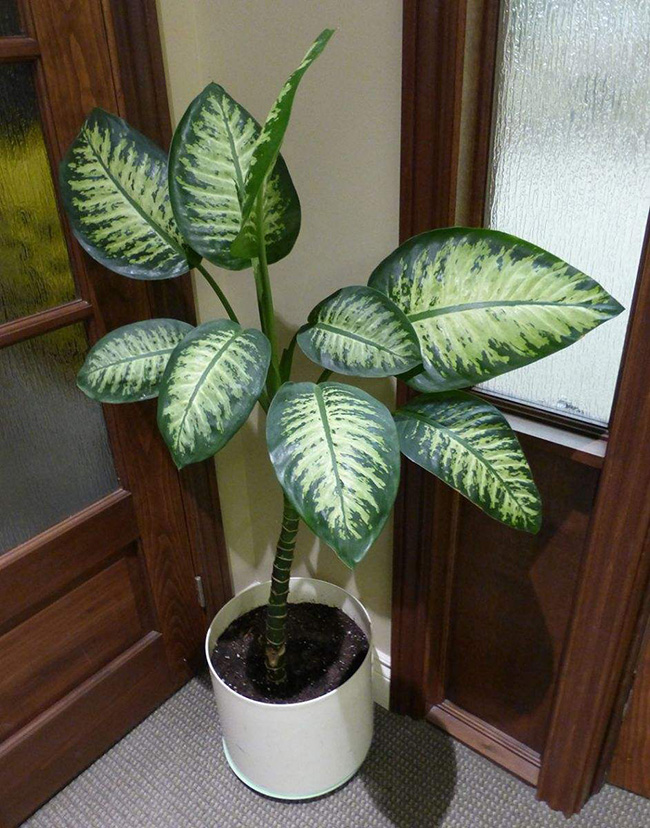
Dieffenbachia amoena Growing Environment
It prefers a high-temperature, high-humidity, and semi-shaded environment. It is not cold-tolerant, and the minimum winter temperature must be kept above 15°C. It requires loose, fertile, well-drained soil
Dieffenbachia amoena Distribution Range
Native to the tropical regions of Brazil, Central America, and South America.
Dieffenbachia amoena Propagation Methods
Cuttings are mostly used for propagation. Cuttings are generally taken from April to June, using about 10-15 cm of the top stem as the cutting, removing the lower leaves, dipping the cut end in a medium mixed with equal volumes of charcoal soil and sand, placing it in a more shaded place, and maintaining a temperature of 21-24°C. Rooting begins about half a month after cutting, and they can be potted up after one month.
Dieffenbachia amoena Cultivation Techniques
Dieffenbachia amoena has strong shade tolerance and likes soft, diffused light. In summer, it should be placed in a lightly shaded area to avoid direct strong light. Otherwise, the leaf surface will become rough, the color will be uneven, the gloss will decrease, and scorched leaves may even appear. In winter, it should receive appropriate light, and it should usually be placed in a bright place. If the light is too dark, it will also cause the leaves to fade, affecting its ornamental value.
Dieffenbachia amoena is not cold-tolerant. The suitable growing temperature is 20-30°C. In winter, the room temperature must be kept above 15°C; below 13°C, growth stops. When the temperature drops to 6-8°C, it will suffer cold damage and shed leaves. If kept in a moderately warm environment, the plant can grow year-round.
Dieffenbachia amoena has relatively large leaves and transpires quickly, so it needs a lot of water during the growing period; therefore, watering must be sufficient during the growing season. If the potting soil is too dry, it will lead to poor growth of stems and leaves, and even withering and death. However, it should not be overwatered either; if the potting soil remains too wet for a long time, it can easily cause the roots to turn black and rot. The most suitable air humidity is 80%-90%. In dry weather and summer, water should often be sprayed on the leaves and sprinkled on the ground around the flowerpot. In winter, watering should be appropriately controlled, and it is best to keep the potting soil slightly dry, but warm water should still be used frequently to spray the leaf surface to keep the leaves attractive and clean.
Dieffenbachia amoena is relatively tolerant of fertilizer, and more fertilizer should be applied appropriately during the peak growing season. However, if too much fertilizer is applied, especially when too much nitrogen fertilizer and insufficient phosphorus fertilizer are used, the colored patterns on the leaves will fade and the green parts will increase, affecting the appearance. For young plants, a dilute liquid fertilizer mainly based on nitrogen fertilizer can generally be applied twice a month to promote rapid growth and early shaping; for plants that have already been shaped, in order to maintain a good plant shape, fertilization should be controlled to avoid excessive growth, and generally applying a compound fertilizer once a month is sufficient. During the peak growing season, spraying 1-2 times with 0.2% potassium dihydrogen phosphate solution can make the leaves fresh and bright. Fertilization should be stopped during the overwintering period.
Dieffenbachia amoena grows relatively quickly, so every spring it should be repotted into a pot one size larger. The potting soil can be peat soil plus garden soil, with a small amount of long-acting granules added as base fertilizer. The stem base of old plants often tends to lose leaves and become bare, so it is best to renew them every 2-3 years to encourage new leaves to sprout again. Repotting is generally done in April-May. Be careful not to bruise the plant, so that the sap from its leaves and stems does not come into contact with the skin and cause accidental injury.
Dieffenbachia amoena Pests and Diseases
If poorly managed, it is susceptible to damage from aphids, scale insects, and the like, so prevention and control should be carried out early.
Dieffenbachia amoena Growing Methods
During high summer temperatures, Dieffenbachia amoena has a brief dormant period. At this time, plant growth is slow or completely stalled. It can be placed in a well-ventilated spot for care, avoiding prolonged rain, with slight shading, reduced watering, and no fertilizing.
Spring, autumn, and early summer are the main growing periods for the plant, and sufficient sunlight should be provided. Although it can also grow in semi-shade, the area near the growing point will turn dark green, and the dark purple color of the leaves in other parts will also fade to light brown, affecting its ornamental value.
In addition, excessive nitrogen fertilizer in the soil and overly vigorous plant growth can also cause this phenomenon. Therefore, usually keeping the potting soil slightly drier and letting the plant grow a bit more slowly will actually produce better results. In winter, if the minimum temperature is not lower than 10°C, normal watering can be carried out to allow the plant to continue growing, but fertilizing is not necessary; if such a high temperature cannot be maintained, reduce watering to make the plant dormant, and it can also tolerate low temperatures of 3-5°C.
Repot once every 1-2 years. The potting soil should be fertile and have good drainage. A common mix is 2 parts coarse sand or vermiculite, 1 part leaf mold, and 1 part garden soil, mixed evenly. If conditions permit, adding an appropriate amount of plant ash or bone meal as base fertilizer will give better results. Relatively speaking, Dieffenbachia amoena has strong growth vigor, so management can be a little more extensive.
Growing Methods for Dieffenbachia amoena
During high summer temperatures, Dieffenbachia amoena has a brief dormant period. At this time, plant growth is slow or completely stalled. It can be placed in a well-ventilated spot for care, avoiding prolonged rain, with slight shading, reduced watering, and no fertilizing.
Spring, autumn, and early summer are the main growing periods for the plant, and sufficient sunlight should be provided. Although it can also grow in semi-shade, the area near the growing point will turn dark green, and the dark purple color of the leaves in other parts will also fade to light brown, affecting its ornamental value.
In addition, excessive nitrogen fertilizer in the soil and overly vigorous plant growth can also cause this phenomenon. Therefore, usually keeping the potting soil slightly drier and letting the plant grow a bit more slowly will actually produce better results. In winter, if the minimum temperature is not lower than 10°C, normal watering can be carried out to allow the plant to continue growing, but fertilizing is not necessary; if such a high temperature cannot be maintained, reduce watering to make the plant dormant, and it can also tolerate low temperatures of 3-5°C.
Repot once every 1-2 years. The potting soil should be fertile and have good drainage. A common mix is 2 parts coarse sand or vermiculite, 1 part leaf mold, and 1 part garden soil, mixed evenly. If conditions permit, adding an appropriate amount of plant ash or bone meal as base fertilizer will give better results. Relatively speaking, Dieffenbachia amoena has strong growth vigor, so management can be a little more extensive.
Care Methods for Dieffenbachia amoena and Its Effects and Functions
Dieffenbachia amoena, also called large-leaf dumb cane, is a unique plant native to the tropical regions of South America. Let's take a look below at the care methods for Dieffenbachia amoena and its effects and functions.
Care Methods for Dieffenbachia amoena:
After purchasing Dieffenbachia amoena, because its leaves are relatively large and easily damaged, care should be taken to protect it during transport. If the temperature is too high and the humidity too great for a long time during transport, Dieffenbachia amoena will rot. Therefore, proper ventilation should be provided during transport, and it can be wrapped with newspaper or plastic bags.
Dieffenbachia amoena likes a warm, humid, and semi-shaded environment. The suitable growing temperature is 25-30°C, and the overwintering temperature should be above 10°C. It likes diffused light and avoids strong light. Dieffenbachia amoena likes soil rich in humus and well-drained. If repotting is needed during cultivation, the potting soil can be prepared with leaf mold, garden soil, and river sand = 2:1:2, plus decomposed manure, bone meal, or cake fertilizer.
During the growing season of Dieffenbachia amoena, water once every 1-2 days, preferring wet over dry. At this time, in order to make the markings on Dieffenbachia amoena more obvious and the leaves bright, a 1% compound fertilizer or cake fertilizer water mainly based on nitrogen can be applied 1-2 times a month. When the temperature is above 25°C, in addition to appropriately increasing the amount of watering, water should also be sprayed on the leaves. After autumn when the weather turns cool, watering should be appropriately controlled, following the principle of dry-wet alternation. In winter, water once every 10-15 days to keep the potting soil dry.
If the leaves of Dieffenbachia amoena grown at home become thinner and thinner and the red parts become darker, it means your Dieffenbachia amoena lacks nutrients and needs a soil change. At this time, topdressing should be carried out in time. Topdressing should not be too concentrated; apply dilute fertilizer frequently, once every 15-20 days, and strengthen management of light, temperature, water, and so on. After fertilizing, loosen the soil shallowly and keep the potting soil moist. After 2-3 months of care, it will naturally recover and become robust. After rejuvenation, remove it from the pot and change the soil between spring and summer the following year.
Effects and Functions of Dieffenbachia amoena:
1. Dieffenbachia amoena is a beautiful foliage plant. Its greatest function is greening the environment and providing ornamental value. It is the most common plant variety in many botanical landscapes and an important component of some flower beds. While beautifying the environment, Dieffenbachia amoena can also purify the air.
2. Dieffenbachia amoena can also be made into a potted plant for indoor placement. It can purify indoor air and increase the oxygen content in the air. At the same time, it can also absorb certain substances such as formaldehyde in the air, playing a role in purifying the air. In addition, Dieffenbachia amoena also has a good absorption effect on some radiation sources, which can reduce the harm of radiation to the human body.
3. Dieffenbachia amoena likes to grow in environments with relatively high temperature and humidity, and does not like strong sunlight. Semi-shaded conditions are more favorable for the growth of Dieffenbachia amoena. This plant has relatively poor cold resistance, and in winter it cannot be placed in an environment below 15 degrees, otherwise it cannot safely overwinter. In addition, Dieffenbachia amoena likes fertile soil, and there must be no water accumulation in the soil, which requires the soil to have excellent drainage.
More Information