Cultivation Methods and Pest and Disease Control Tips for Scarlet Cypress Vine
Scarlet Cypress Vine
Scarlet Cypress Vine (scientific name: Quamoclit coccinea (L.) Moench), a plant in the Convolvulaceae family, is an annual twining herb. The leaves are heart-shaped, the cymes are axillary, the flowers are orange-red with a yellow throat, and the capsules are ovoid. Scarlet Cypress Vine is native to South America, is averse to cold, prefers a sunny environment, and is not strict about the number of daylight hours.
Scarlet Cypress Vine is an excellent landscaping plant for courtyard trellises, flower windows, flower gates, flower hedges, and flower walls. It can also be used medicinally and has the effect of clearing heat and reducing swelling.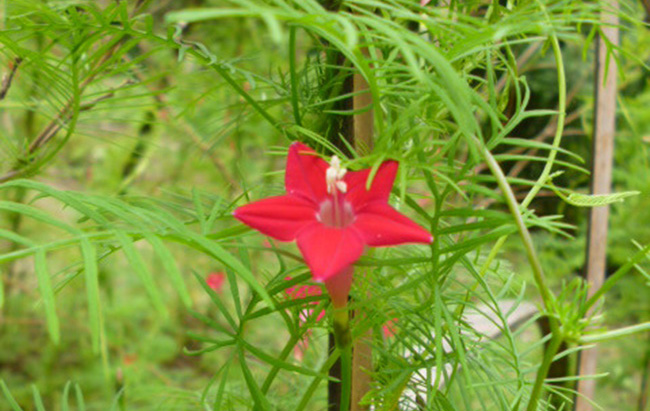
Morphological Characteristics of Scarlet Cypress Vine
Annual herb, with twining stems, smooth, hairless. Leaves heart-shaped, 3-5 cm long, 2.5-4 cm wide, abruptly pointed, entire, or with angular margins, or sometimes angularly deeply lobed, with palmate veins; petioles slender and weak, nearly as long as the leaf blade.
Cymes axillary, with 3-6 flowers, peduncles slender and weak, longer than the petioles, with 2 bracts, pedicels about 1 cm long, bracteoles 2; sepals 5, unequal, ovate-oblong, obtuse, with long awn-like tips, the awns linear, 2 mm long, inserted slightly below the apex of the sepals; corolla salverform, orange-red, with a yellow throat, 8-25 mm long, the tube slender, suddenly expanded at the throat, the limb 5-parted; stamens 5, exserted beyond the corolla, slightly unequal in length, filaments filiform, swollen at the base, with small scale-like hairs, anthers small; pistil slightly longer than the stamens; ovary 4-locular, with 1 ovule per locule; style filiform, stigma capitate, 2-cleft.
Capsules small, spherical, about 5 mm long, seeds 1-4, ovoid or spherical
Growing Environment of Scarlet Cypress Vine
Scarlet Cypress Vine prefers warmth, is averse to cold, and fears frost. Growth is very slow at low temperatures. The suitable temperature for seed germination is 20-25°C. It requires a sunny environment and is not strict about the number of daylight hours.
Distribution Range of Scarlet Cypress Vine
Scarlet Cypress Vine is native to South America and is commonly cultivated in gardens throughout China (such as Shaanxi, Hebei, Jiangsu, Fujian, Hubei, and Yunnan).
Main Value of Scarlet Cypress Vine
Ornamental Value
Cypress Vine grows by climbing straight upward and is used to green environments with a backdrop, such as trellises, fences, and beside trees, or it can be cultivated in front of houses. It can also be grown in pots, placed on a balcony and trained to climb, shaped into a small flower stand. It can also be used as groundcover flowers, climbing over the ground to cover unsightly objects.
Medicinal Value
Cypress Vine is a good medicine for clearing heat and detoxifying. Its whole plant or root is used medicinally, and the drug name is Jinfengmao. It can treat dysentery, bloody stools due to intestinal wind, abnormal uterine bleeding, hemorrhoids, and blood in the stool, among other conditions.
Propagation Methods of Scarlet Cypress Vine
Sowing Method
Generally sown directly in the open field in early spring in April. When the seedlings reach 10 cm in height, thin them to the final spacing, planting them under courtyard fences or on both sides of trellises, with thin strings hung down for them to twine around. For those living in apartment buildings, shallow pots can be used for sowing.
Cutting Method
Softwood cuttings are often taken from current-year branches in late spring and early autumn, or hardwood cuttings are taken from previous-year branches in early spring. When taking softwood cuttings, during the period of vigorous growth from late spring to early autumn, select robust current-year branches as cuttings. After cutting the branches off, select the sturdy parts and cut them into sections 5-15 cm long, each with more than 3 leaf nodes. When cutting the cuttings, note that the upper cut should be made flat about 1 cm above the topmost leaf node, and the lower cut should be made at an angle about 0.5 cm below the bottommost leaf node; the upper and lower cuts should be smooth (the knife must be sharp). When taking hardwood cuttings, after temperatures rise in early spring, select robust previous-year branches as cuttings. Each cutting usually retains 3-4 nodes, and the cutting method is the same as for softwood cuttings. After cuttings are taken, cover with 50%-80% shade netting. After roots have grown, remove the shade netting at 4:00 p.m. every day on sunny days, and put the shade netting back before 9:00 a.m. the next day; maintain the optimal rooting temperature at 20-30°C and relative air humidity at 75%-85%.
Layering Method
Select robust branches and remove a ring of bark about 15-30 cm below the growing tip, with the wound after peeling about 1 cm wide and deep enough to just remove the outer bark. Cut a piece of plastic film 10-20 cm long and 5-8 cm wide, place some moistened garden soil on it, and wrap the girdled part as if bandaging a wound, tying the upper and lower ends of the film tightly with the middle bulging. Roots form after about 4-6 weeks. After rooting, cut off the branch together with the roots to form a new plant.
Cultivation Techniques for Scarlet Cypress Vine
Potting
When potting small seedlings or repotting large plants that have been grown for several years, first place a 2-3 cm thick layer of coarse-grained substrate at the bottom of the pot as a drainage layer, sprinkle a layer of fully decomposed organic fertilizer on top as a base fertilizer about 1-2 cm thick, then cover with a thin layer of substrate about 1-2 cm thick, then place the plant in and fill in the substrate, avoiding root burn.
Pruning
In winter, when the plant enters dormancy or semi-dormancy, cut off weak, pest- or disease-affected, dead, and overly dense branches. Branch organization can also be combined with cutting propagation.
Repotting
When the plant has grown to a certain size, consider moving it to a slightly larger pot so that it can continue to grow vigorously. For the potting soil and component ratios used for repotting, one of the following can be chosen: garden soil: cinder = 3:1; or garden soil: medium-coarse river sand: sawdust (cinder) = 4:1:2; or one of paddy soil, pond mud, or leaf mold.
Temperature and Humidity Management
Cypress Vine likes a slightly humid or dry climate environment, and requires the relative air temperature of the growing environment to be 50%-70%. It likes a warm climate, but the high-temperature, stuffy environment of summer (above 35°C, with relative air humidity above 80%) is not conducive to its growth; it has strict requirements for winter temperature. When the ambient temperature is below 10°C, growth stops, and it cannot overwinter safely under frost.
Fertilizer and Water Management
For potted plants, in addition to adding organic fertilizer when potting, appropriate fertilizer and water management should also be carried out during routine care. In the peak growth seasons of spring, summer, and autumn, fertilizer and water management follows the cycle of "Huabao" - clear water - "Huabao" - clear water, with an interval of about 1-4 days; the interval is shorter on sunny days or during high temperatures, and longer or skipped on cloudy and rainy days or during low temperatures. During the winter dormant period, the main task is to control fertilizer and water, with fertilizer and water management following the cycle of "Huabao" - clear water - clear water - "Huabao" - clear water - clear water, with an interval of about 3-7 days.
Pest and Disease Control
When aphids occur sparsely, they can be gently brushed off and killed with a writing brush dipped in water. When aphids occur in large numbers, spraying can be used for control. Pesticides can include 40% dimethoate or 80% dichlorvos emulsion at 1000-1500 times dilution, 2.5% rotenone at 1000 times dilution, or tobacco-lime water at 60 times dilution (with 0.1% laundry detergent added), etc. At the same time, pay attention to protecting and utilizing natural enemies. The main natural enemies of aphids include the harlequin ladybird, the seven-spotted ladybird, the tortoise-shell ladybird, hoverflies, and green lacewings, among others. These natural enemies play an important role in suppressing aphid outbreaks.
Cultivation Methods for Scarlet Cypress Vine: An Overview of Scarlet Cypress Vine Propagation Methods
Scarlet Cypress Vine can not only be cultivated on trellises, fences, beside trees, or in front of houses, but can also be grown in pots, placed on a balcony and trained to climb, shaped into a small flower stand. So what are the cultivation methods for Scarlet Cypress Vine? And how should it be propagated?
I. Cultivation Methods for Scarlet Cypress Vine
1. Potting: When potting small seedlings or repotting large plants that have been grown for several years, first place a 2-3 cm thick layer of coarse-grained substrate at the bottom of the pot as a drainage layer, sprinkle a layer of fully decomposed organic fertilizer on top as a base fertilizer about 1-2 cm thick, then cover with a thin layer of substrate about 1-2 cm thick, then place the plant in and fill in the substrate, avoiding root burn.
2. Pruning: In winter, when the plant enters dormancy or semi-dormancy, cut off weak, pest- or disease-affected, dead, and overly dense branches. Branch organization can also be combined with cutting propagation.
3. Repotting: When the plant has grown to a certain size, consider moving it to a slightly larger pot so that it can continue to grow vigorously. For the potting soil and component ratios used for repotting, one of the following can be chosen: garden soil: cinder = 3:1; or garden soil: medium-coarse river sand: sawdust (cinder) = 4:1:2; or one of paddy soil, pond mud, or leaf mold.
4. Temperature: Cypress Vine likes a slightly humid or dry climate environment, and requires the relative air temperature of the growing environment to be 50%-70%. It likes a warm climate, but the high-temperature, stuffy environment of summer (above 35°C, with relative air humidity above 80%) is not conducive to its growth; it has strict requirements for winter temperature. When the ambient temperature is below 10°C, growth stops, and it cannot overwinter safely under frost.
5. Water and Fertilizer: For potted plants, in addition to adding organic fertilizer when potting, appropriate fertilizer and water management should also be carried out during routine care. In the peak growth seasons of spring, summer, and autumn, fertilizer and water management follows the cycle of "Huabao" - clear water - "Huabao" - clear water, with an interval of about 1-4 days; the interval is shorter on sunny days or during high temperatures, and longer or skipped on cloudy and rainy days or during low temperatures. During the winter dormant period, the main task is to control fertilizer and water, with fertilizer and water management following the cycle of "Huabao" - clear water - clear water - "Huabao" - clear water - clear water, with an interval of about 3-7 days.
6. Pest and Disease Control: When aphids occur sparsely, they can be gently brushed off and killed with a writing brush dipped in water. When aphids occur in large numbers, spraying can be used for control. Pesticides can include 40% dimethoate or 80% dichlorvos emulsion at 1000-1500 times dilution, 2.5% rotenone at 1000 times dilution, or tobacco-lime water at 60 times dilution (with 0.1% laundry detergent added), etc.
II. How to Propagate Scarlet Cypress Vine
1. Sowing Method: Generally sown directly in the open field in early spring in April. When the seedlings reach 10 cm in height, thin them to the final spacing, planting them under courtyard fences or on both sides of trellises, with thin strings hung down for them to twine around. For those living in apartment buildings, shallow pots can be used for sowing.
2. Cutting Method: Softwood cuttings are often taken from current-year branches in late spring and early autumn, or hardwood cuttings are taken from previous-year branches in early spring. When taking softwood cuttings, during the period of vigorous growth from late spring to early autumn, select robust current-year branches as cuttings.
Each cutting usually retains 3-4 nodes, and the cutting method is the same as for softwood cuttings. After cuttings are taken, cover with 50%-80% shade netting, maintain the optimal rooting temperature at 20-30°C and relative air humidity at 75%-85%, to promote growth.
3. Layering Method: Select robust branches and remove a ring of bark about 15-30 cm below the growing tip, with the wound after peeling about 1 cm wide and deep enough to just remove the outer bark. Cut a piece of plastic film 10-20 cm long and 5-8 cm wide, place some moistened garden soil on it.
Wrap the girdled part as if bandaging a wound, tying the upper and lower ends of the film tightly with the middle bulging. Roots form after about 4-6 weeks. After rooting, cut off the branch together with the roots to form a new plant. This layering method is not commonly used.
The above isScarlet Cypress Vine cultivation methodsandScarlet Cypress Vine propagation methodsintroduced above. We hope this is helpful to everyone for better cultivating Scarlet Cypress Vine.
Common Pests and Diseases of Cypress Vine: Control Methods for Powdery Mildew, Leaf Spot, Aphids, and Scarab Beetles
Although Cypress Vine has very strong vitality and is not weak in its ability to adapt to the environment, during the planting process it can sometimes become infected with pests and diseases due to neglect of management, sudden environmental changes, and other reasons. Once this occurs, the consequences can be unimaginable. Here, the editor will tell everyone several common pest and disease control methods for Cypress Vine to avoid tragedy.
Common Pest and Disease Control for Cypress Vine
1. Leaf Spot
Main symptoms: Blackish-brown diseased spots appear on the leaves of Cypress Vine. The spots on the stems and petioles are elongated and brown. They are initially small but continuously expand, eventually becoming irregular in shape. The spots also develop concentric rings, causing leaves to wither and yellow, and the plant's growth to weaken.
Control method: Usually pay attention to pruning to ensure the density of Cypress Vine branches and leaves is moderate, increase the ventilation of the environment, and reduce air humidity. After onset, spray with 38% oxadixyl-fenaminosulf-copper 800-1000 times dilution or 50% thiophanate 1000 times dilution.
2. Powdery Mildew
Main symptoms: Small yellow spots appear on Cypress Vine leaves. These spots gradually expand and develop into circular or elliptical shapes. The surface of the diseased spots has a white powdery mold layer, and usually the lower leaves are more severely affected. Because the leaves are covered by the powder, the plant lacks photosynthesis, and decline occurs earlier.
Control method: Among the common pests and diseases of Cypress Vine, powdery mildew is relatively easy to prevent. Its occurrence pattern is excessive nitrogen fertilizer application, overly dense branches and leaves that do not let light through, and so on. Avoiding these two situations can effectively prevent powdery mildew. When the disease occurs, spray with 15% triadimefon 1000 times dilution.
3. Scarab Beetles
Scarab beetles are a type of pest with very many species. They gnaw on the roots and stems of Cypress Vine, causing damage to the underground parts. They are especially likely to attack during the propagation process, reducing propagation success rates. In addition, they may also harm the leaves, flowers, and fruits of Cypress Vine.
Control method: When planting, choose relatively superior and robust Cypress Vine varieties. In daily care, maintain good environmental sanitation, ensure moderate air humidity and not-too-high temperatures, and let Cypress Vine receive sufficient light. After onset, spray with 10% chuchongjing emulsifiable concentrate 2500 times dilution to kill scarab beetles.
4. Aphids
Aphids are very small in size but reproduce very quickly. They are one of the most common pests, sucking the sap from Cypress Vine leaves and causing nutritional deficiency in the plant. They are one of the most headache-inducing pests when growing flowers, but the control methods for them are relatively mature.
Control method: When aphids are few, they can be gently scraped off with a brush to reduce the harm to the plant, then cut off the affected branches and leaves. After that, pesticides still need to be sprayed to completely eliminate the aphids. Common pesticides include 40% omethoate emulsion 2000 times dilution, etc.