Cultivation Methods for Red Water Lilies and Pest and Disease Control Techniques
Red Water Lily Encyclopedia
Red Water Lily: A variety of the white water lily, a perennial aquatic herb; rhizome creeping; leaves papery, nearly round, 10-25 cm in diameter, base with a deep curved notch, lobes sharp, nearly parallel or spreading, entire or wavy, leaf margins with shallow triangular teeth, both surfaces hairless, with small dots; young leaves purplish red. When old, the upper surface turns dark green, glossy, the lower surface dark purplish red, petiole up to 50 cm long. Leaves round or nearly round, base deeply cleft, young leaves purplish red. When old, the upper surface turns dark green, glossy. Flowers large, 30-34 cm in diameter, rose red.
Relatively cold-tolerant; in the Jiangnan region of China it can overwinter safely in winter without protection. Prefers strong light, good ventilation, ponds with tree shade. Distributed in China, India, the Caucasus region and Europe.
Red Water Lily Morphological Characteristics
Red Water Lily is a perennial aquatic herb; rhizome creeping; leaves papery, nearly round, 10-25 cm in diameter, base with a deep curved notch, lobes sharp, nearly parallel or spreading, entire or wavy, leaf margins with shallow triangular teeth, both surfaces hairless, with small dots; young leaves purplish red. When old, the upper surface turns dark green, glossy, the lower surface dark purplish red, petiole up to 50 cm long.
Flowers large, 30-34 cm in diameter, rose red, fragrant; pedicel slightly equal in length to the petiole; sepals lanceolate, 3-5 cm long, deciduous or decaying after the flowering period; petals 20-25, white, ovate-oblong, 3-5.5 cm long, the outer whorl slightly longer than the sepals; receptacle cylindrical; anther apex not extended, pollen grains wrinkled, with papillae; stigma with 14-20 radiating lines, flat.
Berry flat to hemispherical, 2.5-3 cm long; seeds elliptical, 2-3 cm long. Flowering period June-August, fruiting period August-October.
Red Water Lily Growth Habits
Red Water Lily is relatively cold-tolerant; in the Jiangnan region of China it can overwinter safely in winter without protection. Prefers strong light, good ventilation, ponds with tree shade. Not demanding about soil quality, pH 6-8, all can grow normally, optimal water depth 25-30 cm, maximum not exceeding 80 cm. Prefers loam rich in organic matter. Sprouts and grows leaves in March-April, blooms successively from May to August, each flower blooms for 2-5 days. Sets fruit after flowering. Stems and leaves wither in October-November. Sprouts again the following spring. Grows in ponds and lakes, often cultivated in some park pools.
Red Water Lily Origin and Distribution
Produced in China's Hebei, Shandong, Shaanxi, Zhejiang. Grows in ponds. Distributed in China and Japan, Korea, India, Siberia and Europe and other places.
Red Water Lily Propagation Methods
Division
Water lilies mainly use division propagation. Cold-tolerant species are usually divided in early spring before sprouting, in March-April; cold-intolerant species have high requirements for air and water temperature, so division can only be carried out around mid-May. When dividing, first dig out the rhizome, select rhizomes with plump new buds, cut into 8-10 cm long root segments, each segment with at least 1 bud, then plant. Bury the terminal bud facing up into the surface soil, with the covering soil depth such that the plant's bud eye is level with the soil surface, 5-7 segments per pot. After planting, expose to a little sun, then add shallow water, to help maintain water temperature, but watering should not be too deep, otherwise it will affect sprouting. When the temperature rises and new buds sprout, then deepen the water level. Place in a well-ventilated, sunny location for care, cultivation water depth 20-40 cm, in summer the water level can be appropriately deepened, in the high-temperature season pay attention to keeping the pot water clean.
Sowing
Water lilies can also use sowing propagation, that is, after flowering, move into water; before the fruit matures, wrap the flower with a gauze bag, so that after the fruit breaks the seeds fall into the bag. After the seeds are collected, they must still be stored in water; if stored dry they will lose their germination ability. Sow in March-April, use fertile clay loam for the pot soil, the soil should not be too full, preferably 5-6 cm from the pot rim, after sowing the seeds cover with 1 cm of soil, press firmly and immerse in water, the water surface 3-4 cm above the pot soil, cover the pot soil with glass, place in a sunny and warm place, to raise the temperature inside the pot. The sowing temperature is preferably 25-30°C, germination occurs after about half a month, and it can bloom the second year.
Red Water Lily Cultivation Methods
Vat Cultivation
When planting, choose a bottomless flower vat about 50 cm tall with as large a diameter as possible, place evenly mixed nutrient soil in the flower pot, control the soil filling depth at 30-40 cm, to facilitate water storage. Bury the well-grown propagule in the center of the flower vat, with the depth such that the terminal bud is slightly exposed above the soil. After planting, add water but do not fill it full, 2-3 cm above the soil layer is best, to facilitate temperature rise, to ensure the survival rate. As the plant grows, gradually increase the water level.
Pot Cultivation
Choose a bottomless nutrient pot, 30 cm tall, 40 cm in diameter, the planting method and nutrient soil as for vat cultivation, fill soil to a height of about 25 cm, after planting is completed sink into the pool, control the pool water level to just submerge the nutrient pot, then gradually increase the water level as it grows. The advantage of this method is that overwintering is easy; simply raise the water level in winter so that the water lily's terminal bud stays below the ice layer to overwinter. The disadvantage is that management requires entering the pool, which feels slightly inconvenient.
Pond
Choose a pond with fertile soil, with at least 30 cm of mud at the bottom; propagules can be planted directly into the mud, the water level should be shallow at first, controlled at 2-3 cm, to facilitate temperature rise, gradually increase the water level as it grows. Depending on the region, before winter deepen the water level in the pond so that the rhizome is below the ice layer to overwinter. The advantage is better group effect and large growth volume; the disadvantage is difficulty in digging and harvesting the next year, and pests and diseases are not easy to control.
Water Level
Whether cold-tolerant water lilies can grow normally, water level control is one of the important factors. Cold-tolerant water lilies have different requirements for water level at different growth stages; pay attention to water level control. Since water temperature has a direct effect on the growth and flowering of water lilies, at the early growth stage the petiole is short, so the water level should be as shallow as possible, so as not to let the leaves be exposed to the air, in order to raise the water temperature as quickly as possible, promote root growth, and improve the survival rate; as the leaves grow, gradually raise the water level; when reaching the vigorous growth period, the water level reaches its maximum, thus making the petiole longer and the leaves larger, helping nutrient storage; entering autumn, lower the water level and raise the water temperature, so that the leaves get sufficient light and enhance photosynthesis, to promote the growth of the water lily's rhizome and lateral buds, and increase the number of propagules for the next year; after the weather turns cool in late autumn, gradually deepen the water level, keeping it so as not to submerge most of the leaves, to control vegetative growth; before the water surface freezes, deepen the water level all at once, depending on the historical maximum ice thickness, keeping the water lily's terminal bud below the ice layer, to overwinter safely.
Topdressing
The principle of topdressing must be that it benefits water lily growth and is not wasted in the water, because fertilizer waste will cause water eutrophication and accelerate the growth of algae and aquatic plants, thereby polluting the water body. You can use tough, absorbent paper to wrap the fertilizer, and poke a few small holes in the packet to facilitate the release of nutrients, apply at a position 15-20 cm from the center, at a depth below 10 cm. You can also use moist garden soil or clay mixed evenly with fertilizer in a certain ratio (generally 10 to 1 with chemical fertilizer, 4 to 1 with organic fertilizer) and then squeeze into mud balls (it is appropriate if it does not stick to the hand when squeezed and does not fall apart when the hand is released), apply radially at 3 points 15-20 cm from the rhizome center to 10-15 cm below the rhizome, squeezing and applying as you go. Topdressing time is generally 15 days before the full flowering period, then topdress once every 15 days thereafter, to ensure the amount of flowering, but topdressing should not be too much; too much easily increases vegetative growth, increases the number of leaves, and affects the overall effect of the flowering period. Reasonable topdressing can prolong the group flowering period of cold-tolerant water lilies, and can also increase the number of propagules growing the next year.
Red Water Lily Pest and Disease Control
Rot Disease
Implement 2-3 year crop rotation in severely affected fields. Select disease-free seed lotus rhizomes, and use 50% carbendazim or 20% thiophanate-methyl wettable powder 800-fold solution plus 75% chlorothalonil wettable powder 800-fold solution, spray and then cover-seed, cover with plastic film and seal for 24 h, dry and then plant.
Deep plow and harrow the lotus field, apply 1500-2250 kg of lime per hectare.
Strengthen fertilizer and water management, apply sufficient decomposed organic fertilizer, timely and appropriate topdressing, achieve the combination of organic fertilizer and chemical fertilizer, nitrogen fertilizer with phosphorus and potassium fertilizer; manage the water layer well according to the different growth stages of lotus root, achieve appropriate depth, regulate temperature and fertilizer with water, prevent aggravation of the disease due to excessively high water temperature or long-term deep water irrigation.
Promptly pull out diseased plants and spray 50% carbendazim wettable powder 600-fold solution plus 75% chlorothalonil wettable powder 600-fold solution.
Leaf Rot Disease
At harvest time remove diseased and residual plants, bury them deeply or burn them in a concentrated manner, to reduce the source of bacteria.
At the early stage of the disease, spray 50% carbendazim wettable powder 800-fold solution or 70% thiophanate-methyl wettable powder 800-fold solution or 30% basic copper sulfate suspension 500-fold solution, spray once about every 10 days, spray 2-3 times consecutively.
Anthracnose
During the growing season, collect diseased and residual matter and bury deeply or burn.
Apply sufficient decomposed organic fertilizer, timely and appropriate topdressing, achieve the combination of organic fertilizer and chemical fertilizer, nitrogen fertilizer with phosphorus and potassium fertilizer.
Promptly pull out diseased plants and spray 50% carbendazim wettable powder 600-fold solution, 75% chlorothalonil wettable powder 600-fold solution, 36% thiophanate-methyl suspension 500-fold solution, 50% carbendazim wettable powder 1500-fold solution or 80% anthracnose thiram wettable powder 800-fold solution, spray once about every 10 days, spray 2-3 times consecutively.
Water Lily Leaf Beetle
It is a devastating pest; adults overwinter in vegetation near the pond edge, lay eggs on the leaf surface in late spring, can produce 2-3 generations per season; at this time you can wash the leaf surface with water, so that adults and pupae fall into the water and are eaten by fish. Once larvae cause damage, you can spray and kill with 1200-fold solution of deltamethrin.
Water Lily Rhopalosiphum Aphid
It damages many soft-leaved aquatic plants; in summer it infests leaves and flower stems, causing flower color changes. Its eggs overwinter on Prunus plants, especially on plum and hawthorn trees, rarely overwintering on cherry trees; avoid planting large areas of Prunus plants by the water's edge, or in winter wash these host plants with tar oil; you can also wash the leaves with a water hose, spray insecticides, etc.
Snails
When they cause damage, you can mix carbofuran or trichlorfon with sawdust, put it into a cloth bag, tie it to the petiole, so that the bag floats on the water surface, fluctuates with the water, diffuses the pesticide solution, and kills the pests. Biological control works very well; stocking 5 kg of loach in 1000 sq m of water surface can effectively stop the spread and overflow of pests.
Aphids
Affected leaves can be sprayed with dichlorvos 1000-1200-fold solution, or sprayed with 50% dimethoate emulsifiable concentrate 2000-2500-fold solution.
Red Water Lily Main Value
Garden
In the history of Chinese lotus culture, when the form of potted lotus first appeared it was only used for viewing in private courtyards. The arrangement technique combining pot cultivation and pond cultivation has improved the ornamental value of potted lotus, and it often appears in garden water features and garden ornaments. The water lily water-stone bonsai is a new type of bonsai. It is an organic combination of water lily pot cultivation and water-stone bonsai, reflecting both the firmness and uprightness of the rocks and the delicate charm of the water lily.
Medicinal
According to the analysis of the nutritional components of water lilies, the results show that water lilies are rich in 17 amino acids, and water lily protein is a high-quality protein. The analysis results also show that water lilies are rich in VC, flavonoid glycosides, and the trace element zinc; the combination of the latter two has a strong lead-removing function. Animal acute toxicity tests, micronucleus tests and sperm aberration tests all show that water lily is a safe and reliable substance with no toxic or side effects. Water lily pollen is rich in nutrition, with characteristics such as completeness, balance and concentration, and is a natural nutritional source with prospects for development and utilization.
Plant Culture
In ancient Greece and ancient Rome, water lilies, like China's lotus, were regarded as the embodiment of holiness and beauty, and were often used as offerings to worship goddesses. In the New Testament, there is also the saying "a holy thing, emerging from the mud unstained."
The water lily is the birth flower of August 5 every year, flower language: cleanliness, purity, glamour. In the minds of Germans, the water lily's flower language is glamorous (Glamorous). Anyone born under the blessing of this flower is naturally endowed with a charm that the opposite sex finds hard to resist, but finds it difficult to get along peacefully with friends of the same sex.
In ancient Egyptian mythology, the sun was born from the blooming of the lotus, so the water lily was revered as the "sacred flower," becoming a totem throughout the colonnades of ancient Egyptian temples, symbolizing the blessing "only beginning, never vanishing." Plant, flower, Dicotyledoneae, Ranunculales, Nymphaeaceae
Water Lily Care Methods | Water Lily Pest and Disease Control | Water Lily Management Methods
Water Lily Care Methods | Water Lily Pest and Disease Control | Water Lily Management MethodsWater Lily Care -- Measures for Earlier Flowering
To make water lilies bloom before "June 1," you can use the division method to raise seedlings from late March to early April. Plant the newly divided rhizomes into flower pots; the planting time should not be later than 50 to 60 days before the required flowering date; the cultivation substrate needs to maintain a water layer 10 to 20 cm high; under these conditions, water lilies grow very rapidly. Fertilizer supply must be guaranteed to be sufficient; in addition to applying an appropriate amount of base fertilizer at planting, during the vigorous growth stage it is best to insert stick-shaped organic fertilizer into the cultivation substrate every 10 days as topdressing. Water lilies are aquatic plants; the water management after the flowers open is the same as before flowering. It is best to topdress frequently, otherwise dumb buds easily appear. Be careful not to place them in a shaded place, because water lilies can only bloom normally when there is sufficient sunlight. In addition, also note that the temperature of the placement environment should not be too low, so as to avoid the plant's flowering being inhibited.
Water Lily Garden Management
Water lilies are long-day plants; the planting site should have sufficient light and good ventilation. Water lilies also have certain requirements for water level at different growth stages. For open-air pot cultivation, shallow water at the early stage, full water at the peak stage. For submerged pot cultivation, at the early stage the water just slightly covers the pot rim; as the leaves grow, gradually raise the water level, with the water surface about 20 to 30 cm from the pot; at the peak stage, the water surface 30 to 50 cm from the pot rim. For pond-cultivated water lilies, when entering the rainy season, if the water depth exceeds 1 m, drain in time. For potted water lilies at the early growth stage, if the base fertilizer is sufficient, no topdressing is needed; during the flowering period, to promote flower bud differentiation, apply quick-acting potassium dihydrogen phosphate (use absorbent paper, wrap the fertilizer well, one packet 5 g, 2 packets per vat, you can poke several small holes in the packet. Insert along the pot wall below the rhizome, once every half month, apply 3 to 4 times consecutively). For pond cultivation, as long as there is a fertile mud layer at the bottom of the pond, no topdressing is needed. Pay attention to removing weeds and dead leaves in the pot and algae in the pond. If there is too much algae, spray 0.3% to 0.5% copper sulfate solution, once every half month, several times consecutively, which can have a certain control effect. For overwintering protection, potted plants can be stored in cellars. For cold-tolerant varieties, the cellar temperature is 0 to 5°C; for tropical varieties, the cellar temperature should be maintained at 10 to 15°C, which can avoid freezing damage. For pond cultivation, cold-tolerant varieties can overwinter under the ice at the bottom of the pond; tropical varieties in the north can have their bulbs taken out of the pond and stored in a 10 to 15°C greenhouse using the sand stratification method, until the next year when it turns warm for planting.
Water Lily Main Diseases
1. Black Spot Disease Mainly damages leaves
At the early stage of the disease, chlorotic yellow spots appear on the leaves, later becoming round or irregular, turning brown with concentric rings, sometimes with a yellow-green halo at the edge, with black mold layer on top, 5 to 15 mm in diameter. In severe cases, the spots merge into patches, and except for the leaf veins, the whole leaf withers and yellows. This disease is caused by fungi, occurs severely in the rainy season; under conditions such as continuous cropping in lotus ponds or pots, and excessive nitrogen fertilizer application or excessively high water temperature in summer, the disease is very severe.
Control Methods:
Strengthen cultivation management, promptly remove diseased leaves. For plants with relatively severe disease, replace with new soil before replanting, do not apply biased nitrogen fertilizer. When the disease occurs, spray 75% chlorothalonil 600 to 800-fold solution for control.
2. Brown Spot Disease damages lotus leaves
On diseased leaves, round spots 0.5 to 8 mm in diameter appear, light brown to yellow-brown, with darker edges. In the later stage of the disease, many small black mold spots grow on the lesions. The disease is more severe when there is much rain in autumn. The pathogen mostly overwinters on residues.
Control Methods:
Remove residual leaves to reduce the source of disease. For severe cases, spray 50% carbendazim 500-fold solution or use 80% zineb 500 to 800-fold solution for control.
Water Lily Propagation Methods Water Lily Common Pest and Disease Control
Water lily, also known as Ziwulian, is one of the precious flower varieties, similar in appearance to the lotus. It is mostly seen by park lakesides, and of course is also pot-cultivated indoors. So how do water lilies propagate? How to control common pests and diseases? Let's learn about it together below.
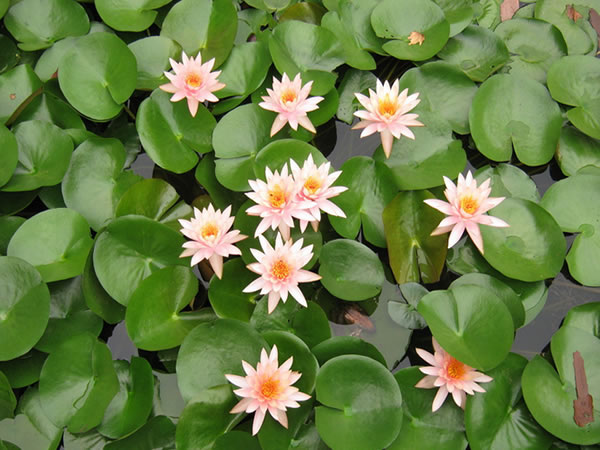
I. Water Lily Propagation Methods
1. Division propagation: Water lilies mainly use division propagation. Cold-tolerant species are usually divided in early spring before sprouting, in March-April; cold-intolerant species have high requirements for air and water temperature, so division can only be carried out around mid-May. When dividing, first dig out the rhizome, select rhizomes with plump new buds, cut into 8-10 cm long root segments, each segment with at least 1 bud, then plant. Bury the terminal bud facing up into the surface soil, with the covering soil depth such that the plant's bud eye is level with the soil surface, 5-7 segments per pot. After planting, expose to a little sun, then add shallow water, to help maintain water temperature, but watering should not be too deep, otherwise it will affect sprouting. When the temperature rises and new buds sprout, then deepen the water level. Place in a well-ventilated, sunny location for care, cultivation water depth 20-40 cm, in summer the water level can be appropriately deepened, in the high-temperature season pay attention to keeping the pot water clean. When pot-cultivating in small quantities, you can pour out water lilies that have been planted for 2-5 years, cut them into 2-4 pieces, and plant them again in the pot.
2. Sowing propagation: Water lilies can also use sowing propagation, that is, after flowering, move into water; before the fruit matures, wrap the flower with a gauze bag, so that after the fruit breaks the seeds fall into the bag. After the seeds are collected, they must still be stored in water; if stored dry they will lose their germination ability. Sow in March-April, use fertile clay loam for the pot soil, the soil should not be too full, preferably 5-6 cm from the pot rim, after sowing the seeds cover with 1 cm of soil, press firmly and immerse in water, the water surface 3-4 cm above the pot soil, cover the pot soil with glass, place in a sunny and warm place, to raise the temperature inside the pot. The sowing temperature is preferably 25-30°C, germination occurs after about half a month, and it can bloom the second year.
II. Water Lily Common Pest and Disease Control
a. Anthracnose: Apply appropriate fertilizer, and at the same time promptly pull out diseased plants; you can also use 50% carbendazim wettable powder 1500-fold solution or 80% anthracnose thiram wettable powder 800-fold solution, spray once about every 10 days, spray 2-3 times consecutively.
b. Pest diseases: There are relatively many causes and types of pest diseases; different control methods should be made according to different pest types.
c. Leaf rot disease: At harvest time remove diseased and residual plants, bury them deeply or burn them in a concentrated manner, to reduce the source of bacteria. At the early stage of the disease, spray 50% carbendazim wettable powder 800-fold solution or 70% thiophanate-methyl wettable powder 800-fold solution or 30% basic copper sulfate suspension 500-fold solution, spray once about every 10 days, spray 2-3 times consecutively.
The above isWater Lily Propagation Methodsand an introduction to common water lily disease control; you might as well learn about it, so that your own water lilies propagate more and bloom more luxuriantly.