How to Grow the Golden Rat Tail Cactus: A Detailed Guide to Cultivation Methods and Precautions
Golden Rat Tail Cactus (Cactus)
The Golden Rat Tail Cactus is a perennial succulent plant in the Cactaceae family. Its place of origin is Mexico in the Americas, and its stems are slender and soft. The flowers are brilliantly colored, and it can be grown as a hanging plant to create a unique display. The flowering period is from April—June.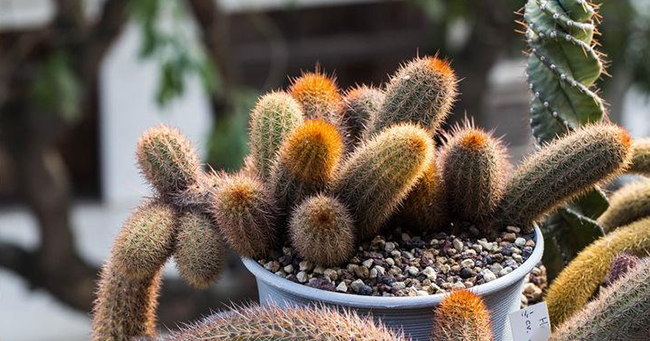
Morphological characteristics of the Golden Rat Tail Cactus
The stems are slender and cylindrical, 1.5—2.5 cm thick, up to 1.5 m tall, much branched, climbing or creeping and drooping, bright green, with 16—18 low ribs, covered with golden bristle-like fine spines. A single plant resembles a golden snub-nosed monkey's tail, and as a whole it looks like a gathering of snakes. The flowers are lateral, funnel-shaped, with pink inner petals and orange-red outer petals interspersed with bright red stripes
Growing environment of the Golden Rat Tail Cactus
It likes a sunny and well-lit environment. It is drought-tolerant and tolerates partial shade, but dislikes waterlogging. The optimum growth temperature is 20-25°C, and it can tolerate a low temperature of 4°C. It is robust in habit and has no special requirements for soil, growing well in ordinary flower-growing soil.
Main value of the Golden Rat Tail Cactus
The whip-like stems of the Golden Rat Tail Cactus are glittering gold and captivating, and the furry red flowers add to the beauty, making one feel refreshed and clear-headed. It is an excellent variety for balcony cultivation and home decoration.
Propagation methods of the Golden Rat Tail Cactus
It is commonly propagated by division through the method of cutting the top to promote branching, carried out in spring and autumn. Cut 5—8 cm stem segments from mature plants, dry the cut ends, and they can be propagated by cuttings; 3-4 cm long stem segments can be used as scions for grafting propagation
Cultivation methods of the Golden Rat Tail Cactus
During the growing season, watering should follow the principle of alternating dry and wet, and a light fertilizer should be applied once a month, mainly phosphorus and potassium fertilizers. Long-term insufficient light is unfavorable for flowering, so it should often be placed in a sunny spot for care. In midsummer, provide appropriate shading; in winter, restrict watering and keep the potting soil slightly moist. Pay attention to preventing and controlling leaf spot disease, red spider mites, and whiteflies.
Soil:
Sandy loam and forest soil with sufficient fertility and good permeability; avoid waterlogged areas; drought-tolerant.
Water:
In summer, water must not be lacking; keep the potting soil moist and frequently mist to maintain humidity. In winter, water once every ten days, and be careful not to spray water onto the stem skin.
Sunlight:
It likes light, tolerates intense sunlight, and also tolerates partial shade, but long-term shading makes the stems grow slender.
Fertilizer:
Before potting, add decomposed organic fertilizer to the nutrient soil, and fertilize once a month during the growing season. Do not fertilize during dormancy in winter and summer.
Temperature:
It likes warm climatic conditions with a large temperature difference between day and night, and is not cold-tolerant.
Precautions for the Golden Rat Tail Cactus
Light
The Golden Rat Tail Cactus tolerates intense sunlight, so light will not cause any possibility of scorching it. On the contrary, not giving it sunlight will cause the plant to grow leggy and slender, and affect flowering. The Golden Rat Tail Cactus should be cared for in a sunny spot.
Pests
Common pests of the Golden Rat Tail Cactus: red spider mites and whiteflies. Summer is the season of high incidence for red spider mites and whiteflies, so everyone should pay attention to checking for spider silk and white spots and deal with them promptly. Common disease of the Golden Rat Tail Cactus: leaf spot disease.
Cultivation Methods and Precautions of the Golden Rat Tail Cactus Grafting Methods of the Golden Rat Tail Cactus
The Golden Rat Tail Cactus, also called the rat tail cactus, is a very warm succulent, and can also be called the warm-hearted one among cacti. Golden Rat Tail Cacti mostly live in groups; their big family lives together, and during growth they become intertwined with one another, so those who like group living and warmth can try growing them.
Cultivation Methods and Precautions of the Golden Rat Tail Cactus
1. Growth habits
It likes a sunny and well-lit environment. It is drought-tolerant and tolerates partial shade, but dislikes waterlogging. The optimum growth temperature is 20-25°C, and it can tolerate a low temperature of 4°C. It is robust in habit and has no special requirements for soil, growing well in ordinary flower-growing soil.
2. Propagation methods
It is commonly propagated by division through the method of cutting the top to promote branching, carried out in spring and autumn. Cut 5—8 cm stem segments from mature plants, dry the cut ends, and they can be propagated by cuttings; 3-4 cm long stem segments can be used as scions for grafting propagation.
3. Cultivation management
During the growing season, watering should follow the principle of alternating dry and wet, and a light fertilizer should be applied once a month, mainly phosphorus and potassium fertilizers. Long-term insufficient light is unfavorable for flowering, so it should often be placed in a sunny spot for care. In midsummer, provide appropriate shading; in winter, restrict watering and keep the potting soil slightly moist. Pay attention to preventing and controlling leaf spot disease, red spider mites, and whiteflies. Soil: Sandy loam and forest soil with sufficient fertility and good permeability; avoid waterlogged areas; drought-tolerant.
4. Precautions
①Water: In summer, water must not be lacking; keep the potting soil moist and frequently mist to maintain humidity. In winter, water once every ten days, and be careful not to spray water onto the stem skin.
②Sunlight: It likes light, tolerates intense sunlight, and also tolerates partial shade, but long-term shading makes the stems grow slender.
③Fertilizer: Before potting, add decomposed organic fertilizer to the nutrient soil, and fertilize once a month during the growing season. Do not fertilize during dormancy in winter and summer.
④Temperature: It likes warm climatic conditions with a large temperature difference between day and night, and is not cold-tolerant.
Grafting methods of the Golden Rat Tail Cactus
Grafting is mostly carried out in May-June, and upright columnar cacti such as the Indian fig prickly pear and the large-flowered snake cactus can be used as rootstock. Take a 10 cm section of the modified stem from the top of the Golden Rat Tail Cactus as the scion; after grafting, it heals in about 50 days.
Through grafting, it can grow into a good hanging plant shape. Flat grafting and slant grafting can be used. The most suitable grafting time is from May—September. The method is as follows: choose a branch of the leaf cactus that has not fully lignified, cut it off 2—3 cm from the branch, and shape it into a cone about 1 cm long; insert the base of a young, green Golden Rat Tail Cactus stem into the pointed cut of the rootstock; no tying is needed.
After grafting the Golden Rat Tail Cactus, pay attention to shading and controlling watering; humidity should not be too high, otherwise grafting will fail. If the scion remains fresh and green after more than ten days, it has survived. Remove the tying material, then proceed to normal management. Grafted plants are more robust and grow faster than cutting-propagated plants, and can produce 4-5 side branches or even more.
Common pests of the Golden Rat Tail Cactus and their control methods
1. Red spider mite
The red spider mite is one of the most common plant pests, and it reproduces quickly, able to produce about 10 generations a year. The red spider mite is extremely small; it uses its piercing-sucking mouthparts to insert into the leaf mesophyll and stem skin of the plant, sucking the plant's sap, causing the plant to turn yellow and even wither.
Control method: Spray-kill with a 1500-fold dilution of 40% omethoate emulsifiable concentrate.
2. White spider mite
The white spider mite was not originally a pest found in our country; it is an imported species. Generally, imported species have strong pesticide resistance, so controlling the white spider mite is relatively difficult. However, difficult as it is, it must still be controlled, otherwise a beautiful pot of Golden Rat Tail Cactus could be ruined!
Control method: Spray-kill with a 2000-fold dilution of 5% fenazaquin suspension concentrate.
3. Whitefly
Pest symptoms: Adults and nymphs pierce and suck the sap of leaves, fruits, and tender branches. Affected leaves show chlorotic yellow-white spots, which expand into patches as the damage worsens, and eventually the whole leaf turns pale and falls early; affected fruits have reduced flavor and quality, and young fruits often drop when severely damaged. The honeydew they excrete can induce sooty mold.
Control method: For early-stage pest damage, begin spraying when whiteflies appear sporadically with a 1500-fold dilution of 20% buprofezin wettable powder, or a 1000-fold dilution of 25% pyridaben emulsifiable concentrate, a 3000-4000-fold dilution of 2.5% bifenthrin emulsifiable concentrate, a 2000-3000-fold dilution of 2.5% cyhalothrin emulsifiable concentrate, a 2000-fold dilution of 20% fenpropathrin emulsifiable concentrate, or a 1500-fold dilution of 10% imidacloprid wettable powder, once every 10 days or so, for 2-3 consecutive treatments.
Flower language of the Golden Rat Tail Cactus
The flower language of the Golden Rat Tail Cactus is: warm family
The Golden Rat Tail Cactus is a succulent and pulpy plant, also known as the golden-haired crowned column, golden button, rat tail cactus, medicinal sage, salvia, golden button, golden button column. It generally blooms in summer, has the effect of removing formaldehyde, and can protect against radiation. The Golden Rat Tail Cactus is an ornamental plant and a flower very familiar to all of us. Its glittering golden stems and gorgeous flowers are all in warm tones, unlike those plants that look cold and icy, which is why it has the flower language of "warm family"!
A warm family is indeed very representative for the enthusiastic and unrestrained Golden Rat Tail Cactus, which also very much likes group living. The methods and techniques for growing the Golden Rat Tail Cactus are not much different from those for ordinary succulents and cacti, so the difficulty of growing it is not great either.
How to Grow the Golden Rat Tail Cactus Cultivation Methods of the Golden Rat Tail Cactus
The Golden Rat Tail Cactus is a succulent plant in the Cactaceae family that blooms very easily, and its rose-red flower color is extremely brilliant. The Golden Rat Tail Cactus has a long flowering period and can continue blooming from summer to autumn. So how exactly should the Golden Rat Tail Cactus be grown? And what are the cultivation methods of the Golden Rat Tail Cactus? Let's find out together.
I. How to grow the Golden Rat Tail Cactus
The Golden Rat Tail Cactus likes warm, humid, and sunny environments. It is not cold-tolerant, tolerates drought and partial shade, and dislikes waterlogging. It likes fertile soil with good drainage and aeration, which can be made by mixing leaf mold, sand, and loam.
The optimum growth temperature of the Golden Rat Tail Cactus is 20-25°C, and it can tolerate a low temperature of 4°C. It is robust in habit and has no special requirements for soil, growing well in ordinary flower-growing soil. During the summer growing period, the Golden Rat Tail Cactus needs sufficient water and frequent spraying to maintain relatively high air humidity. Fertilize once a month. The overwintering temperature needs to be above 10°C.
When cultivated outdoors in midsummer, appropriate shading is needed. When moved indoors in winter, it needs sufficient sunlight and reduced watering. The stems of the Golden Rat Tail Cactus are slender, creeping, and much branched. When potted, a support frame needs to be set up, or it can be grown in a hanging basket. The whole plant must be pruned to maintain a graceful shape. During the growing period, in addition to sufficient watering, it should also be sprayed frequently to increase air humidity. In summer, pay attention to the ventilation of the cultivation site; it is best to place the plant outdoors in a semi-shaded spot. In winter, the potting soil should remain appropriately moist and not dry out completely.
Flowering picture of the Golden Rat Tail Cactus
II. Cultivation methods of the Golden Rat Tail Cactus
1. Temperature and light: The Golden Rat Tail Cactus is not tolerant of strong sun exposure. Summer is the growing period of the Golden Rat Tail Cactus, and the plant also needs slight shading and ventilation; the high-temperature period from July to September is basically maintained in a cool, ventilated place. In addition, when the potting soil is dry, it is relatively tolerant of low temperatures.
2. Watering: During the growing period of the Golden Rat Tail Cactus, water only after the soil has dried completely, and give mature plants as little water as possible. From September to December, water is also given only after the soil has dried completely. In addition, prevent water accumulation in the potting soil in summer. Throughout the cold winter, when the temperature is below 2 degrees, water can almost be withheld; at this time the Golden Rat Tail Cactus enters dormancy, and less water can also prevent frostbite and root rot caused by low temperatures. In spring, watering must be increased gradually, paying attention to weather changes. The Golden Rat Tail Cactus is still relatively easy to care for.
3. Cultivation soil: The cultivation soil for the Golden Rat Tail Cactus is perlite mixed with peat, with vermiculite and coal cinder added; the ratio is arbitrary, with aeration as the priority.
4. Propagation: The Golden Rat Tail Cactus is mainly propagated by sowing and by division and cuttings, and there is also grafting.
5. Fertilizing: Apply a light fertilizer to the Golden Rat Tail Cactus once a month, mainly phosphorus and potassium fertilizers. In addition, before potting, add decomposed organic fertilizer to the nutrient soil; do not fertilize during dormancy in winter and summer.
6. Pests: During the cultivation of the Golden Rat Tail Cactus, pay attention to preventing and controlling leaf spot disease, red spider mites, and whiteflies.
Flowering picture of the Golden Rat Tail Cactus
The above ishow to grow the Golden Rat Tail Cactusandthe cultivation methods of the Golden Rat Tail Cactusintroduced. Friends who like the Golden Rat Tail Cactus can refer to it, and I hope it is helpful to everyone.