What are the cultivation methods and propagation methods for African violets?
African violet morphological characteristics
The whole plant is hairy; the leaves are clustered at the base, slightly succulent, with round or ovate blades, purple on the underside, and long petioles. Flowers are borne 1 to 6 together in long-stalked dichasial cymes; the flowers have a short tube, a 2-lipped corolla, unequal lobes, and diverse colors, including white, purple, light purple, or pink. Capsule, seeds extremely tiny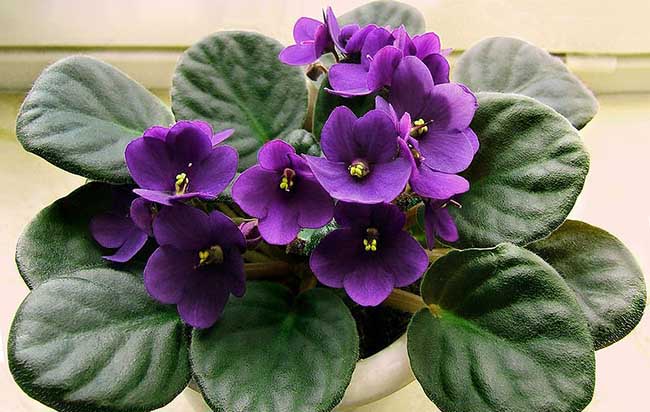
African violet growth habits
It likes a warm, humid, and semi-shaded environment. In summer it fears strong light and high temperatures. The suitable growth temperature is 16-24°C, 18-24°C from April to October, and 12-16°C from October to the following April. The daytime temperature should not exceed 30°C; high temperatures are unfavorable for African violet growth. In winter, the nighttime temperature should not be lower than 10°C, otherwise it is prone to cold damage. Relative humidity of 40%-70% is more suitable; if the pot is too wet, roots rot easily. If the air is dry, the leaves lack luster. African violets need shading in summer, when the leaf color is fresh and green; in winter, sufficient sunlight is needed for continuous blooming; adding supplemental light on rainy and snowy days is very beneficial for the growth and flowering of African violets
Common African violet varieties
Common varieties include large-flowered, single, semi-double, double, and variegated-leaf types, with flower colors such as purple-red, white, blue, pink, and bicolor. A common cultivated variety is the single-flowered Snow Prince
African violet propagation methods:
Seed propagation
The sowing period also changes according to the variety. Biennial and annual varieties are usually grown outdoors and generally sown from August to September; annual varieties should be sown in spring and dislike hot climates. For autumn-sown varieties, the seedlings should be placed in a cold greenhouse to overwinter, while spring-sown varieties need low-temperature vernalization and generally do not bloom easily in the same year.Leaf cutting propagation
African violets commonly use cutting propagation, mainly leaf cuttings. After flowering, choose healthy, plump leaves, cut them off leaving a 2 cm petiole, let them dry slightly, insert them into a sand bed, maintain high air humidity, keep the room temperature at 18-24°C; roots form 3 weeks after insertion, seedlings are produced in 2-3 months, and they are moved into 6 cm pots.During the cutting process, treatment with vitamin B is beneficial for the growth of seedlings after African violet rooting. Treating the petioles with 25 mg/L kinetin for 24 hours is favorable for the formation of adventitious buds. From cutting to flowering takes 4-6 months.
Stem cutting propagation
Stem cutting propagation is also a propagation method chosen for African violets, mainly after the flowers fade in spring. Combined with repotting and changing the soil, the underground tubers are divided and planted. Seedlings form quickly, but the plant shape is not attractive enough, and because the plant is not renewed, growth is not vigorous enough
African violet cultivation methods
Choose a good growing medium
Violets require loose, fertile, slightly acidic soil. For pot cultivation, you can use a growing medium made by mixing 6 parts leaf mold and 4 parts sandy soil, or a growing medium made of 1/3 leaf mold, 1/3 peat soil, and 1/3 sandy soil.
Light should be suitable
Violets like semi-shade. If the care location is too shady, there will be fewer flowers with pale colors or only leaves and no flowers; if the light is too strong, the leaves will turn yellow and appear scorched.
Temperature should be suitable
The suitable growth temperature for violets is 18°C-24°C. When the temperature exceeds 27°C, growth is poor, so cooling measures must be taken in hot summer, and the winter room temperature should not be lower than 12°C.
Watering should be moderate
After planting, water thoroughly and place in a shady spot; after 3-4 days, it can be placed in a well-ventilated sunny spot. However, do not water too much, otherwise root rot is likely. At the same time, be careful not to splash the leaves, otherwise leaf rot is likely.
Fertilization should be light
During growth and development, apply a dilute decomposed liquid fertilizer or compound fertilizer about once every 7-10 days. Do not apply too much nitrogen fertilizer, otherwise the leaves grow very luxuriantly but there are few flowers. Therefore, the ratio of nitrogen, phosphorus, and potassium is best at 1:1:1. After flower buds appear, apply more phosphorus and potassium fertilizer appropriately, and the flowers will be large and brightly colored.
Pinching and seed collection
When about 9 leaves have grown, pinching is needed to promote branching. When the plant grows to 40 cm, it needs a thin bamboo stake for support. For seed production, collect the seeds in time before the capsules turn yellow and split.
African violet cultivation methods: how to propagate
The flowers of African violets are purple, and many people still like them. What are the cultivation methods for African violets? How should African violets be propagated?
African violet cultivation methods:
1. The soil must be loose and breathable, and drainage must also be good. You can use leaf mold plus perlite at a 1:1 ratio, then add some vermiculite; you can also use humus soil plus coarse sand mixed at a 1:1 ratio.
2. Watering does not need to be frequent, and the potting soil must not accumulate water. Except when it is too cold in winter, keep it slightly moist in other seasons.
3. The water method provides us with more assurance, because we can see the roots growing.
African violets like bright light. They can get a little sunlight in the morning; just a little light is enough!
They are still very easy to care for. As long as the potting soil does not stay dry for too long or waterlogged for too long, there will basically be no problems!
It generally takes 8 months for small leaf-cutting seedlings to grow to flowering, and variegated-leaf varieties grow a bit more slowly from leaf cuttings.
African violet propagation methods:
First method: water culture leaf cuttings
First choose a healthy African violet, select a few robust leaves, and use a sharp knife or scissors to cut the leaves off at the petiole. The petiole length is about 4 to 5 cm.
Note: do not damage the plant's roots or leaves.
Find a cup or bottle and fill it with room-temperature clean water (cool boiled water is also fine), insert the leaf into the cup with the petiole soaked in the water, then place the cup in a warm, ventilated, brightly lit place. The leaf should not be soaked in too much water! (A propagation temperature of about 20°C is most suitable; too high a temperature affects the success rate.)
Note: do not place the propagation cup in direct sunlight, as it will scorch; instead, place it in a warm, bright place. After 2-4 weeks, you will see roots growing from the petiole.
After roots grow, the leaf can be transplanted into slightly moist sandy soil. Each rooted leaf can quickly grow new small leaves (small shoots)!
Second method: soil culture leaf cuttings
The propagation method is to insert the leaves directly into slightly moist sandy soil (the petiole length is best at 4-5 cm; if longer or shorter, it will affect the germination rate). Bury 1/3 of each leaf in the soil; if buried too shallow, roots rot easily! If buried too deep, it cannot sprout!
Note: the small pot for leaf cuttings should preferably be small, just a little larger than the leaf. If in a large pot, more moist water is retained and moisture dissipates slowly, making leaves rot easily!
Many flower lovers have also tried this method, but the leaves always rot. What is going on? Is it because no rooting powder was used?
In fact, soil culture leaf cuttings do not need any rooting hormones at all (adding a little is also fine). The most important trick is not to water, but to prop it up with plastic film to make it look like a tent, which can achieve moisture and heat retention. After about 2-4 weeks, the leaves will root and sprout!
After 4 weeks, the potting soil in the slightly moist plastic film begins to dry. At this time, you can see new small leaves growing from the petiole, very cute little buds, with leaves growing in clusters, full of vitality! At this time, these seedlings need to be transplanted into new flower pots. Remember to transplant them together with the soil; the success rate is also very high!
That is all for the introduction to African violet cultivation methods and propagation methods. Why not hurry and get a few for your home?
African violet - African violet cultivation methods | African violet pictures
African violet
African violet (scientific name: Saintpaulia ionantha), also known as African violet, is a perennial herbaceous plant in the genus Saintpaulia of the family Gesneriaceae. It has no stem, and the whole plant is covered with hairs. The leaves are ovate, and the petioles are thick and succulent. The flowers are borne one or several together, light purple. There are many cultivated varieties, including large-flowered, single, semi-double, double, and variegated-leaf types, with flower colors such as purple-red, white, blue, pink, and bicolor.African violet cultivation methods
1. Soil: the potting soil should be loose and fertile, and soil rich in humus is suitable. Generally use 5 parts leaf mold, 3 parts garden soil, and 2 parts decomposed manure soil, or mix 6 parts leaf mold with 4 parts sandy loam, or mix equal parts leaf mold, peat soil, and sandy soil evenly.
2. Watering: watering is very important. In early spring with low temperatures, watering should not be excessive, otherwise the stems and leaves rot easily and flowering is affected. In summer with high temperatures and dryness, water more and spray water to increase air humidity, otherwise the flower stalks droop and the flowering period shortens. However, if too much water is splashed on the leaves when spraying, it can also cause leaf rot. In autumn and winter, as the temperature drops, watering should be appropriately reduced.
How to grow African violets
African violets like semi-shaded, warm, and humid environments, and need attention to ventilation; they dislike high temperatures and strong light. Spray-type watering can be used, and the principle is not to water until the potting soil surface is dry, but it must not dry out completely, otherwise growth and flowering will be affected. In general, nitrogen-phosphorus-potassium ternary or multi-element compound fertilizers are suitable. The growth temperature must not be higher than 28°C; generally 15-25°C is suitable, and a high-temperature environment is not conducive to growth. If African violet cultivation lacks light, it will only grow leaves and not bloom; if the sunlight is too strong, yellow spots will appear on the leaves.
The role of African violets
The role of African violets: 1. Ornamental value. African violet plants are short, can bloom all year round, have leaves as thick as velvet, elegant and refined flower shapes, and rich, brilliantly colorful flowers. They have high ornamental value and are excellent indoor ornamental plants.
The role of African violets: 2. Decorating the home. African violets are all hybrid cultivars, with many varieties and flower colors such as white, pink, red, and blue. The plants are short, bloom in all four seasons, and are relatively shade-tolerant, making them good decorative items for indoor windowsills, living rooms, and tables.
African violet disease control
1. African violet root-knot nematode disease
African violet root-knot nematode disease is a root disease caused by root-knot nematodes. The main symptom is on the fibrous roots and lateral roots, where root nodules of various sizes can form. The root nodules start milky white and later turn light brown. When the root nodules are cut open, there are very small milky white nematodes inside. This causes African violet plants to be short and stunted.
Solution: 5% ethoprophos can be used at 0.1% of the soil weight, or 0.75 g for a 6 cm flower pot, or 10% fosthiazate at 0.5 g for a 6 cm flower pot. These two agents can be used during the growing period, but use before planting is more effective. 10% aldicarb, 5.6 g per square meter, with at least 4 weeks between treatment and planting. In addition, when planting in nursery land, dihaiping can be evenly spread within 15-20 cm around the seedling roots at 2 kg/mu, which can effectively control the occurrence of nematodes.
How to propagate African violets
1. African violet leaf cutting propagation method
African violets commonly use cutting propagation, mainly leaf cuttings. After flowering, choose healthy, plump leaves, cut them off leaving a 2 cm petiole, let them dry slightly, insert them into a sand bed, maintain high air humidity, keep the room temperature at 18-24°C; roots form 3 weeks after insertion, seedlings are produced in 2-3 months, and they are moved into 6 cm pots. During the cutting process, treatment with vitamin B is beneficial for the growth of seedlings after African violet rooting. Treating the petioles with 25 mg/L kinetin for 24 hours is favorable for the formation of adventitious buds. From cutting to flowering takes 4-6 months.
Related encyclopedia
Pocket scale non-woven bag lamp wick bamboo shoot crab claw Redmi Note 3 YKK zipper YBS zipper Sargent cherry climbing rose wild senna wintersweet green pine wristwatch Omega Longines famous watch children's building blocks flint Rhododendron orchid curling iron soursop