A Detailed Guide to the Benefits, Uses and Cultivation Methods of Kochia
Kochia Encyclopedia
The plant clump is dense, with a form ranging from ovate to spherical, obovate or elliptical. It branches abundantly and finely, bears short soft hairs, and the base of the stem is semi-lignified. The stem has many branches, the leaves are linear-lanceolate, simple and alternate, linear or strap-shaped. The spike inflorescence bears small reddish-brown flowers; the flowers are extremely small and have no ornamental value. The utricle is flattened-spherical. The plant is tender green, and the leaf color turns red in autumn. The fruit is flattened-spherical and can be used as medicine, called Kochia fruit (Di Fu Zi). The tender stems and leaves can be eaten, and the old plant can be used to make brooms.
Kochia Growth Habits
Kochia has strong adaptability. It prefers warmth and light, tolerates drought, and is not cold-tolerant. It is not strict about soil requirements and is relatively tolerant of alkaline soil. Fertile, loose loam rich in humus favors the vigorous growth of Kochia.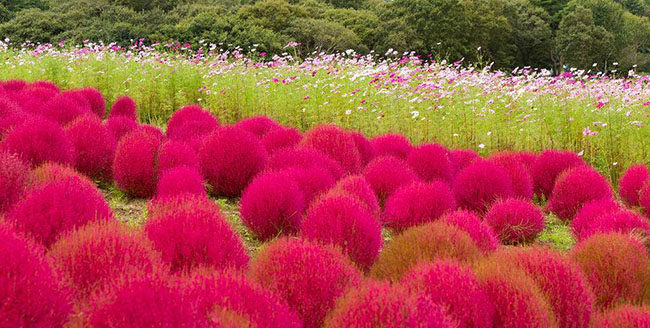
Varieties of Kochia
Alkali Soil Kochia
This variety differs from the original variety in that there is denser tufted rusty-colored soft hair beneath the flowers.
Alkali Soil Kochia
Produced in Heilongjiang, Jilin, Liaoning, Inner Mongolia, Hebei, Shanxi, Shaanxi, Gansu, Ningxia, Qinghai, **. It grows in mountain valley wetlands, riverbanks, roadsides, seasides and other places.
Broom Kochia
Broom Kochia has numerous branches, and the plant is ovate or obovate; the leaves are relatively narrow. It is cultivated for use as brooms. In late autumn the branches and leaves turn red and can be used for ornamental purposes.
Kochia Cultivation Techniques
Kochia Seedlings
Kochia has strong adaptability and can be planted in both north and south China. It is not strict about soil requirements and can be planted in front of and behind houses, at field edges and corners, and other places. It is propagated by seed, sown in April in spring. Before sowing, water thoroughly, then drill sow with a row spacing of 0.5-0.8 m, cover with 0.4-0.5 cm of soil, at a sowing rate of 1 kg/667 sq m, and press lightly after sowing. Keep the soil moist; seedlings emerge in about 10 days. After the seedlings emerge completely, thin and final-thin them in time, loosen the soil and weed promptly, water at the right time, and apply topdressing 2-3 times each year. In autumn when the fruit is ripe, cut the whole plant, dry it in the sun, thresh out the fruit, remove impurities, and dry it in the sun for later use. The stems and leaves can be cut into sections and dried in the sun.
Sowing and Raising Seedlings
The suitable germination temperature for Kochia is 10-20°C. When raising seedlings, either direct sowing in the open field or seedling raising in protected conditions followed by transplanting can be used. Direct sowing in the open field can be done in mid-to-late April. Hole sowing, drill sowing and broadcast sowing are all acceptable. For seedling raising in protected conditions, bed sowing can be done from early to mid-March. Although Kochia is relatively drought-resistant and not strict about soil requirements, the soil should still be watered sufficiently before sowing, and a certain amount of decomposed organic fertilizer should be applied. The soil covering thickness is 1-1.5 cm.
Field Management
Final thinning or transplanting. If direct sowing in the open field is used, when the seedlings grow to 15-20 cm tall, final thinning can be carried out at a plant-to-row spacing of 70-100 cm along with harvesting the seedlings; if seedling raising in protected conditions is used, transplanting and planting can be done when the seedlings grow to 6-10 cm.
Water and Fertilizer Management
In addition to applying sufficient base fertilizer, during thinning and seedling recovery, apply a water-soluble biological organic fertilizer at 150 kg/ha once by flushing with irrigation water. Although Kochia is relatively drought-tolerant, keeping the field moist can not only increase yield but also help improve product quality. Therefore, during the growing period, water once every 7-10 days.
Timely Harvesting
Generally, when the plant grows to 15-20 cm tall, the seedlings can be harvested; from April to July, tender stems and leaves can be harvested successively; after the Beginning of Autumn, the whole plant or seeds can be harvested.
Pest and Disease Control
Kochia is susceptible to aphid damage, which can be controlled with a 1000-1200 times dilution of 40% dimethoate emulsifiable concentrate. Kochia is also easily parasitized by dodder; once found, it should be removed promptly.
Weed Management in Kochia
The main methods for controlling farmland weeds include manual control, chemical control, mechanical control, replacement control and ecological control. Using principles such as covering and shading, methods such as mulching with plastic film or sowing other crops (or grass species) are used for weed control.
① Manual control
Controlling weed seeds from entering the field. Manual control first means trying not to let weed seeds or reproductive organs enter the crop field, clearing weeds at field edges and roadsides, strictly enforcing the weed quarantine system, carefully selecting sowing materials, and in particular, weeds that are not present in the country or have not yet spread widely must be strictly prohibited from introduction or strictly controlled to prevent their spread, thereby reducing the sources of weeds in the field. When composting farmyard manure with weeds, farmyard manure containing weed seeds should be covered with plastic film and composted at high temperature for 2-4 weeks, decomposed into organic fertilizer, and used only after its germination capacity has been killed.
Manual weeding combined with farming activities, such as directly pulling out or cutting weeds by hand after weed germination or during the growth period, or removing weeds in combination with farming measures such as intertillage and fertilization.
② Mechanical control
Combined with farming activities, using farm implements or large agricultural machinery to carry out various measures such as plowing, harrowing and intertillage loosening of the soil to control weeds at different periods such as before sowing, before emergence and at various growth stages, directly killing, cutting or eradicating weeds.
③ Chemical control
Its main features are high efficiency and labor saving, eliminating the heavy labor of field weeding. There are already more than 300 chemical herbicides at home and abroad, processed into formulations of different dosage forms, which can be used for weed control in almost all grain crops and cash crop fields.
Main Values of Kochia
Medicinal Kochia fruit functions and indications: promotes urination and clears damp-heat. It treats difficult urination, gonorrhea, leukorrhea, hernia, rubella, sore toxins, scabies and damp itching of the genital area.
① "Shennong Bencao Jing": Mainly treats bladder heat and promotes urination. Tonifies the middle, benefits essential qi.
② "Bielu": Removes hot qi in the skin, disperses malignant sores, hernia and abdominal masses, strengthens yin, and makes people lustrous.
③ "Yaoxing Lun": Taken together with actinolite, it mainly treats male impotence, tonifies qi and boosts strength; treats testicular swelling and pain, removes wind-heat, and can be used as a decoction for bathing.
④ "Rihuazi Bencao": Treats exogenous heat and red swelling.
⑤ "Diannan Bencao": Promotes urination and relieves accumulated heat in the bladder, washes away wind on the skin, treats exogenous heat in various meridians of women, clears and relieves fetal heat, and damp-heat leukorrhea.
⑥ "Bencao Yuanshi": Removes accumulated heat in the skin and eliminates damp itching on the outside of the skin.
⑦ "Bencao Beiyao": Benefits essence and strengthens yin, removes deficiency heat, promotes urination and frees strangury.
⑧ "Yuqiu Yaojie": Treats swelling and pain of the head and eyes, inguinal hernia and sagging genitals, waist pain and hypochondriac pain, blood dysentery and malignant sores.
Supplementary Formulas for Kochia Seedlings
① Treating strangury: 14 bundles of Kochia herb, decocted in 2 sheng of water. It can also be taken over a long period. ("Fan Wang Fang")
② Treating frequent urination, or heat pain and aching soreness, with vexing pain of the hands and feet: 3 liang of Kochia herb, boiled in 4 sheng of water, reduced to 2.5 sheng, divided into three doses. ("Chanru Ji Yan Fang")
③ Treating eye injury by foreign objects, or pterygium: 5 liang of fresh Kochia seedlings, washed clean, pounded and squeezed to obtain the juice, stored in a porcelain box, and applied frequently to the eyes with a copper chopstick. In winter, use the dried form, boil the juice and apply it. ("Shenghui Fang")
Pharmacological Functions of Kochia Fruit
① Antibacterial:
The water infusion 1:3 has an inhibitory effect on skin fungi such as Trichophyton schoenleinii and Microsporum audouinii in test tubes. The water infusion, using the test tube dilution method, at 1:3 has an inhibitory effect on Trichophyton schoenleinii, Microsporum audouinii and Nocardia asteroides, etc. Antibacterial effect: the water infusion 1:3 in test tubes has varying degrees of inhibitory effect on skin fungi such as Trichophyton schoenleinii, Microsporum audouinii, Microsporum ferrugineum and Microsporum lanosum. The 50% decoction, using the dry plate trench method, has a relatively weak inhibitory effect on Salmonella typhi.
② Anti-allergic:
The water extract of Kochia fruit has an inhibitory effect on the mononuclear phagocyte system and delayed-type hypersensitivity in mice.
③ Ornamental value
Landscape uses: flower beds, flower borders, flower clusters, flower groups
The Medicinal and Edible Uses of Kochia
The Medicinal Value of Kochia
Kochia can promote urination and clear damp-heat, and treat conditions such as difficult urination, hernia, sore toxins, gonorrhea, rubella and scabies.
Kochia Is Edible
Kochia is also edible, mainly its tender stems and leaves, which are blanched in boiling water and then served cold, stir-fried, or used as filling. Stir-fried Kochia with meat is a tender, delicious and flavorful dish.
The above are the uses of Kochia, and there are indeed quite a few of them. I hope everyone can carefully care for their own Kochia; once grown, there will be endless surprises!
Cultivation Methods and Precautions for Kochia
Cultivation Methods for Kochia
Soil
Kochia is not demanding about soil. It prefers loose, fertile sandy soil containing humus and with good drainage, but it can also tolerate poor and thin soil, and can also tolerate alkaline soil.
Light and Temperature
Kochia prefers a sunny, well-lit environment, but it is also a relatively shade-tolerant plant.
In terms of temperature, Kochia prefers warmth and is not cold-tolerant. In addition, the suitable germination temperature for Kochia is between 10-20°C.
Water and Fertilizer Management
In terms of water and fertilizer management, the care and management of Kochia is still very simple and extensive. Basically, when planting, a certain amount of base fertilizer should first be applied to Kochia, and it should be watered thoroughly once.
After planting, Kochia needs topdressing 2-3 times each year; of course, no further fertilization may also be given. As for watering, although Kochia can tolerate drought, a certain amount of water should still be supplied to keep the soil moist so that Kochia grows well. During the growing period, water once every 7-10 days. Let the soil dry and wet alternately, and avoid waterlogging.
Propagation Methods
Kochia is generally propagated by sowing, usually carried out in spring by direct sowing. Sow Kochia seeds in April each year. Apply base fertilizer before sowing, keep the soil moist, and seedlings will emerge in about 10 days; then plant them at the appropriate time. Propagation of Kochia by sowing germinates quickly and uniformly, and is simple to care for.
Precautions for Cultivating Kochia
Weeds
During the growth of Kochia, it is inevitable that many weeds will appear, and the weeds need to be removed. Methods such as manual control, mechanical control, chemical control, replacement control and ecological control can be used for weed control.
Pests and Diseases
Kochia is relatively susceptible to aphid damage and parasitism by dodder. Timely control is needed.