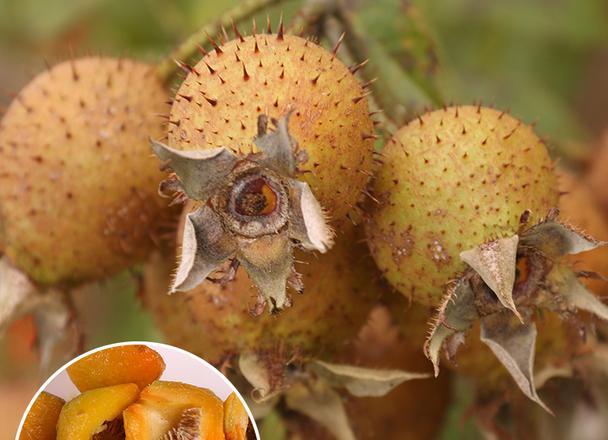
Rosa roxburghii planting management and common pest and disease control methods
Rosa roxburghii planting management and common pest and disease control
1 Planting and management
1.1 Scientific planning and variety selection
Rosa roxburghii is suitable for growing in warm and humid, sunny, and fertile soil conditions. Therefore, areas suitable for Rosa roxburghii cultivation should be rationally planned according to local conditions. Moreover, Rosa roxburghii resources are abundant with many varieties, so varieties should be scientifically selected based on local characteristics and market demand.
1.2 Cultivation of strong seedlings
Use current-year lignified branches for propagation. Select strong branches and autumn green branches for cuttings; the rooting rate of cuttings is about 45%, and treatment with indolebutyric acid and naphthaleneacetic acid can increase the rooting rate to over 70%. Alternatively, 1-3 a old mature branches can be used for cutting propagation, which can be done in spring, summer, and autumn, all with high rooting rates; summer and autumn cuttings are best, with a rooting rate of up to 100%. The length of branches for cutting propagation should be controlled at 13-16 cm, not too short or too long. The soil used in the seedbed must be fertile, fine, loose, and have good water retention. After cutting, water immediately to ensure the soil is moist, and cover to enhance heat and moisture retention to facilitate rooting.
1.3 Scientific planting
Whether the planting technique for Rosa roxburghii seedlings is scientific and whether post-planting management is appropriate greatly affects the survival rate after planting, shortening the recovery period, and ensuring normal plant growth. Planting must be done in the planting hole at the top of the main planting hole or trench; the depth and width of the planting hole should be 33 cm, and the roots should be spread out in all directions. On the day of planting, water for root establishment must be applied; if the seedlings used are relatively tall, support stakes should be inserted and tied to prevent wind from shaking them and affecting survival. After planting, water once every 5-7 d depending on weather conditions to ensure the soil is moist. If the tree disc is covered, the watering interval can be longer; post-planting watering management should continue until the rainy season before stopping.
1.4 Emphasize orchard management
The focus of orchard management is clearing weeds in the orchard and improving deep soil permeability, providing guarantees for enhancing the soil's water, fertilizer, and heat retention capacity; in the dry season, tree disc mulching should also be carried out. In spring, summer, and autumn, apply quick-acting fertilizer 7-10 d before shoot sprouting, usually nitrogen-based, to promote branch and leaf growth; in the second and third years, gradually increase the application rate. Before summer and autumn shoots sprout, apply 0.05-0.10 kg urea or 5 kg clear manure water per plant. When each season's shoots and leaves are taking shape, spray potassium dihydrogen phosphate or other high-efficiency compound fertilizers on the leaves to promote shoot and leaf maturation.
2 Control of common pests and diseases
2.1 Powdery mildew
The main parts affected by powdery mildew are young shoots and young leaves; it also affects flower buds, flowers, and young fruit. It mainly spreads conidia by wind, with the highest dispersal during the day, accounting for over 90% of the total daily dispersal, and the highest dispersal after 10:00, while less at night. The disease occurs from late April to November; in July-August, symptoms are not prominent due to high temperature inhibition. The older the seedling age, the more severe the disease; young leaves are generally severely affected, while old leaves are relatively less affected [1]. Plants with better fertilizer and water management have strong growth vigor and resistance, and are relatively less affected. Rosa roxburghii planted on hillsides and field edges generally has milder disease due to shorter plants, fewer branches, and strong permeability; plants planted in flatland areas have denser growth and more tender branches and leaves, and are more severely affected.
For this disease, comprehensive control should be carried out. First, select sunny hillside plots as the main planting area; strengthen water and fertilizer management to enhance plant disease resistance; scientifically prune and shape to increase plant permeability, focus on cultivating vegetative branches and fruiting branches to enhance disease resistance; at the same time, prune diseased branches to prevent pathogen accumulation and reduce the disease incidence. Second, chemical control. Biological agents such as 25% triadimefon 2,000-fold solution, agricultural antibiotic 120, or antibiotic BO-10 can be used for control.
2.2 Brown spot
The main part affected by this disease is leaves, with old leaves being the most severely affected. The disease occurs from May-October, with the most severe incidence in July-August. Comprehensive control is the same as for powdery mildew; in the early stage of control, 70% mancozeb or 50% carbendazim can be sprayed, once every 15 d, for a total of 4 sprays, with good control results.
2.3 Sooty mold
This disease mainly occurs on leaves and branches; initial symptoms are dark brown mold spots, which gradually expand and spread, finally merging into a black sooty mass. It is prone to occur in dense, shaded, and damp areas; the occurrence of this disease is closely related to aphids and whiteflies. This disease can be controlled with 40% omethoate, which is effective against aphids and whiteflies.
2.4 Peach fruit moth
The peach fruit moth is the main boring pest among Rosa roxburghii insect pests; in the early stage it causes flower and fruit drop, and in the middle stage it causes black fecal-like material inside the fruit, seriously affecting the yield and quality of Rosa roxburghii. For control, in November prune the orchard after harvest and strengthen field management; or use 50% phoxim emulsifiable concentrate mixed with fine soil to make toxic soil for broadcasting.
2.5 Yellow slug moth damage
The yellow slug moth is the most serious insect pest of Rosa roxburghii; the period of more severe damage is from mid-June to early July, because the number of larvae in the forest is relatively high during this period. The control method is to timely clean up debris in the forest and spray 70% phoxim 1,000-fold solution during the early hatching stage of larvae, with relatively good control results.
2.6 Rose long-tube aphid
The main parts affected by the rose long-tube aphid are young shoots and flower buds, and the occurrence time is mainly from mid-April to November. The control method is to prune insect-infested branches after autumn and promptly remove weeds and fallen leaves in the orchard; fully protect and utilize beneficial organisms such as parasitic wasps and predatory ladybugs; when insect pests occur over a large area, spray 25% menazon (ethiofencarb) 1,000-fold solution for control.