How to grow freesia? Detailed guide to propagation methods and planting techniques
Freesia (Fressia hybrida Klatt.), also known as xiaocanglan, xiaochanglan, jiandaolan, suxianglan, xiangyuanwei, and yangwanxiangyu, is a perennial bulbous herbaceous flower of the Iridaceae family, genus Freesia. It is beautiful and has a very strong floral fragrance, so many consumers use it as a household potted plant. Nowadays many people like to grow freesia themselves, because when the freesia blooms it feels more rewarding. Today, follow the editor to look at freesia propagation methods and planting techniques, so everyone knows how to grow freesia.
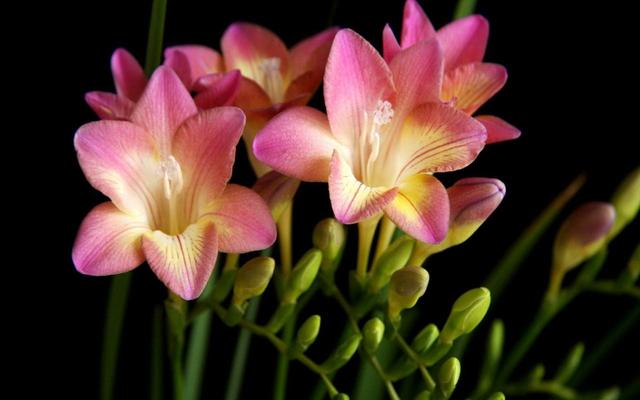
The beautiful legend of freesia
According to legend, in the early 18th century, this flower was still in a wild state. One day, a noble young lady from the Netherlands was hunting in South Africa with her lover and saw this strange flower for the first time. She liked it very much, and later personally dug it up and brought it back to Europe. The flowers, giving off a delicate fragrance, were blown by the wind onto the snow along the way, and as a result even the ice and snow were stained with a rich aroma. Afterwards people gave this flower a pleasant name: "freesia".
Freesia propagation methods
1. Bulb division propagation
Bulb division propagation is the main propagation method for freesia. After the plant dies and goes dormant, dig out the underground corms. At this time the mother bulb has already died, and 1 new bulb and several daughter bulbs have formed on it. Generally the diameter of the new bulb is above 1cm, and it can bloom after planting. Daughter bulbs with a diameter greater than 1cm can also be used as flowering mother bulbs, with good results. Those smaller than 1cm need 1-2 years of propagation before they can be used as flowering mother bulbs. Daughter bulbs also have the habit of high-temperature dormancy, and after being dug out they should be stored in a ventilated, dry place.
2. Seed propagation
Cut flower varieties can be propagated by seed. After the seeds mature in May-June, collect them in time, otherwise the capsules will split open and the seeds will be lost. Seeds have no dormancy habit and can be sown immediately after collection. The optimum temperature for seed germination is 15-20°C, and germination is neat under dark conditions, taking about 21d. When the seedlings have 5-7 leaves, the aboveground part turns yellow and withered, and the underground corm enters a high-temperature dormancy period. After dormancy, plant again and cultivate the daughter bulb for 1 year, and it can then be used as a flowering mother bulb.
Using container seedling cultivation, flowering bulbs can be obtained in one year. The specific method is: after harvesting seeds in May-June, sow them immediately in a greenhouse. After emergence, keep cultivating them in containers in the greenhouse, maintain room temperature at 15-18°C, and provide good water and fertilizer. By May-June of the following year, the diameter of the daughter bulb can reach more than 10m, and it can be used directly as a flowering seed bulb.
3. Tissue culture propagation
At present, tissue culture propagation of freesia has been applied in production. For example, some developed countries have already mass-produced virus-free freesia seedlings. The explants used are young flower buds. Culture conditions: temperature 20-25°C, light intensity 1500Lux, pH value 5.8.
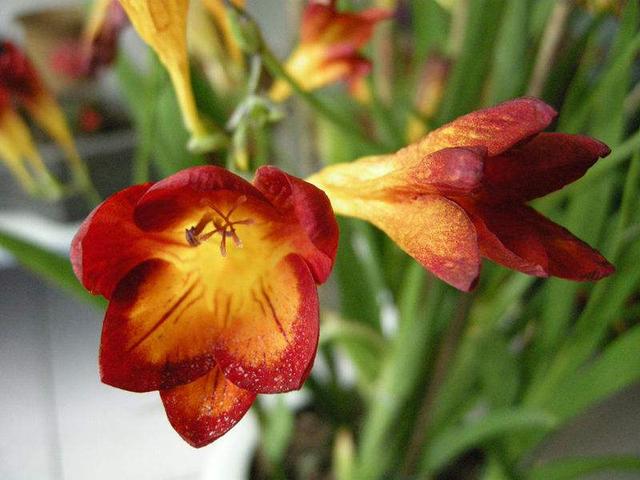
Freesia planting techniques
Freesia cultivation is mainly based on protected cultivation for flower supply in winter and spring.
1. Soil preparation
Before cultivation, the cultivation soil should be deeply plowed, fertilized, and disinfected. The plowing depth should be at least 20-30cm. The amount of base fertilizer is generally controlled at 100g of N, P, K compound fertilizer per square meter, with a ratio of 12:10:18. Soil disinfection methods can use steam disinfection or chemical disinfection. If highly toxic chemicals are used for disinfection, they must be fully aired before use, so as not to harm people and plants. Then make raised beds 10cm high and 1-1.2cm wide for later use.
2. Planting
The planting time is determined according to the desired flowering time, generally planting 3-4 months before the flowers are needed. Generally speaking, corms stored at 31°C or newly purchased corms are still in a dormant state. First give them a temperature treatment of 13-17°C for 2-3 weeks, then plant them. Only in this way can the emergence period be uniform and the expected flowering be achieved. During treatment, the corms can be placed in containers or underground in a thin layer. The treatment room temperature should be controlled at 13-17°C, relative humidity 80%, and good ventilation should be maintained. Check every day, and plant immediately when the corms show slight buds or root protrusions (if roots or buds have already grown before planting, it is easy to damage the roots and buds).
After dormancy, low temperature and high humidity can promote flowering. The treatment temperature is 8-10°C, humidity 90%, and time 2-3 weeks. If planting in summer and autumn, when the greenhouse temperature is too high, the corms can also be placed in moist peat or sawdust and put into a low-temperature cold storage at 8-10°C for 30-40d, then planted after the root system grows. Just be careful not to damage the root system during planting. This can save energy for cooling a large greenhouse and also advance the flowering period.
The planting density varies somewhat depending on variety, corm size, and cultivation season. Narrow-leaf varieties are denser than broad-leaf varieties. The planting density is 80-100 plants/sq m, that is, 10cm×10cm or 10cm×12cm.
3. Depth and covering
Generally speaking, the planting depth of freesia should be determined according to climate, soil, and corm size. The covering soil depth is generally twice the size of the corm. In winter, the corm can also be placed into the soil, but the soil should be shallow; in summer it can be slightly deeper to reduce the impact of high temperature on the corm. At the same time, slightly deeper covering soil is conducive to growth and flowering, and conducive to the full development of the lower root system at the base of the mother bulb and the upper root system at the base of the new bulb.
After cultivation, if the temperature is relatively high, a thin layer of peat, pine needles, straw, etc. can be spread on the soil surface to preserve warmth, prevent soil surface hardening, and prevent weed growth.
4. Water management
After planting, water thoroughly immediately, and provide sufficient water supply until new buds emerge. Drip irrigation is preferable. When using sprinkler irrigation, be sure to prevent washing away the surface soil and exposing the corms. After rooting, appropriately reduce the water supply and just keep it moist. After flowering, keep the soil as dry as possible, and carry out supplementary watering only in the morning, so that the soil surface is slightly dry in the afternoon, thereby reducing air humidity and preventing pests and diseases.
5. Temperature management
Both root system formation and flower bud differentiation of freesia require a relatively cool environment. The root system grows best at 15-18°C, flower bud differentiation is best at 12-15°C, and inflorescence growth is fastest at 18-20°C. Therefore, maintain room temperature at 15-18°C in the early planting stage; at the 5-7 leaf stage, induce flower primordia at 12-15°C, and maintain this temperature for 4-6 weeks so that inflorescence development will not reverse; then raise the temperature to 16-17°C to make the inflorescence elongate rapidly and enter the flowering period.
6. Nutrient management
If the soil is relatively fertile, topdressing can be done at the 4-5 leaf stage; otherwise, topdress at the 2-3 leaf stage. In the early stage, only N fertilizer can be applied. During flower bud differentiation, add P and K. A ratio of 1:1:1 for the three is sufficient, 20-30g/sq m, with a total of 3-5 fertilizations during the growth period.
7. Light and climate
Freesia likes sufficient sunlight and relatively low temperatures. At a temperature or room temperature of 15C, the plant can grow normally and robustly, but when the temperature or room temperature exceeds 20C, the plant is prone to lodging due to excessive growth, or is unwilling to flower. When the outdoor temperature is lower than 15 degrees, it should immediately be moved indoors. Throughout the winter, it should be placed indoors at a room temperature of 15-18C..
In areas with higher latitudes (above 38N), supplementary lighting is preferable for winter cultivation. Supplementary light intensity is conducive to photosynthesis and earlier flowering. High-pressure sodium lamps equipped with reflectors have a good effect on supplementing light intensity, but continuous lighting is not conducive to flower bud differentiation. While supplementing light, pay attention to the carbon dioxide concentration in the greenhouse. Ventilate as much as possible to ensure carbon dioxide concentration, or use a carbon dioxide generator to supplement carbon dioxide into the greenhouse. In summer cultivation, shading is needed, with the shading degree limited to 30%.
8. Netting
Freesia stems are relatively thin and the flowers are numerous, so it is prone to lodging. Support nets should be set up before the 3-leaf stage, with a total of 2-3 layers, and checked frequently to keep one plant per grid. Flower harvesting, handling, and market release harvesting.
When the first small flower on the flower branch fully shows color, it is the suitable harvesting period. Carry out harvesting in the early morning or evening. Sometimes several flower branches grow from one seed bulb. If the lateral branch inflorescence is small and the number of flowers is few, cut it off early and keep only 1 or 2 flower branches. When cutting flowers, if it is for consumptive cultivation, cut from the base. If bulbs are also to be harvested, keep all basal leaves and strengthen water and fertilizer management of the plant after harvesting until 2-3 weeks before bulb harvesting, so that the new bulb and daughter bulbs can grow further.
That is all for the related information about freesia. I hope this article is helpful to everyone.