High-yield cultivation of arrowroot is very simple: an 8-year veteran farmer shares the secrets of planting

Click to follow us, we update agricultural planting techniques every day to help you achieve high yields and prosperity
1. Seed selection and seedling raising
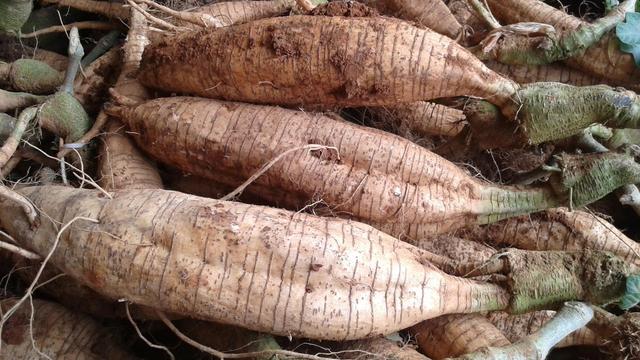
There are many varieties of arrowroot, mainly including fine-leaf arrowroot, large-leaf arrowroot, purple arrowroot, etc. Among them, fine-leaf arrowroot (fine-vine arrowroot, chicken-neck arrowroot) has well-formed storage roots that are spindle-shaped, with smooth skin, few wrinkles, little fiber, sweet taste, a high starch yield, relatively good drought tolerance, early maturity and high yield. From December each year to February of the following year, among the harvested arrowroot vines, select disease-free, thick, plump-budded middle-section vine stems for seed use, dig 20 cm shallow holes in the original harvest field for burying, cover with weeds, or take them back indoors and cover-store them with slightly moist river sand. About 20-30 days before planting, lift out the seed vine stems, cut them with a sharp knife into seed stem strips with 2-3 nodes, and according to a 20×10 cm spacing, insert them diagonally in a concentrated manner on seedling beds made 1 m wide, loose and fertile, and water every other day. When the new shoots grown from the seed stem strips have spread about 3 leaves and reached a length of 5-10 cm, they can be lifted with soil for transplanting. The lifting action should be gentle so as not to damage the young seedlings.
2. Land selection and land preparation
Choose sunny land with good drainage and irrigation, a relatively low groundwater level, no waterlogging, deep soil layers, and loose, fertile red-yellow soil or sandy loam for planting, preferably with crop rotation. Use the winter slack season for deep plowing and land preparation. On flat land, form ridges at 1-1.2 m including furrows, with a ridge height of 30-35 cm and a furrow width of 30 cm, and open planting holes at the center of the ridge at a planting spacing of 1.0 m, with each hole 40 cm deep and 40 cm wide. On hillside land, open 1.2 m wide strips along the contour lines, then open planting holes of 50×50 cm, with a hole spacing of 1 m and a row spacing of 1.0-2.5 m (depending on the slope). About 30 days before planting, backfill the planting holes layer by layer with weeds and fertile topsoil, coarse below and fine above, until they are 15-20 cm above the hole surface. Generally, each planting hole requires 2.5-5 kg of decomposed farmyard manure or 10-15 kg of soil and miscellaneous fertilizer, and 0.5 kg of calcium magnesium phosphate fertilizer or ternary compound fertilizer. The fertilizer must be mixed evenly with organic fertilizer and soil when backfilling the planting holes.
3. Planting time
Plant from mid-February to late April each year. Planting specifications: rows 1.0-1.2 m (including furrows), plant spacing 1.0 m, single-row single-plant planting, 500-600 plants per mu (hillside land depending on terrain and slope). Before planting seedlings, first dig small holes about 15 cm deep, plant the seedlings diagonally into the holes at a 30-degree angle to the ground, press the soil firm with both hands, and water thoroughly to settle the roots.
4. Strengthen management
1. Replanting and trellis insertion
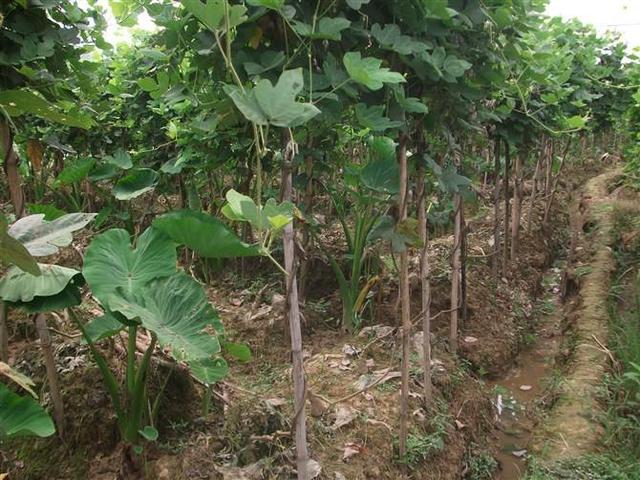
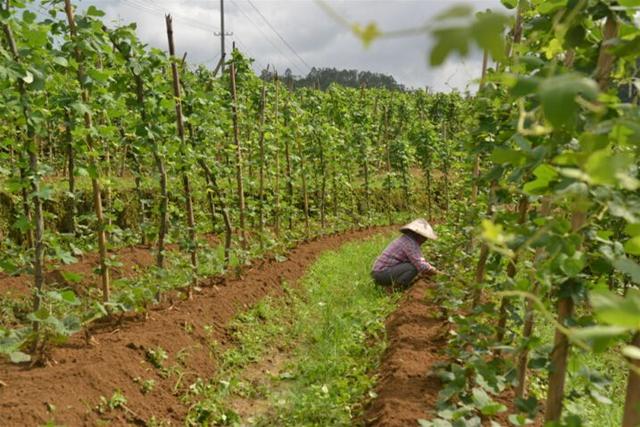
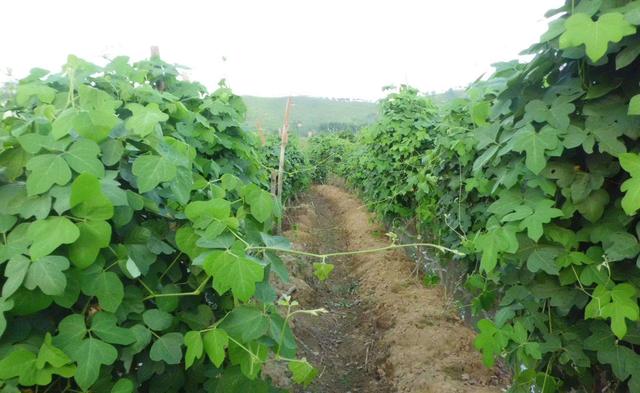
Five days after transplanting the seedlings, diluted human and livestock manure water may be appropriately applied to settle the roots, and inspections should be made carefully; dead seedlings found should be replanted in time. About one month after planting, when the seedlings grow to a height of 50 cm, insert trellises, placing between two rows a highly branched tree trellis or bamboo trellis 1.5-2.0 m tall (on sloping land, small branches may be laid between two rows or two rows), select one strong seedling to keep, remove the other weak seedlings, and guide the vines of two adjacent plants onto the trellis, thereby ensuring ventilation and light transmission and improving the photosynthetic efficiency of the arrowroot seedlings.
2. Topping, vine training and bud removal
This is an important measure to control the growth of the aboveground part of arrowroot, promote underground growth, and enable rapid formation of storage roots. When the main vine of the arrowroot seedling grows to about 1 m long, remove the top, keep 3-4 lateral vines, and prune the rest. The retained lateral vines should be evenly distributed. When they reach 1-1.5 m in length, top them and remove the lateral buds. After that, remove lateral buds about once every 15 days.
3. Fertilizer and water management
Fertilizer and water management is the key to ensuring high yield and good quality of arrowroot. Carry out the first topdressing 20 days after planting, applying 0.3-0.5% urea water. After that, apply 25-50 g of ternary compound fertilizer in holes every 1-2 months, gradually increasing the fertilization amount. On sunny days, flush and water it on; on rainy days, it may be applied in holes. For water management, keep the soil moist throughout the whole period. Arrowroot is drought-tolerant but not waterlogging-tolerant, so watering should be less in the early planting stage; it is better to keep it slightly dry than too wet, and accumulated water should be drained promptly after rain.
4. Pest and disease control
Arrowroot has relatively few pests and diseases throughout its life. Those that occasionally appear are mainly leaf spot disease, downy mildew, leaf blight, rust disease, leaf miners, scale insects, scarab beetles, red spiders, etc. For disease control, mancozeb, carbendazim sulfur suspension concentrate, thiophanate-methyl, triadimefon, etc. may be used; for pest control, pesticides such as trichlorfon, dichlorvos, cypermethrin, dicofol, etc. are mainly used.
5. Timely harvest
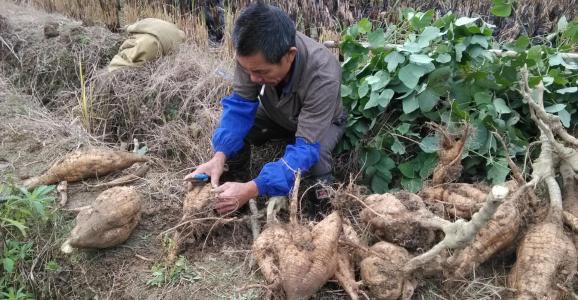
High-yield arrowroot can be planted and harvested in the same year, or harvested only after 2 years of planting. After late November, arrowroot begins to enter the mature stage. When most arrowroot leaves turn greenish-yellow and the leaves are relatively brittle and hard, with no further growth potential, choose a sunny day for harvest. During harvest, you can directly dig open the soil around the plant roots from cracks in the ground, expose the head of the storage roots, harvest the large ones and keep the small ones, and cut off the large storage roots from the base of the stem with a sharp knife, avoiding damage to other storage roots and fibrous roots kept for use. At the same time, apply some overwintering base fertilizer to lay the foundation for a bumper arrowroot harvest the following year, then level the soil. If harvesting is not completed in that year, it can be grown across years; in February of the following year, cut off old vines more than 0.5 m from the root crown and cultivate 3 lateral vines anew, so that the yield is higher and the quality is better. Arrowroot can be harvested continuously for 3-5 years after one planting.
Welcome to subscribe to and follow this Toutiao account. We share the latest agricultural planting techniques and agriculture-related information every day. You are welcome to share, forward and like. If you have good suggestions or planting techniques you would like to learn about, you are welcome to leave a message. We will select some of the issues everyone cares about most and invite agricultural technical experts to provide professional guidance and sharing.