Suitable Regions for Wasabi Cultivation and Key Technical Points for High-Yield Management
Suitable Regions for Wasabi Cultivation: Techniques for High-Yield Wasabi Cultivation and Management
1 Site Selection
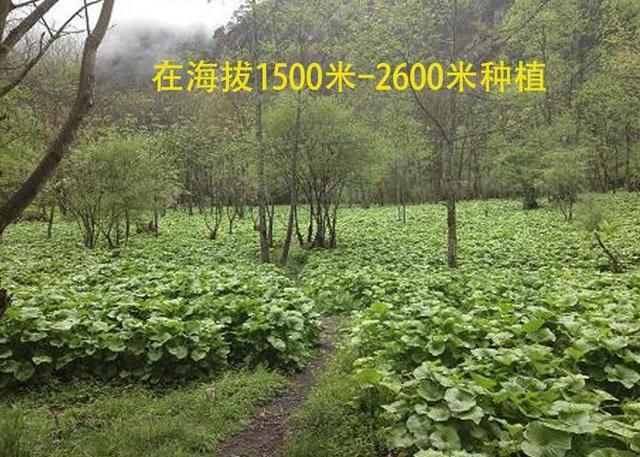
Choose an elevation between 1,500 and 2,600 m, a gently sloping gradient of 5°-15°, loose and fertile soil with a pH of 5.9-7.0, and a clean, adequate irrigation water source for growing wasabi in sandy loam soil.
2 Sowing and Seedling Raising
Wasabi can be sown locally from September to February of the following year. Sowing and raising seedlings in October results in rapid emergence, a high emergence rate, strong seedlings, and the ability to overwinter in the open field. If sowing in September when temperatures are high, shade structures are needed. When sowing from November to February of the following year, temperatures are low, so seedlings must be raised in plastic greenhouses or small arch sheds. Wasabi seeds lose viability very easily if they lose too much moisture, so they must be stored by low-temperature stratification. The seeds have a long dormancy period; before sowing, they need to be treated with 10 mg·L-1 of 6-BA or 75-100 mg·L-1 of GA3, and germinated at 15-20 °C, which can achieve a germination rate of over 70%. Once 50% of the seeds have germinated, germination can be stopped and they are ready for sowing. The thousand-grain weight of wasabi seeds is 8.8-9.4 g, and the seeding rate per 667 sq m of seedbed is 1.5 kg. Open shallow furrows for dibbling, with a plant spacing of 4 cm and a row spacing of 10 cm, sowing 2-3 seeds per hole; the seedbed should be about 10 m long and 1.2 m wide. Each 667 sq m of seedling-raising area can supply 1 hm2 (15 mu) of field for cultivation. Alternatively, plug tray seedling raising can be used, sowing 2 seeds per cell and covering with 0.5 cm of soil. Wasabi seeds are not drought-tolerant; once they dry out and lose water, they lose their germination ability, so water promptly after sowing to keep the soil moist. After 5-6 months, when the seedlings have 3-4 leaves and a plant height of 10-15 cm, they can be transplanted to the field.
Wasabi can also be propagated by tiller buds and roots, or by tissue-cultured plantlets. When propagating by tiller buds, at harvest time, remove the tiller bud shoots that have grown out from the rhizome and use them for propagation; however, tiller bud shoots easily carry pathogens (especially black heart disease), causing the spread of disease. When propagating by roots, at harvest time cut healthy, thick fibrous roots 5-10 cm long, and in autumn bury them shallowly in soil under cool forest (or under shade netting); after 4-6 months, the small plantlets can be planted in the field. Note that tiller buds and roots should be soaked in a 500-fold dilution of 70% carbendazim for 15 min for disinfection before propagation, to reduce the occurrence of disease.
3 Transplanting
3.1 Land Preparation, Fertilization, and Bed Making: Choose deep soil (cultivated layer over 30 cm) and fertile sandy loam for planting; wasabi should not be continuously cropped with cruciferous crops. Prepare the land 1 month before transplanting, deep plow 30 cm, and apply base fertilizer. Apply 2,000 kg of decomposed farmyard manure, 50 kg of superphosphate, 15 kg of potassium sulfate, 10 kg of urea, and 1 kg of boron fertilizer per 667 sq m. After deep plowing and mixing the fertilizer evenly into the soil, make beds following the slope from top to bottom, with a bed surface width of 70 cm, a furrow width of 40 cm, and a bed height of 40-45 cm. The bed direction must be sloped to avoid water, not horizontally blocking water, and certainly not running water along the direction. For plots with a slope greater than 25°, drainage ditches should be opened above the planting area to prevent mountain floods from scouring the planting area.
3.2 Transplanting: Wasabi can be transplanted from March to December, but spring (March-April) and autumn (September-October) are best. If transplanting is advanced to February, an arch shed must be added. When transplanting in high-temperature seasons, shade netting is needed for shading. The basic principle of wasabi planting is deep plowing and shallow planting, with a depth of 5 cm, roots not exposed, and soil covering not exceeding the growing point; water promptly after transplanting to settle the roots, and be careful not to wash the seedlings over. If the fibrous roots are too long, they can be shortened before planting. Plant 2 rows per bed with a plant spacing of 35-40 cm, in a triangular arrangement, planting about 3,500 plants per 667 sq m.
4 Field Management
4.1 Shading Management: Wasabi growth requires a cool environment; excessive light easily scorches, yellows, or burns the leaves, causing them to lose commercial value and affecting economic returns. Although summer temperatures in Gudui Township, Leibo County are not very high, the light is relatively strong, so shade structures made of wooden stakes, etc., should be used, covered with shade netting of 60%-70% shading rate for shading treatment. The wooden stakes are 2 m high, buried 20 cm deep, with a spacing of 3 m × 4 m being suitable; the stakes are connected vertically and horizontally with No. 10 iron wire, and both ends are fixed with guy lines to increase stability. Cement columns of 6 cm × 6 cm or steel pipes with a diameter of 3-5 cm can also be used. The shade structure should be extended east-west as much as possible, and in high-temperature seasons shade curtains should also be set up on the east and west sides. From November to March of the following year, no shading is needed.
4.2 Fertilizer and Water Management: About 40 d (days) after spring transplanting, carry out the first topdressing, applying 10-15 kg of urea per 667 sq m; 5 months after transplanting, i.e., September of that year, carry out the second fertilization, applying 50 kg of potassium sulfate compound fertilizer (N-P-K 15-15-15, same below) per 667 sq m; after harvesting flower stalks in March of the following year, carry out the third fertilization, applying 30 kg of potassium sulfate compound fertilizer per 667 sq m; in May carry out the fourth fertilization, applying 50 kg of potassium sulfate compound fertilizer per 667 sq m, and in September the whole plant can be harvested. During the rhizome swelling and formation period, spray 0.2%-0.4% monopotassium phosphate 2-3 times to promote rhizome swelling.
After autumn transplanting, no fertilizer is applied that year. In March-April of the following year, carry out the first fertilization, applying 50 kg of potassium sulfate compound fertilizer per 667 sq m, and remove a small number of flower stalks; in May, if leaves are harvested, carry out the second fertilization, applying 30 kg of potassium sulfate compound fertilizer per 667 sq m; in September carry out the third fertilization, applying 20 kg of potassium sulfate compound fertilizer per 667 sq m; in March of the third year carry out the fourth fertilization, applying 50 kg of potassium sulfate compound fertilizer per 667 sq m, and harvest in May or delay until late August for harvest. When fertilizing, note that the fertilizer must be 10 cm away from the rhizome to prevent scorching the rhizome and causing black spots. Weak seedlings can appropriately increase the number of fertilizer applications to regulate their growth balance.
During the wasabi growth period, weeds easily grow on the ground, so manual weeding should be done 3-4 times per year. Pay attention to watering to keep the soil moist, preserve soil moisture in the dry season, and prevent flooding and drainage in the rainy season.
4.3 Disease Control: The main fungal diseases of wasabi include black heart disease, downy mildew, white rust, clubroot, and stem rot, among others; the main bacterial disease is soft rot. In addition, a comprehensive symptom of internal black rot of the tuber caused jointly by bacteria (soft rot bacteria) and fungi (black heart disease fungi) is also prone to occur.
Disease control must adhere to prevention first, integrated control, and rational and scientific use of chemical agents. First, do a good job of seed source control: do not buy seedlings from diseased areas, choose disease-resistant varieties, and do a good job of disease prevention at the seedling stage. Change the traditional wasabi seedling propagation method, promote tissue-cultured seedling propagation methods, cultivate healthy seedlings, and establish disease-free seedling propagation areas and production areas. Cultivation plots should preferably be chosen where summer temperatures do not exceed 28 °C, soil water-holding capacity is high, and there is a slope. Promptly remove lower leaves and diseased plant residues of wasabi. Promptly dig out diseased plants, and seal diseased holes with lime or agents such as chlorothalonil, carbendazim, and thiophanate-methyl. Avoid continuous cropping as much as possible; it is preferable to rotate with gramineous and leguminous crops; or interplant smooth vetch 6-8 months after wasabi transplanting, and after the smooth vetch reaches full bloom, pull it out and mulch it in place on the bed surface to improve the wasabi micro-ecological environment; or implement a fallow system.
5 Harvesting
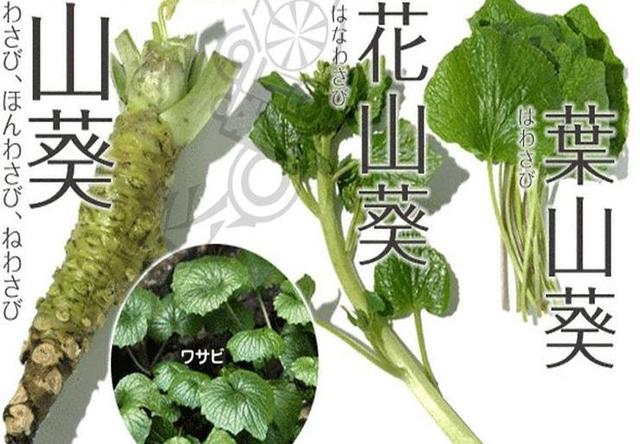
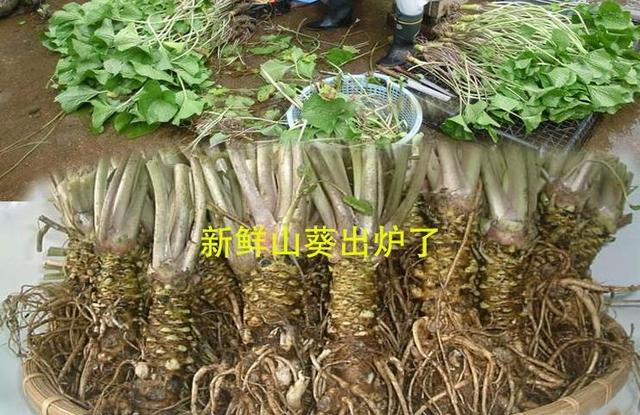
The harvesting period for wasabi flower stalks is best in March each year; when the stalks are 8-12 cm long, pick them and tie them in bundles for sale. Leaf harvesting is mainly in May each year, with September as a supplement; at harvest, cut off healthy, disease-free leaves with petioles longer than 20 cm together with the petioles, and tie them in bundles for sale according to petiole thickness. Rhizomes are harvested after 18 months of growth; dig out the whole wasabi plant, separate individual plants, retain a petiole length of 2 cm, and trim off fine roots. After washing the rhizomes, grade them by 20-30 g, 30-50 g, 50-70 g, and greater than 70 g, and pack them in boxes for sale.