Ridge planting of peanuts changes the planting method and has a significant impact on soil structure and growth.
In high mountains, sowing is done by digging furrows or holes, which is mainly suitable for some fields with uneven terrain and incomplete watering conditions. Ridge planting is a planting method accepted for medium-grade and fertile-water land in the south, and is carried out in fields with flat terrain, deep soil layers, and complete drainage and irrigation conditions. In places like Southwest China, Hebei, and Shandong, ridge planting is mostly adopted. Ridge planting of peanuts changes the planting method and has had a significant impact on soil structure and peanut growth, with an obvious yield-increasing effect. In recent years, ridge planting has gradually become more common in Henan.
I. Ridge planting mainly has the following advantages:
1) It increases the light-receiving surface and raises soil temperature: after ridging, the ground surface receives light on three sides, which raises soil temperature and benefits peanut germination as well as peg penetration into the soil and pod development. According to experimental measurements, the average ground temperature for ridge-planted peanuts increases by 1.7°C, seedlings emerge 2-3 days earlier, the accumulated temperature during the seedling stage increases by 36-57°C, and seedlings grow robustly;
2) It thickens the active soil layer, which benefits pegging and pod expansion: peanuts flower above ground and form pods underground. Their pegs enter the soil, pods expand, roots develop, and rhizobia reproduce and fix nitrogen, all of which require a loose soil environment;
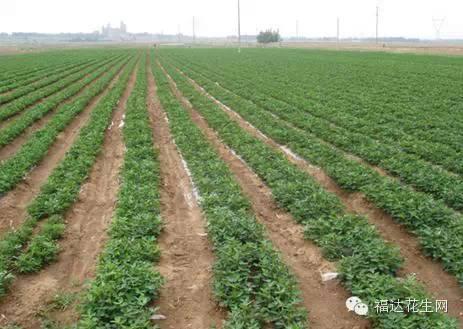
3) It facilitates light penetration and ventilation in the field and increases yield and quality: peanuts are a light-loving crop. Ridge planting provides good ventilation and light penetration in the field, effectively improving the field microclimate, reducing the occurrence and risk of pests and diseases. It maximizes the edge advantage of peanuts, enhances peanut vigor, and achieves the goals of more pods, fuller pods, increased yield, and improved quality;
4) It increases fertilizer use efficiency (in high mountains, fertilizer is mostly broadcast, while ridge planting allows mostly banded application), benefits drainage and irrigation, and benefits routine management and sowing.
II. Ridge planting ridge data
Large-ridge double-row is currently a relatively popular planting pattern. Fuda Peanut High-Yield Center believes that the general ridge spacing is 80-90 cm, ridge surface width is 50-60 cm, 2 rows are sown on the ridge, the small row spacing on the ridge is 30-40 cm, hill spacing is 13.5-18 cm, and 8500-11000 hills are sown per mu, with two seeds per hill. At present, some areas in Henan also have ridge spacing around 75. In short, according to local conditions, achieve a reasonable density so that plants do not lodge in fertile fields and can close the rows in thin fields.
III. Precautions recommended by Fuda Peanut Network for peanut ridge planting:
1) Ridge formation with sufficient soil moisture: there should be sufficient soil moisture when forming ridges. In drought, soil moisture should first be created before ridging;
2) The distance from the peanut rows to the edge of the ridge should be kept at at least 10 cm to ensure there is enough soil around for pegging when peanuts flower;
3) For peanuts that need film removal, closely monitor the temperature at emergence and the time of soil penetration to prevent burning the seedlings. There are now also integrated machines for sowing and mulching plus covering soil on the film, which do not require film removal.