What medicinal herbs are profitable to plant on contracted land in 2018? These varieties are recommended
1 Achyranthes bidentata
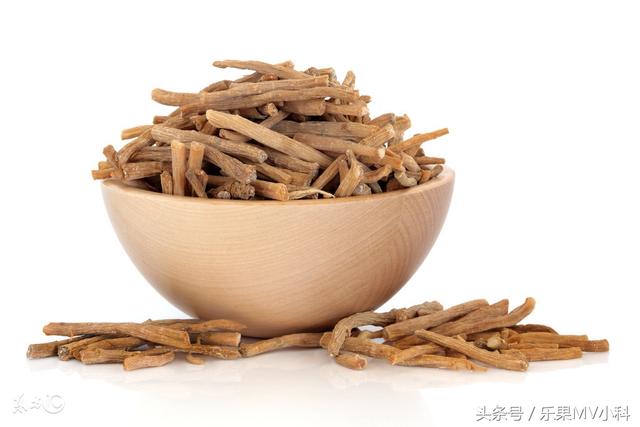
It likes a mild climate and cannot tolerate severe cold; growth is slow at low temperatures, but it grows faster in the north where temperature differences are large. Achyranthes bidentata is suitable for cultivation in sunny, relatively dry sandy loam with deep soil and good drainage, so the roots grow long and yields are high. When planted in clay soil, the main root is short and there are many lateral roots, which affects quality. Achyranthes bidentata is a herbaceous plant of the genus Achyranthes in the Amaranthaceae family, 70-120 cm tall, with a cylindrical root 5-10 mm in diameter, earth-yellow in color. The stem is angular or quadrangular, green or tinged with purple, covered with white appressed or spreading soft hairs, or nearly hairless, with opposite branching. The leaves are elliptical or elliptically lanceolate, a few oblanceolate, with a wedge-shaped or broadly wedge-shaped base, and appressed or spreading soft hairs on both surfaces. The apex of the staminodes is flat and round, with slightly notched fine serrations. The utricle is oblong, yellow-brown, and smooth. The seeds are oblong, yellow-brown. The flowering period is July to September, and the fruiting period is September to October. The root is used as medicine, used fresh or raw, to invigorate the blood and free the meridians.
2 Licorice
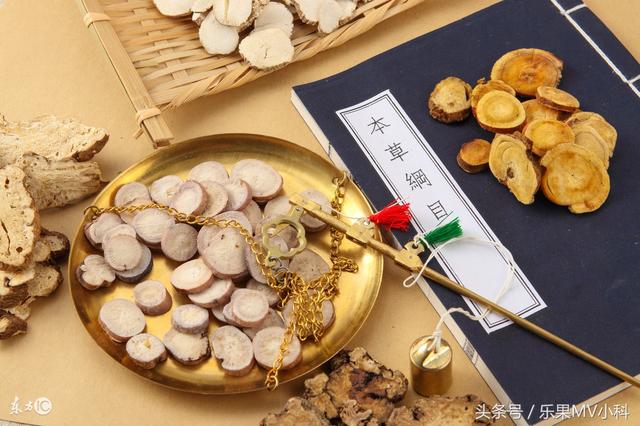
Also known as Guolao, sweet herb, Ural licorice, sweet root, etc., it is the dried root and rhizome of the legumes licorice, inflated licorice, or smooth licorice, distributed in Northeast China, North China, Shaanxi, Gansu, Qinghai, Xinjiang, Shandong, and other places. Licorice has the characteristics of liking light, tolerating drought, heat, salt and alkali, and cold. Inner Mongolia and Xinjiang are especially suitable. Licorice has the effects of tonifying the spleen and replenishing qi, clearing heat and detoxifying, resolving phlegm and relieving cough, relieving acute pain, and harmonizing various medicines. It is often used for weak spleen and stomach, fatigue and lack of strength, palpitations and shortness of breath, cough with excessive phlegm, abdominal and limb spasm pain, carbuncles and sores, and to reduce the toxicity and harshness of medicines. Also known as Guolao, sweet herb, Ural licorice, sweet root, etc., it is the dried root and rhizome of the legumes licorice, inflated licorice, or smooth licorice, distributed in Northeast China, North China, Shaanxi, Gansu, Qinghai, Xinjiang, Shandong, and other places. It has the effects of tonifying the spleen and replenishing qi, clearing heat and detoxifying, resolving phlegm and relieving cough, relieving acute pain, and harmonizing various medicines. It is often used for weak spleen and stomach, fatigue and lack of strength, palpitations and shortness of breath, cough with excessive phlegm, abdominal and limb spasm pain, carbuncles and sores, and to reduce the toxicity and harshness of medicines.
3 Isatis root
It is a common Chinese medicinal material, the dried root of the cruciferous plant woad. Isatis root has no strict requirements for soil; generally sandy soil or slightly alkaline soil can be used for planting, and it can adapt to soil with a pH of 6.5-8. Isatis root is a herbaceous plant that is resistant to fertilizer and has a relatively strong preference for fertilizer; fertile soil with deep soil layers is a necessary condition for the growth and development of Isatis root. Low-lying land that easily accumulates water and heavy, sticky soil are not suitable for planting. Isatis root is divided into northern Isatis root and southern Isatis root. Northern Isatis root comes from the root of the cruciferous plant woad, while southern Isatis root is the rhizome and root of the acanthaceous plant Strobilanthes cusia. It is cold in nature and tastes slightly sweet at first and then bitter and astringent. It has the effects of clearing heat and detoxifying, preventing colds, and soothing the throat, and is mainly used to treat diseases such as warm toxin macules, dark purple tongue, and rotting throat and scarlet fever.
4 Schizonepeta

It is one of the commonly used Chinese herbal medicines and has broad market prospects; cultivation requires little investment and produces quick results, making it a good project for farmer friends to become prosperous. Also known as fragrant schizonepeta, xianji, four-angled stalk artemisia, false perilla, etc., it is a plant of the genus Schizonepeta in the Lamiaceae family. The stem is strong, woody at the base, much branched, 40-150 cm tall, nearly quadrangular at the base, obtusely quadrangular above, with shallow grooves, covered with white short soft hairs. Its dried stems, leaves, and flower spikes are used as medicine. The fresh tender sprouts are best for calming children. Schizonepeta leaves are yellow-green, the stem is square and slightly purple, the cross-section is yellow-white, and the spikes are slightly dark purple and yellow-green. The taste is mild, the nature is warm, it is non-toxic, and it has a strong clear fragrance. Schizonepeta is a diaphoretic and antipyretic medicine and is one of the commonly used Chinese herbal medicines. It can calm phlegm, dispel wind, and cool the blood, and treats influenza, headache with chills and fever and sweating, and vomiting.
5 Chrysanthemum
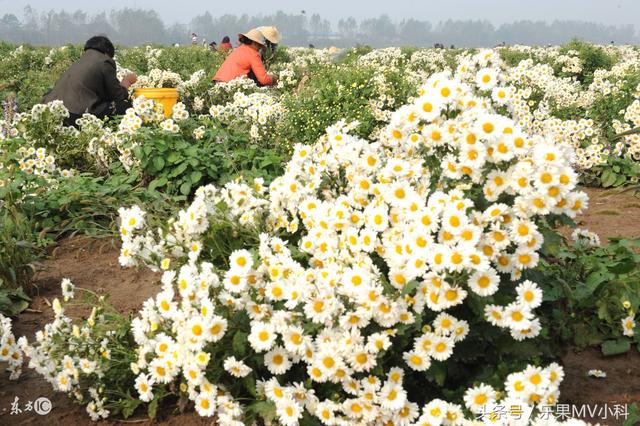
It can bloom earlier under short-day conditions. It likes cool conditions and is relatively cold-tolerant. The suitable growth temperature is 18-21°C. The underground rhizome is drought-tolerant and most avoids waterlogging. It likes high terrain, deep soil, rich in humus, loose and fertile, and well-drained soil. It can grow in soil from slightly acidic to slightly alkaline. It is the dried flower head of a plant in the Asteraceae family, mainly produced in Zhejiang, Anhui, Henan, and other places. From September to November, when the flowers are in full bloom, harvest in batches, dry in the shade or roast dry, or dry in the sun after smoking or steaming, and use raw. According to different producing areas and processing methods, the medicinal material is divided into "Bozhou chrysanthemum", "Chuzhou chrysanthemum", "tribute chrysanthemum", "Hangzhou chrysanthemum", etc. Because the flower colors also differ, it is further divided into yellow chrysanthemum and white chrysanthemum.