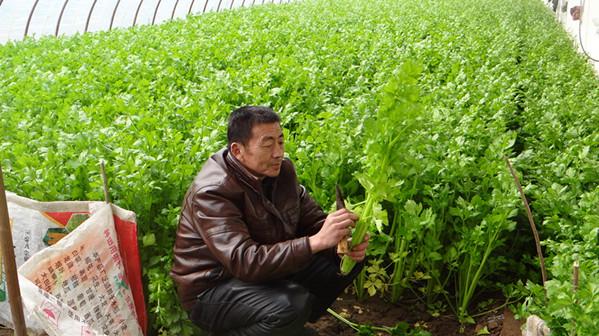
How to grow celery in a greenhouse? An old farmer teaches you the key points of planting and cultivation techniques

Click to follow us, we update agricultural planting techniques every day to help you achieve high yields and get rich. Please click here to enter the image description.
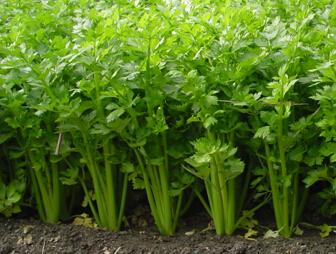
1. Environmental requirements
1. Temperature
Celery originates from the Mediterranean coast. It is an Apiaceae vegetable with a shallow root system, and it prefers a cool and mild climate. The suitable temperature for seed germination is 18-25°C, the minimum temperature is 4-6°C, the room temperature during the seedling stage is 15-20°C, and the maximum temperature is 30°C.
2. Light
Low temperature and long daylight can promote flower bud differentiation at the shoot apex. High temperature deteriorates the quality of celery. Therefore, celery is suitable for cultivation in a protected environment.
3. Moisture
The celery root system is shallowly distributed, mostly around 12-18 cm, so it is not tolerant of drought and needs moist soil and air.
4. Soil
Celery is suitable for loam or clay loam rich in organic matter, with strong water retention and fertilizer retention capacity.
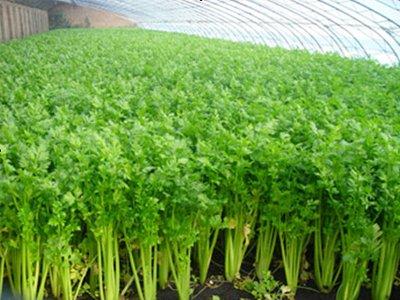
2. Land selection and sowing
Choose a leeward and sunny seedbed site with fertile soil and strong water and fertilizer retention capacity, using loam or clay loam. Water thoroughly before sowing, and sow after the water has infiltrated. To sow the seeds evenly, mix in fine soil or fine sand. After sowing, cover with 0.3-0.5 cm of fine soil. For local celery, raise seedlings with 100-150 grams per mu; for western celery, raise seedlings with 25-50 grams per mu.
3. Seedling stage management
After sowing, keep the soil moist. A temperature of 15-18°C is appropriate. Thin and transplant seedlings appropriately. When the seedlings grow to 3-4 leaves, apply 10 grams of urea per square meter to promote seedling growth. The seedling age is 50-70 days.
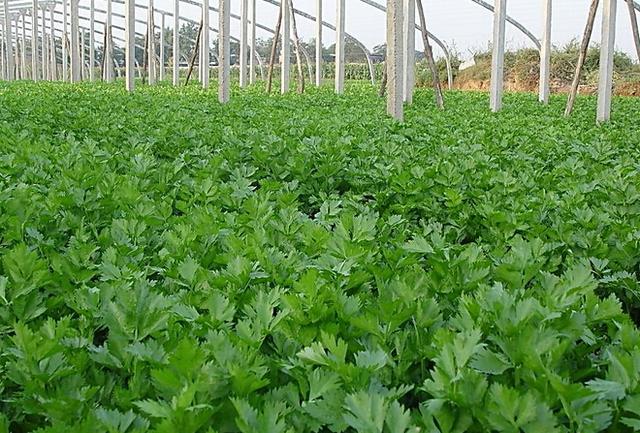
4. Transplanting
1. Land preparation and fertilization
Pay attention to crop rotation. After the current crop is harvested, plow or deeply dig the soil to a depth of 20-25 cm, and clean the field. Apply 4000-5000 kg of farmyard manure, 50-60 kg of superphosphate, 25-30 kg of potassium sulfate, and 0.5-1 kg of borax per mu. Incorporate them into the soil as base fertilizer while preparing the land. Generally, make high beds.
2. Timely transplanting
Local celery is suitable for close planting, with a plant spacing and row spacing of 10-16 cm, and 2-3 plants per hole; western celery has a plant spacing and row spacing of 25-30 cm, with one plant per hole.
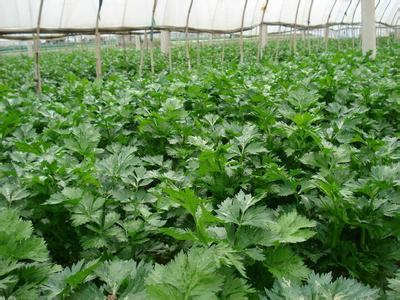
5. Field management
1. Fertilizer and water management
After transplanting, water thoroughly to settle the roots, then water several times continuously to help the seedlings recover, keeping the soil moist. After the seedlings recover, apply timely topdressing together with watering. Each time, use 10-15 kg of urea per mu and 20 kg of phosphorus-potassium compound fertilizer diluted in water to irrigate the field, for a total of 2-3 times. Stop topdressing and spraying 20 days before harvest.
2. Intertillage and weeding
Weed promptly before the plants close the rows, carry out shallow intertillage, and earth up to prevent lodging.
3. Temperature management
Celery prefers a mild and cool climate. It is not tolerant of high temperature and is also afraid of frost. Adjust the temperature inside the greenhouse according to the climate.
6. Pest and disease control
1. Physical control: use insect-proof nets and yellow sticky boards for trapping and killing.
2. To control late blight, brown spot, sclerotinia, and other diseases, use 37% difenoconazole 6 grams per mu, or 75% chlorothalonil 100 grams per mu diluted in water for spraying, once every 8-10 days, alternating use.
3. To control soft rot, use 72% agricultural streptomycin, or 3000-4000 times of new streptomycin, or 500-600 times of DT wettable powder, alternating use, once every 7-10 days.
4. To control aphids and leafminers, use 50% pirimicarb wettable powder 2000 times solution, or 70% cyromazine 5000-8000 times, or 1.8% abamectin 50 ml per mu, sprayed for control.
7. Harvest
When celery reaches 60-100 cm tall and has about 10 leaves, it can be harvested.
Welcome to subscribe to and follow this Toutiao account. We share the latest agricultural planting techniques and agriculture-related information every day. You are welcome to share, forward, and like. If you have good suggestions or planting techniques you would like to learn about, you are welcome to leave a message. We will select some of the issues that everyone is most concerned about and invite agricultural technical experts to provide professional guidance and sharing.