11 major advantages of dental implants: experts explain the differences between dental implants and natural teeth
Recently, a patient said: the dental implant I had done two years ago feels more comfortable to use than my own natural teeth, and now I plan to have another one of my bad teeth pulled and replaced with an implant.
Reading this, many people are puzzled: why do dental implants feel more comfortable to use than other types of dental restorations?
Dental implants are known as humanity's third set of teeth after deciduous teeth and permanent teeth, and in recent years they have become popular worldwide. So far, dental implants are the closest thing to natural teeth among all dentures, mainly because a dental implant has an artificial tooth root.
Are dental implants really the same as natural teeth? What benefits do they offer to our oral cavity and facial appearance? What are the differences between dental implants and natural teeth?
Today we have invited Gu Hongxia from Zhengzhou Little Elf Dental Clinic to tell us about the differences between dental implants and natural teeth.
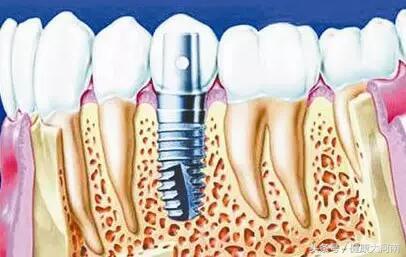
What benefits do dental implants offer to our oral tissues and facial appearance?
1. They can slow down alveolar bone resorption.
When teeth are present, alveolar bone resorption generally does not occur often, but after tooth loss, alveolar bone resorption accelerates rapidly. At this point, wearing ordinary dentures (especially ill-fitting ones) increases the burden on the alveolar bone, making resorption proceed even faster, and the dentures must be replaced every few years. In contrast, because artificial dental implants are similar to our natural teeth, they make our alveolar bone more firm and reduce resorption.
2. They do not damage other teeth.
Because artificial dental implants are placed independently, they do not require the neighboring teeth to bear any force, so they have no adverse effect on the surrounding teeth.
3. They restore chewing power.
If we take the maximum bite force of our healthy natural teeth as 100, ordinary dentures can restore only 10 to 20 of that force, while artificial dental implants can exert 80 to 90. So dental implants can restore our normal bite force.
4. They restore the feel of chewing.
Because ordinary dentures rest on top of the gums, food can hardly come into contact with our oral cavity, which not only greatly reduces chewing power but also reduces the feel. Artificial dental implants, however, are stabilized by the alveolar bone, similar to our natural teeth, so they do not affect our feel.
5. They cause little damage to the gums.
Wearing dentures often leads to oral ulcers and the like, but using artificial dental implants reduces this phenomenon.
6. There is no foreign-body sensation.
Patients who have worn ordinary dentures all know that dentures produce a strong foreign-body sensation, but artificial dental implants do not.
7. They can maintain the connections between teeth, giving a person a complete dental arch.
8. They maintain a natural and beautiful appearance.
We all know that after tooth loss, especially the loss of most teeth, the face tends to look very aged. Even if missing teeth are restored with dentures, the expression is still unnatural. But artificial dental implants, like natural teeth, can maintain a natural appearance very well.
9. They provide psychological security.
Mainly, with artificial dental implants there is no need to worry about strange sounds when speaking or eating.
10. They do not cause pronunciation problems.
Dentures wobble in the mouth and are too bulky, which can cause difficulty in pronunciation.

Dental implants have so many benefits, so what are the differences between them and natural teeth?
The first point: dental implants form a rigid connection with the alveolar bone through osseointegration, while natural teeth are suspended in the alveolar bone by the fibrous ligaments in the periodontal membrane. This structure of natural teeth avoids a rigid connection between the tooth and the alveolar bone and can buffer strong bite forces.
The second point: dental implants have no periodontal membrane, while the periodontal membrane contains nerve receptors that can sense the size of the bite force. When the bite force is too great, natural teeth will feel uncomfortable or painful and will actively avoid it, but dental implants do not have this function. Although dental implants can restore 100 percent of the chewing function of natural teeth, because they lack nerve receptors, when chewing you cannot tell how much force you are using, and it is easy to cause long-term overload.
The third point: dental implants do not move in the jawbone, while natural teeth move throughout life in the jawbone, mainly moving forward. When the proximal surfaces of teeth wear down, this movement of the teeth can prevent gaps from appearing between two adjacent teeth. But dental implants cannot do this. What problem does this cause? In a short time there should not be a big problem, but over a long time, if the positions of the natural teeth shift while the position of the dental implant does not, then a gap will appear between the dental implant and the natural teeth, causing food impaction.
The fourth point: dental implants have no hard tooth tissue, so there will be no diseases such as tooth decay or pulpitis, and no pain from the dental pulp nerve.
The fifth point: the neck of the implant is generally narrower than that of a natural tooth, especially for posterior teeth, so an interdental brush is generally needed for cleaning to prevent peri-implantitis.
Dental implants are hailed as humanity's third set of teeth
That is right. So far, no other restoration method can compare with dental implants; no other restoration method can rival dental implants in terms of comfort, aesthetics, function, protection of the remaining teeth, and prevention of alveolar bone atrophy.
However, no matter how technology develops in the future, teeth that are implanted (or grown) can never be exactly the same as the teeth we first erupted. Therefore, we all need to cherish our first and second sets of teeth. Paying attention to oral hygiene and health care and preventing dental disease is the best approach; prevention is always greater than treatment.

Gu Hongxia
Section Chief of the Dental Implant and Aesthetic Restoration Department at Zhengzhou Little Elf Dental Clinic