Which saplings and trees are suitable for planting in a large courtyard? Recommended courtyard tree and sapling varieties
I've found some trees and saplings that can be planted in courtyards and will introduce them to you, so you can see whether you can plant some in your own small yard too.
Palm.
The palm tree is an evergreen tree of the palm genus. Its trunk is cylindrical, often retaining old leaf stalks and the leaf bases below them. It is native to China, and apart from Tibet it is distributed throughout the regions of China south of the Qinling Mountains. It is often used in courtyards, along roadsides and in flower beds, and is suitable for viewing in all four seasons. Its wood can be made into utensils, its leaves can be made into fans, hats and other handicrafts, and its roots are used as medicine.
Sophora japonica (Japanese pagoda tree).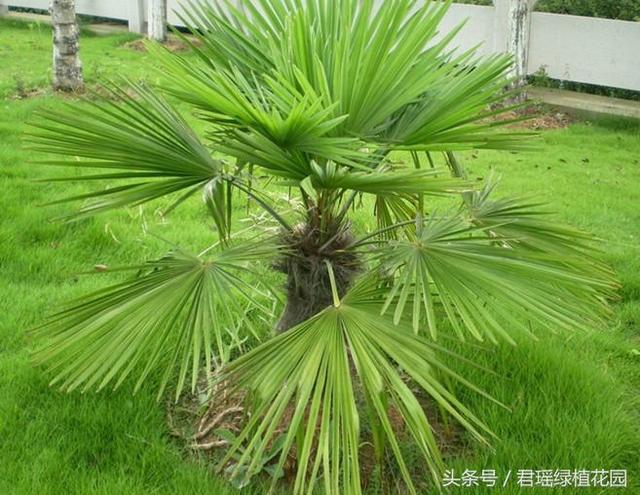
The Sophora japonica tree is tall in form, light-loving, deep-rooted and fast-growing. Its pinnate compound leaves resemble those of the black locust, but the leaves of the black locust are slightly transparent. The flowers of Sophora japonica are white, can be cooked and eaten, and can also be used as Chinese medicine or dye. Its pod differs from those of other leguminous plants: the flesh is gelatinous and contracts between the seeds, forming a bead-like shape, commonly known as "huaimi," which is also a kind of Chinese medicine. Sophora japonica blooms in late summer, unlike other tree species, so it is an important nectar source plant.
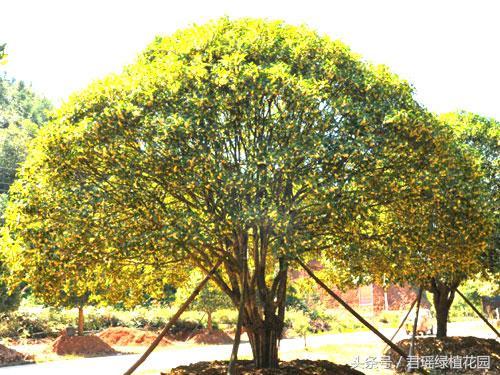
Osmanthus tree.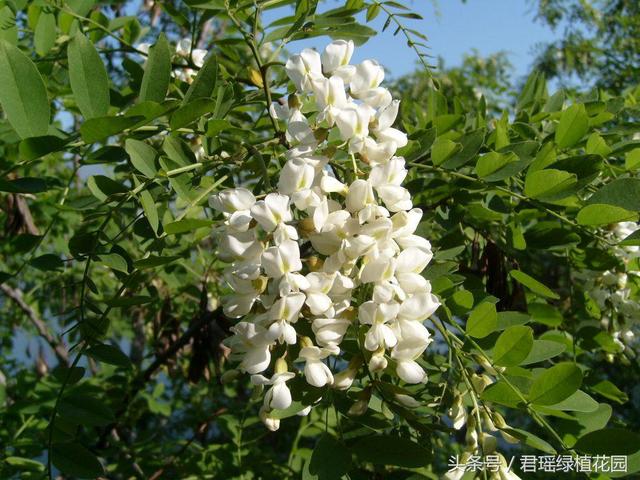
An evergreen shrub or tree of the Oleaceae family, reaching up to 18 m in height; the bark is grayish-brown. The leaves are leathery, elliptical, long-elliptical or elliptic-lanceolate, with fine serrations on the upper half, hairless on both sides, and the petiole can reach up to 15 cm long, hairless. The cymose inflorescences cluster in the leaf axils, the bracts are broadly ovate, the pedicels are slender and weak, and the flowers are extremely fragrant; the corolla is yellow-white, pale yellow, yellow or orange-red, the filaments are extremely short, and the fruit is skewed, elliptical and purple-black. It blooms from September to October and fruits in March of the following year.
Banyan tree。
A large tree, 15-25 m tall, with a diameter at breast height of up to 50 cm and a widely spreading crown; old trees often have rusty-brown aerial roots. The bark is dark gray. The leaves are thinly leathery, narrowly elliptical, dark green and glossy on the surface, with entire margins. The figs are borne in pairs in the leaf axils or in the leaf axils of branches that have already lost their leaves; when mature they are yellow or slightly red, oblate, with 3 basal bracts, broadly ovate and persistent; male flowers, female flowers and gall flowers all grow within one fig, with a few short bristles between the flowers; the tepals number 3, broadly ovate, the style is nearly lateral, and the stigma is short and club-shaped. The achene is ovate. The flowering period is from May to June.
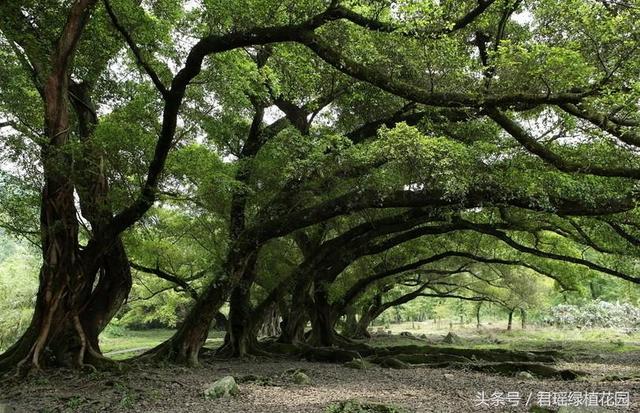 Quite a nice large courtyard tree, right? A small yard won't do though.