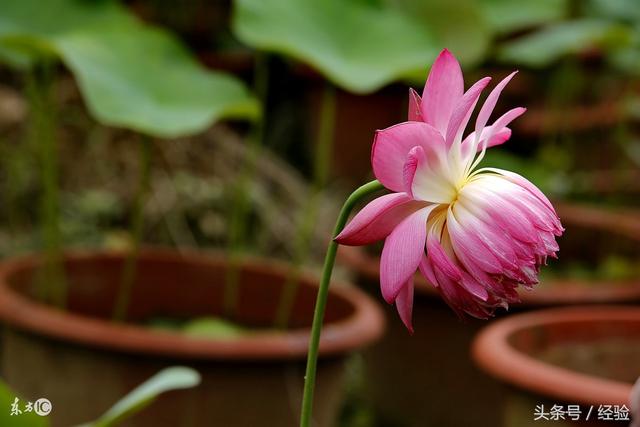
How to Grow Ornamental Lotus in Pots? A Detailed Guide to Planting Techniques
1. Pot selection: Small lotus varieties are planted in pots (caliber 26 cm, height 20 cm); medium lotus varieties use pots (caliber 30 cm, height 21-26 cm); large lotus varieties need pots with a caliber of 36 cm or more; do not use pointed-bottom pots. For placement in courtyards or institutions, high-grade ceramic pots may be chosen; when building ornamental lotus scenic areas or bases, pots, vats, ponds, pools and lakes should be used together to enhance one another's beauty; for industrial production of large quantities of commercial potted lotus for market sale, attractive, lightweight and inexpensive plastic flower pots should be chosen, with the bottom holes sealed with cement, and a height and diameter range of 26-36 cm. For first-time cultivation, the pot caliber should be larger to encourage early blooming, more blooms and the development of seed lotus rhizomes. Only after gaining some experience should small and miniature pot cultivation be attempted (caliber 12-18 cm).
2. Soil preparation (except for soilless cultivation): Vegetable garden soil, farmland soil, and unpolluted river and pond mud in which fish and grass can grow are all suitable. Add half a pot of soil per pot, soak in clean water and set aside for use. Do not fertilize. Never use chemically polluted mud or sewage sludge.
3. Timing: When the temperature exceeds 15°C, the lotus terminal buds begin to sprout; above 20°C they grow rapidly. In southern regions, cultivation can be done in early March; in northern regions, in late April.
4. Planting: Place the seed lotus rhizome flat or with the tip angled downward and bury it 8-16 cm into the mud. Adjust flexibly according to the size of the rhizome, planting only one per pot. Add water to 3-6 cm above the mud. If the temperature is on the low side, the "plastic film covering method" summarized by Liujia Garden can be used: cover at night, uncover at noon, which is safe and simple and produces uniform sprouting.
5. Fertilizing: Do not fertilize at initial planting. After the standing leaves emerge from the water, if the leaf color turns yellow, a small amount of soaked plant cake fertilizer liquid or phosphorus-potassium compound chemical fertilizer may be applied as a top dressing, with imported diammonium phosphate being best, 10-16 granules per pot each time, at intervals of 2-3 weeks. Different varieties have different tolerance to fertilizer, so fertilizer should be applied dilute and frequently; experiment first, then promote. Do not apply urea before flowering. Fertilizing principles: rather less than more, less first and more later, more phosphorus and potassium and less nitrogen.
6. Management: Potted lotus must be placed in a ventilated, sunny location. 1800-2200 pots can be placed per mu, preferably in double rows running north-south, with 80-90 cm wide walkways left on both sides. Planted in April, buds appear successively in late May, and the full bloom period begins in early to mid-June, when commercial potted lotus can be brought to market in flower, selling for 30-100 yuan. Late-flowering varieties or those replanted a second time can bloom until early October. The lotus emerges from mud unstained, and generally has no pests or diseases, but in poorly ventilated areas or near vegetables or orchards, it is prone to aphid infection early on; a small amount of washing powder plus Decis 1000-fold solution can be sprayed for contact killing. Moss in the pot can be removed by hand, or copper sulfate and quicklime in a 1:1 ratio diluted 200-fold with water can be poured along the pot edge, avoiding contact with the lotus leaves. Experiment first, then promote.
The lotus has new shoots and old leaves together, and buds, flowers and fruits coexisting, so leaf, flower and fruit viewing lasts more than 6 months. After flowering, new underground rhizomes form (2-3 per pot), and the leaves yellow and wither, which is natural senescence; keep shallow water, and after winter begins cut away the withered lotus. In areas south of the Yangtze River, the original pots can overwinter outdoors; in the Huang-Huai region, cover with double-layer plastic film; in the Northeast and Northwest regions, bury the original pots below the frozen soil layer and cover with plastic film, with the temperature inside the pots during the overwintering dormancy period kept at 3-10°C. After spring warms, repot, divide and replant.
7. Second replanting: During the growing period from June to August, repot on rainy days. Divide and plant the lotus runners bearing terminal buds or lateral buds; this can increase the propagation coefficient, make the plant shape shorter, extend the flowering period, and enable potted lotus to bloom in a second season, a third season...
8. Winter lotus: The winter lotus is a new variety relatively tolerant of low temperatures selected by our garden from hundreds of lotus varieties. The first planting is in April, flowering in June-July. The second is in mid-to-late August, when new rhizomes are repotted and divided, replacing the pot soil, with 2 planted per pot. In late September it enters a solar greenhouse, kept warm above 20°C. On rainy and snowy days, lighting is strengthened (with fluorescent lamps), and it blooms from November to the Spring Festival.