No Effect from Pesticides Means They're Fake? Actually, You Just Didn't Get These Three Things Right
Cai Xiaomei's Introduction
Some people say that many pesticides have no effect after being sprayed, and some even blame "good pesticides" as "fake pesticides" because of poor efficacy.Pretending to understand when you don't is truly pitiful! Why do others get results after spraying while you don't? It's simply because they're smarter than you and have mastered the following three key points!
I. Choosing Pesticides
1. Choose the right and good pesticide
The factors that affect pesticide efficacy are not only related to the pesticide's composition, but also have a great deal to do with the pesticide's physical and chemical properties, formulation, and the additives added during processing.
There will be differences in efficacy among pesticides with different compositions, pesticides with the same composition and same formulation but different concentrations, and pesticides with the same composition and same concentration but different formulations. Moreover, different companies have different production capabilities, so the efficacy they exhibit will naturally differ as well!
So how do you choose?
First, rely on experience(your own and others' experience with pesticide use); second, rely on consultation(ask agricultural technicians and experienced people more); third, rely on judgment(judge whether others' suggestions can be adopted? Figure it out and judge for yourself)!
2. Choose the right pesticide for the disease and the pest
If preventing disease:
First, you must identify the disease before applying the pesticide,know what disease should be treated with what pesticide, do not use pesticides indiscriminately, clearly distinguish fungal diseases from bacterial diseases, and use different pesticides accordingly;
Second, you must rotate pesticides, do not just keep using the same agent, and you should pay attention torotating and alternating different pesticides。
If preventing pests:
First, you must match the pesticide to the pest,know what pest should be treated with what pesticide, and also target adults, eggs, larvae or nymphs, so as to reduce pest sources;
Second, you must rotate pesticides. Pests generally have high resistance, so do not just use a single agent. You shouldpay attention to rotating and alternating different pesticides, and you can also mix pesticides to increase control efficacy。
II. Choosing the Spraying Environment
1. Determine based on temperature changes
Whether plants, pests or pathogens, they all have a suitable temperature range for activity, roughly 20-30°C, with 25°C being the best. Spraying at this time is not only safe for the crops, but also effective against pests, diseases and weeds in their active period.
For examplein hot weather, you should spray before 10 AM and after 4 PM.
For examplein cool weather, you should spray after 10 AM and before 2 PM.
For examplein greenhouses in winter and spring, it is best to spray in the morning on warm and sunny days.
2. Determine based on humidity changes
The process of the spray liquid depositing on pests and diseases and spreading into an even film is affected by many aspects, and air humidity has a great influence.
For examplewhen air humidity is too high, the deposited spray liquid will become larger droplets, and under the secondary influence of gravity, will deposit onto the lower part of the plant, thereby causing phytotoxicity.
For examplewhen air humidity is too low, the spray liquid evaporates easily, resulting in less pesticide reaching the target, thereby reducing efficacy, and in severe cases causing scorch-like phytotoxicity spots.
(Dafengshou Cai Xiaomei's summary:The spraying environment should be kept ventilated.
For open-field vegetables, you can appropriately prune some leaves and branches of the plants to maintain ventilation in the field;
For greenhouse vegetables, if spraying in the morning, choose to spray after the greenhouse has been uncovered and ventilated for a period; if spraying in the afternoon, choose to spray half an hour or one hour before closing the vents.)
3. Determine based on the characteristics of pests and diseases
For pests:
For example, to controlwhiteflies(which fly away at the slightest touch), spray in the morning when the dew has not yet dried; to controlflower thrips, spray in the morning when flowers open; to controlleaf thrips, spray in the evening or at night, etc.
For diseases:
For example, to controlanthracnose, powdery mildew, phytophthora blight, downy mildew, anthracnose, etc., spray promptly before and after rain, before watering, before cloudy days, and at the early stage of disease onset (because many diseases mainly spread through flowing water, wind and rain; if you don't spray at this time, it will be too late to cry when the disease becomes severe).
III. Choosing the Spraying Method
Before spraying
1. Clear away sources of disease
Clear away diseased leaves, diseased branches, diseased fruit and even diseased plants(the main sources of infection for most diseases), take them out of the field and burn them, and the spraying effect will naturally be better.
(Note: clear away diseased plant residues in the field)
2. Dilute pesticides properly
Dilute and use pesticides according to the instructions,depending on the severity of pest and disease occurrence, you can slightly increase the dosage, but doubling the use is not recommended. If you feel the efficacy is no longer good, on one hand you can rotate to another pesticide with a different mode of action, and on the other hand you can optimize your own spraying technique.
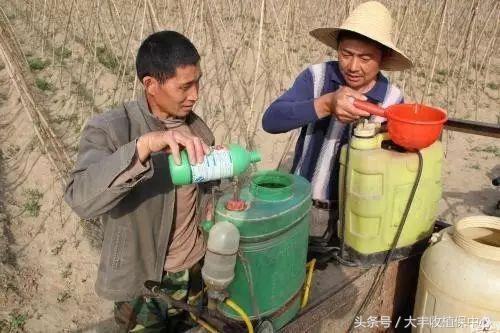
3. Mix pesticides reasonably
For example, at the early stage of disease occurrence, usea protective fungicide + a systemic therapeutic fungicide;
when controlling insects, choose pesticides withovicidal action and adulticidal actionfor mixing, etc.
When spraying
1. Master the spraying technique
For diseases and pests that often damage a certain part of the plant, focus on spraying that part.
For example, for root damage, it is best to use the drenching method;
for damage to the stem, use spraying or brushing;
for leaf damage, spray both the front and back evenly and thoroughly, with emphasis on the underside of the leaves.
2. Grasp the spraying distance and speed
For example, with a knapsack electric sprayer, thenozzle should be kept about 30-50 cm from the target, while for a motorized sprayer, keep it at1 mor so.
When spraying, if you walk slowly, the spray liquid tends to form continuous sheets,if you walk fast, some parts will not receive the pesticide, so you need to grasp the walking speed well and find the routine that suits you.
3. Adjust the droplet size well
According to the performance of the sprayer and its nozzle, adjust to a suitable droplet size.
For controlling diseases and tiny pests such as aphids and whiteflies in greenhouse vegetables, you can choosea smoke machine;
For controlling pests and diseases in open-field vegetables, you should choosea sprayer。
that produces relatively large droplets
After spraying
Pay close attention to the development of pests and diseasesOne or two days after spraying, you shouldpromptly inspect the degree of pest and disease control in the field
, so as to determine whether another spray is needed, what pesticide to use, etc.