How to Use Glyphosate Herbicide and Its Soil Residual Period
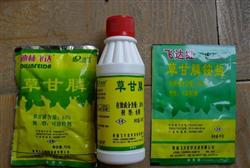
How do you use glyphosate? Please give an introduction.
Glyphosate only has a killing effect after it contacts green tissue. Because various weeds have different sensitivities to glyphosate, the dosage also differs.
1. Weed control in orchards, mulberry fields, etc. To control annual weeds, use 0.5-1 kg of 10% aqueous solution per mu; to control perennial weeds, use 1-1.5 kg of 10% aqueous solution per mu. Dilute with 20-30 kg of water and spray directly on weed stems and leaves.
2. Weed control in farmland. Before crop rotation and sowing in farmland, to control weeds already growing in the field, the dosage can refer to orchard weed control. For application during the cotton growing period, hooded directional spraying must be used. Use 0.5-0.75 kg of 10% aqueous solution per mu, diluted with 20-30 kg of water.
3. Weed control on fallow land, field edges, and roadsides. At the 4-6 leaf stage of weeds, use 0.5-1 kg of 10% aqueous solution per mu, add 100 mL of diesel oil, dilute with 20-30 kg of water, and spray on the weeds.
4. For some malignant weeds, such as purple nutsedge and reed, add an adjuvant at 200 grams per mu for good weed control results.
Glyphosate is a herbicide developed by the American company Monsanto. Also known as: zhencaoning, Roundup, caoganlin, and phosphonomethyl glycine. The pure product is a non-volatile white solid with a specific gravity of 0.5, melting at about 230°C with decomposition. At 25°C, its solubility in water is 1.2%; it is insoluble in ordinary organic solvents, and its isopropylamine salt is completely soluble in water. It is non-flammable, non-explosive, and stable when stored at room temperature. It is corrosive to medium carbon steel and galvanized iron sheet (tinplate).
How to Use
Glyphosate only has a killing effect after it contacts green tissue. Because various weeds have different sensitivities to glyphosate, the dosage also differs.
1. Weed control in orchards, mulberry fields, etc. To control annual weeds, use 0.5-1 kg of 10% aqueous solution per mu; to control perennial weeds, use 1-1.5 kg of 10% aqueous solution per mu. Dilute with 20-30 kg of water and spray directly on weed stems and leaves.
2. Weed control in farmland. Before crop rotation and sowing in farmland, to control weeds already growing in the field, the dosage can refer to orchard weed control. For application during the cotton growing period, hooded directional spraying must be used. Use 0.5-0.75 kg of 10% aqueous solution per mu, diluted with 20-30 kg of water.
3. Weed control on fallow land, field edges, and roadsides. At the 4-6 leaf stage of weeds, use 0.5-1 kg of 10% aqueous solution per mu, add 100 mL of diesel oil, dilute with 20-30 kg of water, and spray on the weeds.
4. For some malignant weeds, such as purple nutsedge and reed, add an adjuvant at 200 grams per mu for good weed control results.
The application temperature is:
Suitable temperature conditions: When the temperature is high, weeds absorb the herbicide quickly and in greater amounts, and metabolic decomposition is difficult, making it easier to achieve the goal of weed control. When herbicides are used at an average daily temperature above 10°C, the control effect can reach more than 80%. Within the range of 15°C-25°C, the effect is best, but it should not exceed 30°C; excessively high temperatures can easily cause poisoning in the applicator, and some herbicides applied at high temperatures can also cause phytotoxicity. Below 10°C, the efficacy is only half; below 5°C, it is basically ineffective. Therefore, when using herbicides in low-temperature seasons, be sure to take advantage of higher temperatures. When herbicides are used at low temperatures, the effect takes longer to appear than at high temperatures. For example, when using haloxyfop to control the weed annual bluegrass in rapeseed fields, it generally takes 12-15 days for the grass to wither, whereas when controlling foxtail in kenaf fields in summer, it generally takes only 3-5 days for all the weeds in the field to wither and die.
People who use glyphosate for a long time have an increased risk of developing non-Hodgkin lymphoma. In March 2015, the WHO classified glyphosate as a "probable carcinogen." To date, more than 30 countries or regions around the world have begun to ban or restrict the use of glyphosate.GlyphosateThe degradation half-life is 10-16 days,The pesticide degradation half-life is the time required for half of the pesticide to degrade. If a pesticide has a degradation half-life of 1 day, and the original residue amount is 10, then after 2 days it will be 5, and so on.In theory, pesticides will not be 100% degraded in crops or soil.
Residue Status of SomeHerbicides
1. Haloxyfop-P-methyl: Its degradation half-life in soil is about 20 hours, making it an easily degradable pesticide, so in theory planting corn after use has little impact, but it is still advisable to pay attention to the dosage.
2. Quizalofop-P-ethyl: Its degradation half-life is within one day; in sesame field soil and sesame plants, the degradation half-life is about 1.5 days.
3. Cyhalofop-butyl: Its degradation half-life in soil is less than 4 hours, and it does not cause toxicity to fish.
4. Acetochlor: It is mainly used for soil sealing before seedling emergence after sowing, and its persistence period in soil is 8-10 weeks.
5. Metolachlor: Its degradation half-life is about 26 days, and its persistence period is 8-12 weeks. Due to differences in soil texture and climate in different places, the soil degradation half-life varies; in Shandong, the soil degradation half-life is 10-12 days, and in Jilin it is 16-17 days.
6. Propisochlor: Its persistence period in soil is 60-80 days.
7. Butachlor: Its degradation half-life in soil is about 30 days, and its persistence period is about 6 weeks.
8. Propanil: Its average degradation half-life in rice plants and soil is 1.2 days and 1.3 days.
9. 2,4-D isooctyl ester: Its residual effect period in soil is about 20 days.
10. Clomazone: Its degradation half-life in soil is 10-137 days, and its persistence period is at least 6 months. The interval before rotating to other crops also varies: 9-12 months for corn; 12-16 months for wheat, peanut, millet, sunflower, and vegetables; and 9 months for sugar beet and sorghum.
11. Bentazone: Its degradation half-life in soil is 1.8-8.6 days.
12. Glyphosate: Its degradation half-life in soil is 10-16 days.
13. Glufosinate: Its degradation half-life in loam soil is 8.9 days, and in sandy soil it is 25.6 days.
14. Pendimethalin: Its half-life in soil is 14.7-19.5 days, and its residual effect period is generally 6-9 weeks.
15. Sethoxydim: Its half-life in soil is 12-26 days.
16. Isoxaflutole: It can provide a persistence period of 8-10 weeks, and a minimum interval of 6 months is required before planting soybean, sorghum, sunflower, potato, and tomato; 4 months before planting wheat; and 18 months before planting rice, peanut, millet, cotton, vegetables, and other crops.
17. Atrazine: Its residual effect period can generally last about half a year. Except for corn, sorghum, and sugarcane, planting other crops requires an interval of at least 24 months.
18. Prometryn: Its persistence period is as long as 20-70 days.
19. Isoproturon: Its half-life in soil is about 20 days, and when applied in autumn its persistence period is 2-3 months.
20. Diuron: It has low water solubility and low leaching in soil. Its persistence period can last as long as 8-16 months, and at low doses it is 2-3 months.
21. Nicosulfuron: Its degradation half-life is 9.63-13.59 days. A minimum interval of 8 months is required before planting wheat; 10 months before planting soybean, cotton, and pea; 12 months before planting rice and peanut; and 18 months before planting vegetables and other crops.
22. Pyrazosulfuron-ethyl: Its degradation half-lives in field water and soil are 5.29-6.42 days and 4.99-6.42 days respectively, and its persistence period is generally 25-35 days.