Sedum planting tutorial, easy enough for beginners to get the hang of
A beginner-friendly tutorial on growing Crassulaceae succulents, covering some common acclimation problems and planting issues. After reading this article, you will roughly know how to grow Crassulaceae plants.
Sedum plants are rich in color, varied in form, and pleasing in appearance, and most varieties are easy to grow, making them suitable for beginners and enthusiasts. First, when you want to expand your succulent army, it is advisable to choose some reasonably priced beginner varieties, so that even if they accidentally get rained on, sunburned, bumped or damaged, and do not survive, you will not feel too heartbroken.
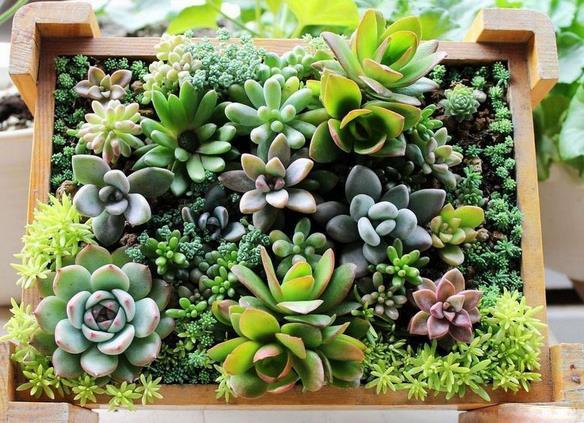
People often ask why, under normal growing conditions, the leaves at the base of a succulent's stem fall off. Others ask why someone else's succulents look so good with old stems, and how those old stems come about. These two questions can be summed up
in one answer: old stems form as the plant keeps growing, the stem keeps thickening and lengthening, and the lowest leaves keep withering away, so it is a kind of accumulation over the years. The old-stem plant in the photo is Sedum 'Frosty Morn' (Phedimus takesimensis), and for a plant grown
from a beheaded cutting to reach this kind of stem condition, it takes about 2 years.
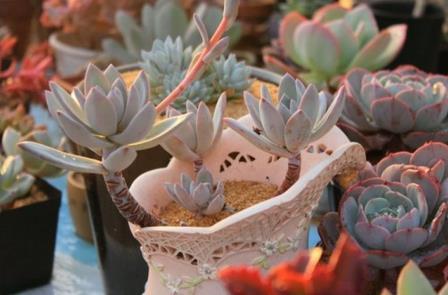
About propagation: generally it can be done by beheading, leaf cuttings, sowing, and division
Beheading: it is easy to understand, just cut the part of the plant above the roots off with a small knife, then let it dry, root, and plant it. Note that the base should keep at least 3-5 healthy leaves, otherwise the base may die. After beheading, the base must not be given water, and should be kept dry for at least 1-2 weeks.
After beheading, place it on the soil surface, and it will grow roots on its own. This situation with Crassula deltoidea (silver beads) is also common and normal for other succulents.
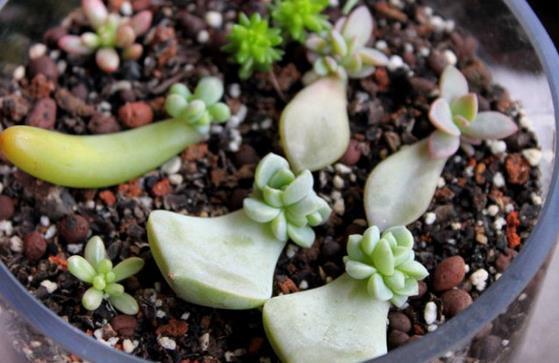
Leaf cuttings: carefully remove healthy, plump leaves, place them on the surface of the growing medium, or gently insert part of them into the growing medium. During this period, avoid direct sunlight and provide appropriate shade. After that, all you need is patience.
Sowing: generally done in October in autumn, and the method is exactly the same as sowing Aizoaceae... Before sowing, you need to prepare seeds, sowing soil, a pot, plastic wrap, and carbendazim.
A. Cover the drainage holes of the pot with mesh, put the sowing soil into the pot, shake it slightly, and level the soil firmly. Do not fill it full; leave 3CM of space at the top.
B. Sprinkle the seeds into the soil. I usually pinch and sprinkle them by hand, or you can fold a piece of paper and gently sprinkle them in. Just try to spread them evenly.
C. Bottom-watering: add the prepared carbendazim to the water for bottom-watering. The water level should not exceed the height of the soil, otherwise the seeds will float up. Just soak the soil through.
D. Seal it with plastic wrap, and remember to always leave 1-2 small gaps for ventilation; do not close it completely.
E. Place it in indirect light, and by no means in direct sunlight!
F. Generally, seedlings begin to emerge 3-7 days after sowing, and most seedlings sprout within the first two weeks. If the germination rate is not high, you can continue enclosed cultivation for 1 more week. During this time, because my soil mix retains water reasonably well, basically no additional watering is needed. If the pot feels very light, you can bottom-water appropriately, but after seedlings emerge, heavy watering is taboo, as the seedlings rot easily.
G. After 3 weeks, emergence is basically complete, and at this point you can gradually increase light.
H. After emergence, sometimes the seedlings tend to lodge, and at this time you can use coarse sand to support them.
I. In the second year, the seedlings grow larger and need to be transplanted.
How to overwinter and get through summer
In areas where the temperature drops below zero, overwinter indoors, water sparingly, and give as much light as possible. In areas where the temperature stays above 5, control watering, and there is generally no big problem.
For summer, provide shade and strengthen ventilation; if conditions allow, move them into an air-conditioned room. Some varieties absolutely cannot get through summer without an air-conditioned room in the hot season, such as Sedum multiceps.
Submission email → [email protected]
Want to read more succulent articles first? Search Baidu for "Xiao Meng Wu Duo Rou Zhi Wu" and follow us, or add the succulent enthusiast WeChat ID "showbe" to have you added to the group and learn more comprehensive succulent care knowledge. Let's all be adorable together.