Detailed Guide to Honeysuckle Cultivation Methods and Planting Techniques
Honeysuckle belongs to the Caprifoliaceae family, genus Lonicera. Also known as Japanese honeysuckle and Yuanyang vine. Honeysuckle is a precious medicinal herb, recorded in the Compendium of Materia Medica, honeysuckle has the effect of clearing heat and detoxifying, honeysuckle is suitable for various febrile diseases, such as body heat, rash, macules, heat-toxin sores and carbuncles, sore throat, etc.
Honeysuckle belongs to the Caprifoliaceae family, genus Lonicera. Also known as Japanese honeysuckle and Yuanyang vine. Honeysuckle is a precious medicinal herb, recorded in the Compendium of Materia Medica, honeysuckle has the effect of clearing heat and detoxifying, honeysuckle is suitable for various febrile diseases, such as body heat, rash, macules, heat-toxin sores and carbuncles, sore throat, etc.
Growth habits:It has strong adaptability to the environment and is not demanding about soil, being able to adapt to both acidic and alkaline soils. The root system is well developed, and it sprouts; stems and vines can take root as soon as they touch the ground. It is cold-resistant, drought-resistant, and also tolerant of water and moisture. It likes light and is also shade-tolerant.
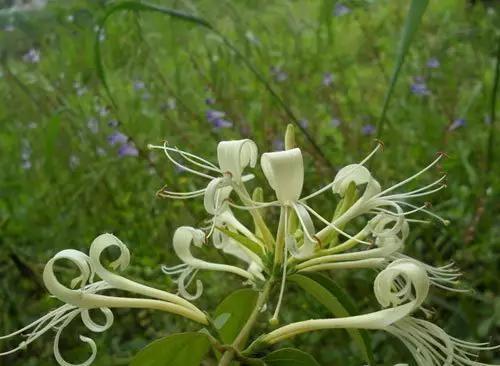
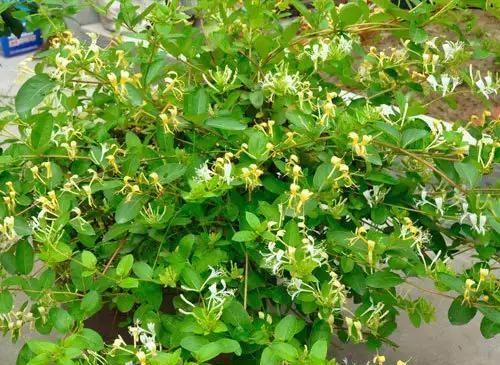
Morphological characteristics:Evergreen or semi-evergreen woody vine. Twining stems, hollow. Young branches densely covered with soft hairs. Leaves opposite, ovate or ovate-oblong. Flowers borne in pairs singly in leaf axils, corolla tube slender, initially white, gradually becoming slightly purple, then turning yellow, fragrant. Berry spherical, blue-black. Flowering period April to June, fruit ripening period August to October.
Geographical distribution:It is widely distributed in the provinces and autonomous regions of both southern and northern China.
Propagation and cultivation:Seed sowing, cuttings, and layering can all be used for propagation, but the cutting method is commonly used. In the plum rain season, cut 1-2 year old robust branches into small sections 20-30 cm long, remove the lower leaves, and insert them obliquely into the soil at 2%, inserting as they are cut. The row spacing and plant spacing in the seedbed are about 25 cm and 10 cm respectively, and they can take root and survive after half a month. Transplant in the spring of the following year, and they can bloom. They grow vigorously and require extensive management; after flowering, appropriately pinch the new shoots. For 3-4 year old old plants, pruning and shaping should be done during the dormant period, and topdressing should be applied if conditions permit. Powdery mildew causes great harm to honeysuckle leaves and can be controlled by spraying with a 1500-fold solution of fenarimol.
Garden uses:Honeysuckle vines twine and coil, with clusters of green leaves; the old leaves do not fall through winter, and flowers bloom continuously in summer, with a pleasant fragrance, making it a climbing plant with both beautiful flowers and leaves. It is suitable for planting on flower stands, flower corridors, door frames, rockeries, * stones, etc. in gardens, and its old stumps can also be used for potted landscapes. Both flowers and stems can be used as medicine.