Detailed Guide to Cultivation Techniques for Sugar Apple (Annona squamosa) in Northern Regions
Sugar Apple Cultivation Techniques in Northern Regions
Editor's note:Sugar apple fetches a good price and can be used as a pick-your-own project for family farms in the north.Sugar apple contains an anti-cancer compound called "annonaceous acetogenins," and has the title of "anti-cancerpioneer." Sugar apple is suitable for cultivation on general mountainous and sloping land.After 2 years from planting, it can flower and bear fruit; flowering can be manually controlled, producing fruit all year round.At peak production, the yield is 2000-3000 jin per mu, with an output value of over 50,000 yuan per mu. Whenripe and harvested, it softens in 2-3 days.
1 Basic Information of the Experimental Park
The experiment was conducted in an energy-saving solar greenhouse at the Landscape Farm Base of the Ningxia Academy of Agriculture and Forestry Sciences in Yinchuan City, Ningxia.
2 Planting Techniques for Sugar Apple
2.1 Seedling Specifications and Planting Time
Bagged seedlings over 2 years of age are optimal. Young seedlings should have a ground diameter of 0.7-1.5 cm or more, and a height of 60-100 cm; the main trunk should be fully lignified, with a relatively developed root system.
2.2 Soil Adjustment Before Planting
Sugar apple is a shallow-rooted plant. The most suitable planting soil is sandy soil or sandy loam with fertile texture, good aeration, and good drainage, with an optimal soil pH of 5.5-6.5.
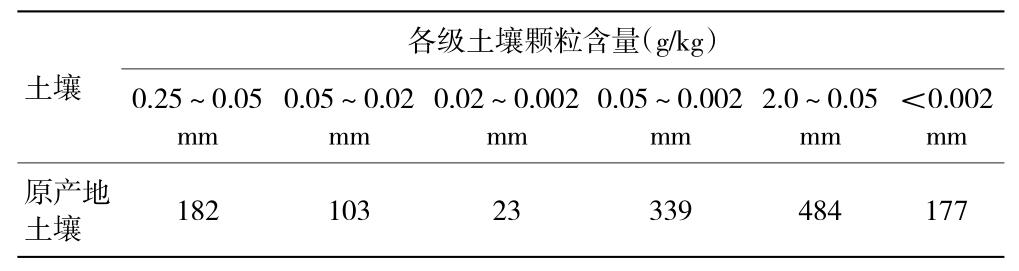
Before planting, the soil particles and physicochemical properties of the soil from the seedlings' place of origin were measured (Table 1, Table 2). From the tables, it can be seen that the pH and total salt content of the soil from the place of origin were far lower than the local soil. Therefore, a root-limiting cultivation mode using root restrictors was adopted, and the nutrient soil for planting seedlings was formulated and proportioned. Two treatments were set for the nutrient soil in the root restrictors. Treatment 1 nutrient soil ratio: substrate : garden soil : sand : furfural residue = 1:2:2:1; Treatment 2 nutrient soil ratio: substrate : garden soil : sand : furfural residue = 1:2:2:2. From Table 2, it can be seen that although the total salt content of the adjusted nutrient soil increased somewhat, the pH decreased by 9.7% and 10.5% respectively. In October 2016, the survival rates of the two treatments were investigated, reaching 97.3% and 94.2% respectively.
Table 1 Soil Particle Composition of the Place of Origin
2.3 Planting Time
Sugar apple seedlings were planted on October 5, 2012 and April 20, 2015 respectively, and their survival rates were investigated. The results showed that the survival rate of spring-planted sugar apple was 94.3%, while the survival rate of autumn-planted sugar apple was only 67.8%, indicating that spring planting is more conducive to the survival of sugar apple than autumn planting.
2.4 Temperature Regulation After Planting
Taiwan sugar apple is a tropical to semi-tropical plant that prefers a warm and humid climate. The most suitable conditions for its growth are an average annual temperature of 21-23°C, annual rainfall of 1,200-1,800 mL, and air humidity of 70%-95%.
Table 2 Physicochemical Properties of Soil from the Place of Origin

Young sugar apple trees can tolerate short periods of low temperatures down to 0°C. From the environmental data of Ningxia's second-generation energy-saving solar greenhouse without any heating measures (taking 2011 as an example), the minimum temperature in December and January, the coldest months in Ningxia, was only 0.7°C. Therefore, after planting sugar apple in a solar greenhouse in autumn or winter, certain heating measures are needed, such as hot-air furnaces, sodium lamps, stoves, etc. At the same time, while increasing the air temperature of the solar greenhouse, the soil temperature can also be appropriately raised.
Sugar apple adapts to relatively high air humidity, and since the humidity inside a solar greenhouse is generally high, there is usually no need to increase humidity. If the humidity falls below 65%, humidity can be appropriately increased, but it should not exceed 95% to prevent disease occurrence.
2.5 Light Management After Planting
Ningxia has strong sunlight. Therefore, after planting sugar apple, especially after spring and summer planting, a single layer of shade net can be used for shading. After about 1 week, the shade net can be gradually removed.
3 Supporting Cultivation and Management Techniques for Sugar Apple
3.1 Training and Pruning
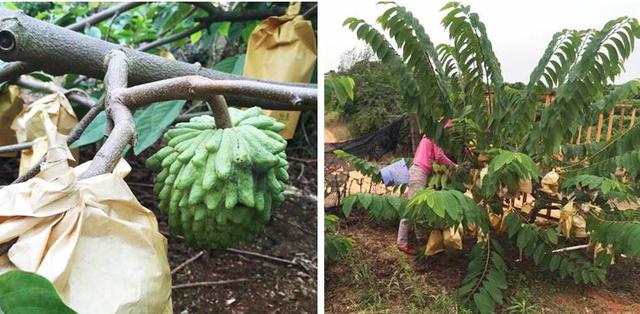
3.1.1 Training and Pruning of Young Trees After small seedlings are planted and grow to 60 cm, the top is cut to establish the trunk, and 3-4 pairs of leaves on the middle-upper part of the main trunk are removed to promote the sprouting and formation of main branches. When the main branches grow to 60 cm, the tops are cut again, and when the leaves are mature, 2 pairs of leaves at the middle and tail sections are removed to promote secondary branching; when the secondary branches grow to about 40 cm, the tops are cut, and when the leaves are mature, 2 pairs of leaves at the middle and tail sections are removed to promote and cultivate third and fourth level branches. The angle between the main branches and each branch with the ground should be kept balanced at 45°-70°. Only one shoot is retained per leaf axil, and excess ones are removed.
3.1.2 Training and Pruning of Fruiting Trees and Production Period Regulation For fruiting trees, since flower bud differentiation of sugar apple does not have strict requirements for environmental conditions, flower bud differentiation can occur as long as there is a certain accumulation of nutrients. The production period regulation technique for sugar apple is mainly carried out in combination with training and pruning. Winter pruning is generally carried out from early February to late March in spring, which can cultivate summer fruit; while summer pruning is generally carried out from June to September each year, which can cultivate three seasons of fruit: autumn, winter, and spring.
For fruiting trees, in addition to removing residual branches after fruiting, weak branches, and diseased and pest-infested branches, the main task is to remove upright water sprouts so as to keep the plant as dwarfed as possible. Flower forcing and production period regulation are mainly achieved through artificial forced defoliation, and vigorously growing trees can achieve high yields through heavy pruning. ① Carry out relatively heavy renewal pruning on the canopy. Cut back the large branches on the outer part of the canopy to about 30 cm from the base of the third and fourth level branches. ② At the same time, also carry out renewal pruning on the third and fourth level branches, retaining only 4-6 nodes; for robust branches over 0.5 cm inside the canopy, generally retain 2-4 nodes for renewal pruning. ③ Water sprouts, weak branches, diseased and pest-infested branches, and leggy branches are all cut off from the base.
5-7 d after renewal pruning, new shoots can sprout. When the new shoots grow to about 10 cm, thinning is carried out, retaining 2-3 per branch. When the new shoots grow to 30-40 cm, pinching is done in a timely manner. After maturing, flower bud differentiation can be completed, and more than 80% of the earlier-sprouted shoots can form flowers.
3.2 Fertilizer and Water Management
3.2.1 Fertilization Management for Young Trees Sugar apple has a relatively high demand for fertilizer. For 1-2 year old young trees, apply 5 kg of organic fertilizer, 0.45 kg of urea, 0.35 kg of superphosphate, and 0.1 kg of potassium sulfate per tree per year. Organic fertilizer is applied all at once before winter pruning. Chemical fertilizers are applied after the first, second, and third new shoots mature and before winter pruning begins. The fertilizer amount at winter pruning is the highest, accounting for about 55% of the total annual amount, while the other 3 applications each account for 15%, to promote tree vigor growth and canopy formation.
3.2.2 Fertilization Management for Fruiting Trees For trees 3-4 years old, apply 15 kg of organic fertilizer, 2 kg of superphosphate, 0.5 kg of potassium sulfate, and 1.2 kg of urea per tree per year, with organic fertilizer applied all at once before and after winter pruning. Chemical fertilizers are applied in 4 split applications: the first before and after winter pruning in February and March, the second from May to June, the third from September to October, and the fourth from December to January of the following year before harvesting the winter fruit.
3.2.3 Water Management Irrigation should be timely and appropriate according to specific conditions. Sugar apple is most afraid of waterlogging, which can easily lead to root rot.
3.3 Determination of Harvest Period
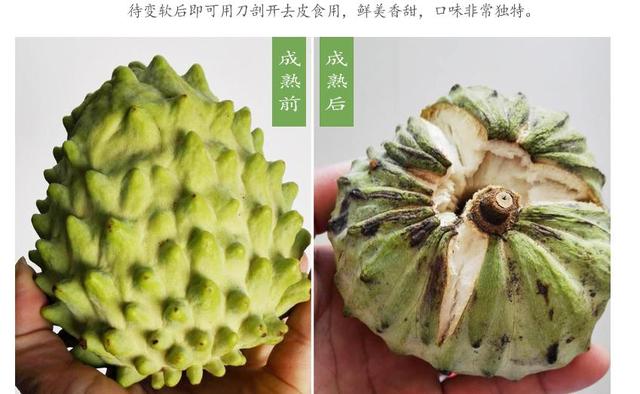
When the scale grooves between the scales on the fruit surface open up and show a creamy yellow color, it indicates that the sugar apple is fully firm-ripe and can be harvested. After harvest, it needs 3-5 d of post-ripening before it can be eaten.
4 Pest and Disease Control Techniques
Sugar apple has few pests and diseases in Ningxia. Currently, red spider mite damage has been found. In cultivation management, 2% abamectin emulsifiable concentrate at 2,000 times dilution, or 20% pyridaben wettable powder at 1,000-2,000 times dilution can be sprayed for control.