How to Grow Potted Grapes: A Detailed Guide to Home Cultivation
HomeHow to Grow Potted Grapes
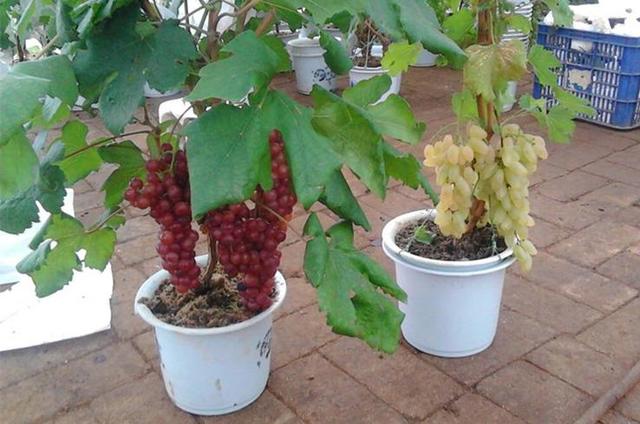
Potted grapes are crystal clear and exquisite, lovely and delicate; the lush green grape leaves and the curving, graceful stems make them highly ornamental. The process of anticipating the grapevine's sprouting, flowering and fruiting is also very interesting. Grapes are very popular among home potted plants. For home potted grape care, indoor potted grapes require mastering the following growing points.
 HomeHow to Grow Potted Grapes
1 Choosing a Pot
The container for potted grapes is usually a clay pot, which has good drainage and air permeability and is relatively cheap; ceramic pots, porcelain pots, plastic pots (buckets), wooden boxes, wooden barrels, cement troughs and other containers can also be used. Container shapes include round, polygonal, rectangular and so on. Depths also vary; for home potting, a diameter of 25~30cm and a depth of 15~30cm is generally sufficient.
2 Preparing the Potting Soil
It should have good air permeability and drainage, good physical and chemical properties, be rich in organic matter and nutrients, have suitable pH, and be free of pests and diseases. The mixing ratio is 30%~50% garden soil, 20%~30% humus or organic fertilizer, and 20%~30% river sand. The prepared growing soil should follow the principle of being loose, fertile and having excellent physical and chemical characteristics. The mixed potting soil can be disinfected by spraying with 0.1% formalin solution, using 500ml of the agent per cubic meter of potting soil; where conditions permit, high-temperature steam sterilization can be used.
3 Planting Time
Use one- or two-year-old grafted seedlings with roots or rooted cuttings, either is fine; planting can be done every year in February~March (rooted seedlings in nutrient pots can be planted from February~April to early May~June).
4 Seedlings and Planting
The seedlings used for potted grapes can be raised by cuttings, grafting, layering and other methods, or 1~3-year-old grape plants can be used, transplanted with a soil ball before sprouting. When planting, cover the central hole at the bottom of the pot with a tile, place a layer of small stones about 3cm thick, then put in part of the potting soil and shape it into a mound; spread the trimmed seedling's root system in all directions on top, then fill with soil and press lightly. When 3~5cm from the pot rim, water so the soil settles, then fill with more soil and water again until water flows out of the bottom hole. After planting, place it in a warm spot and cover with plastic film to preserve moisture.
5 Potted grapes must be placed on a balcony with plenty of sunlight
At a room temperature above 10°C they can sprout and grow; the temperature should not be lower than 5°C. The flowering period requires 25~28°C, the berry enlargement period should be kept at 28~32°C, and the potting soil moisture should be kept at around 70%.
6 Water and Fertilizer Management
In the early spring sprouting period, water thoroughly once every 3~4 days; from June to July, water thoroughly once every 2~3 days; during the December dormancy period, water thoroughly 1~2 times. During the sprouting, flowering and fruit-setting periods, apply sheep manure water once each along with watering and spray the leaves once with nitrogen, phosphorus and potassium fertilizer; spraying the leaves once with zinc fertilizer before and after flowering is especially necessary. Apply base fertilizer together with soil replacement; topdressing during the growing period should be applied in liquid form to prevent excessive concentration from burning the roots. For potted seedlings that have not yet fruited, starting from a seedling height of 20cm (6~7 leaves), apply cake fertilizer water once every 7~10 days until the end of September; for those that have already fruited, it is best to apply once every 5 days. Foliar spraying is effective and economical: in the early growth stage, spray 0.1%~0.3% urea 2~3 times; starting from the fruit enlargement period, spray 0.3% monopotassium phosphate solution once every 7~10 days, for 3~4 consecutive sprays. When watering, the water temperature should preferably be close to the potting soil temperature; watering before 10:00 in the morning and after 4:00 in the afternoon is advisable. Generally, water once every 2~3 days in early spring; as the temperature rises and evaporation increases, water once every 1~2 days. The frequency of watering should be such as to keep the potting soil moist.
7 Leaving Canes and Setting Branches
Grapes planted in the current year can keep 1~2 extension canes. For grapes grown for many years, 3~4 extension canes can be kept; on each cane, leave 1 fruiting branch every 3~4 buds. For those with fruit clusters, pinch the growing tip 3~4 leaves above the cluster; for those without fruit clusters, pinch the growing tip after 3~4 leaves (reserved as next year's fruiting branch). When the extension cane grows to about 1m, pinch the growing tip. For secondary shoots, except those kept as extension canes, pinch the growing tip after 1~2 leaves grow; if forcing a second crop, no leaves need be kept, forcing the winter buds to sprout early.
8 Trellising and Tying
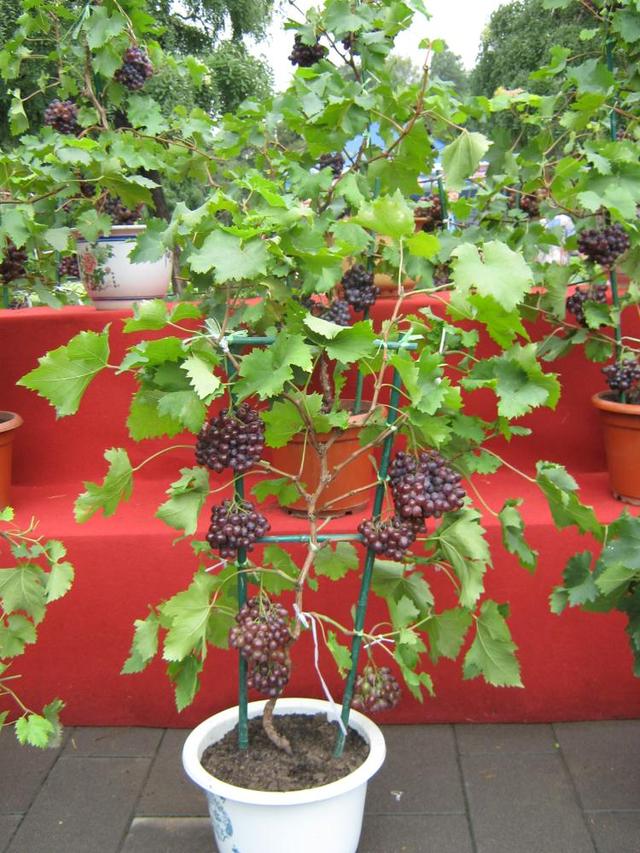
In spring, when the grapes leaf out and extend their canes, insert 3 bamboo poles or wooden sticks about 1.3m long into the pot in a triangle, and tie the tops together with rope to fix them firmly. As the main and side canes of the grape grow, tie them along the triangular frame in a spiral or upward (called the golden dragon coiling around a jade pillar trellis style); be careful to keep a certain distance between canes so that each fruit cluster is exposed. On the balcony, ropes can be used to guide them to the roof or outdoors.
 HomeHow to Grow Potted Grapes
9 Soil Replacement and Root Pruning
Soil replacement can be done in late autumn or before spring sprouting. First water thoroughly, then invert the pot and tap the rim lightly to tip out the entire root system and potting soil. Then use a bamboo strip to loosen and shake off part of the soil ball full of roots, cut back part of the roots around the edges; long roots can be cut back by about half their length, then replant in new growing soil.
10 Adjusting Fruit Clusters and Yield
Adjust the fruit clusters promptly before flowering: keep 1 fruit cluster on each fruiting branch and remove the rest. A pot with a diameter of 33~40cm can carry 1.5~2kg of fruit when 2~3 years old; after 4 years, one pot can carry 5~10kg of fruit; with a larger pot the yield will be even higher.
11 Dormancy and Overwintering
After the autumn harvest, carry out winter pruning. For 1~2 years after planting, keep 1 cane and cut it back at 70~80cm; leave 1 fruiting branch about every 20cm, cut back leaving 2~3 buds. For 3~4 years or more, keep 3~4 extension canes and cut them back at the 8th~9th node (about 1m). Every year from December to the following January, potted grapes can be placed in an empty room or vegetable cellar above 0°C and below 10°C to overwinter in dormancy; generally 30~45 days completes normal physiological dormancy. Water once before or during overwintering dormancy to keep the potting soil moist. This dormancy stage of potted grapes must not be neglected; doing it poorly is one of the important reasons for failure to flower and fruit.
12 Pest and Disease Control
Potted grapes have relatively few insect pests; common diseases include downy mildew, white rot, anthracnose, black pox and so on. During the grape dormancy period, spray 3~5 degrees Baume lime sulfur mixture; after sprouting, spray 1:0.5:200 Bordeaux mixture, or 500-times compound carbendazim solution, once every 15 days.
 HomeHow to Grow Potted Grapes