How to grow peppers in pots on a balcony? A detailed guide to the planting method
Balcony potted vegetables have never been without peppers. Peppers are not prone to pests, and the family likes to eat them, but potted peppers just bear too few, not really enough to eat. A friend grows peppers in pots on the balcony. Peppers are not prone to pests, and the family likes to eat them, but potted peppers just bear too few, not really enough to eat. The friend gave one tip, and the yield was much greater than before. Come and see what the method is!
Peppers are not only a delicious food, they can also become a beautiful potted plant on the balcony. Growing potted vegetables is also an interesting thing, and opening up a small area on a balcony or terrace to grow potted vegetables is a good idea. Moreover, the ornamental value of peppers is not low either. In fact, as long as you can master the following steps for growing potted peppers, you can successfully grow several pots of peppers to supply the whole family, and growing peppers is not difficult at all!
I. Climate conditions for potted peppers
Peppers are a warmth-loving plant and are best grown in a place with plenty of sunlight. Of course, they can also grow in a shady place, but avoid growing peppers in a place without any sunlight. It should be noted that high temperatures are extremely harmful to peppers. Therefore, when planting, it is best to choose an area with tall plants, so that during the high-temperature period the shade of the trees can shelter the peppers.
II. Soil conditions for growing peppers
Peppers are best grown in soil with a pH of 6.2 to 7.0. If your soil is relatively acidic, then you can add a little lime or plant ash to neutralize the pH. If your soil is relatively alkaline, then adding pine needles or peat moss can neutralize the pH.
III. Steps for growing peppers
When growing peppers in regions outside the tropics and subtropics, it is best to do the early stage indoors.
1. Soaking the seeds To help the seeds germinate, you can soak the seeds in water to soften the seed coat. Soak the seeds in warm water for 24 hours, then take them out and let them dry.
2. Sowing After the seeds are completely dry (usually taking 10 to 12 hours), they can be sown. Put soil with a suitable pH into a flower pot, and bury the seeds to about half their depth.
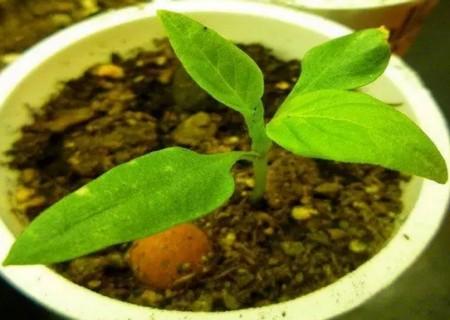
3. Watering and germination Water every day, just keep the soil moist, and do not overwater. Seed germination takes from a few days to a few weeks. The first pair of leaves that the seed sends out is called the "cotyledons." The next pair of leaves that comes out is called the "true leaves." The emergence of true leaves means the pepper seedlings can be moved outdoors.
4. Planting Move the seedlings to an outdoor open area, with a spacing of 30 to 45 cm between plants. If needed, insert some supports to help the plants stay upright. If you do not have the conditions for an outdoor open area, you can place the flower pot in a sunny place, such as on a windowsill.
5. Care For peppers to bloom and bear fruit, it takes at least a month or even longer, and during this period they need careful tending. Be sure to regularly remove weeds, because weeds will consume the nutrients in the soil. Remember to apply compost and potassium fertilizer once a month. Usually, peppers need about two months to fully mature and be ready for harvest. However, you can also let them grow for a while longer before harvesting. The darker the color of the fruit, the riper it is.
6. Harvest Cut the peppers starting from the top of the stem. Pulling the peppers forcefully will damage the fragile stems and roots. If frosty weather is expected, then pick all the fruits in advance, even if some are not ripe enough. This is because frost will destroy all the remaining fruits.
IV. Key points for growing peppers in pots on a balcony
Timing: Choose suitable timing for planting peppers. They can be planted when the temperature is around 17-20 degrees, generally after the warmth of spring arrives. For cultivated peppers, different varieties can be chosen, and each variety should be labeled.
Environment: Growing peppers requires maintaining a slightly moist environment, avoiding excessive humidity, and keeping plenty of sunlight.
Seed selection: Before growing potted peppers, you can choose multiple varieties, such as the common facing heaven pepper, bell pepper, seven-color pepper, and so on.
Seed soaking: Peppers do not need much space to grow. A flower pot of about 30 cm is enough to grow peppers. When propagating from seeds, pepper seeds soaked in water overnight sprout very easily, and the seedlings also grow very quickly.
Disinfection: Before sowing, you can first soak the seeds in a carbendazim solution for disinfection, then soak them in clean water overnight. You can also soak them in warm water for half an hour, and then sow them. The germination rate is especially high, and germination is faster.
Container: The growing container should be at least 25 cm deep. The growing spot should not be in direct strong sun at first, and the seedlings should be given plenty of scattered light.
Watering: After the seedlings have grown strong, you can use 2 tablespoons of Epsom salt mixed with 4 liters of clean water to spray the pepper plants, which can let you harvest peppers faster.
Transplanting: Avoid direct sunlight during the seedling stage and maintain plenty of scattered light. When the seedlings grow to 4 true leaves, they can be transplanted. Choose seedlings with sturdy branches and leaves for cultivation, and the other seedlings can only be discarded.
Moisture retention: The root system of peppers is relatively shallow. Remember that the soil must not become waterlogged. Keep the potting soil slightly moist but not wet, and do not let the soil become excessively dry.
Fertilizing: If you want your peppers to bear more fruit, you not only need to apply thin fertilizer frequently, but you also need suitable fertilizer. In addition to regular topdressing, when just transplanting, you can add an appropriate amount of decomposed cake fertilizer or animal manure beneath the potting soil. After the first fruiting, continuous topdressing is needed, once every half month, to ensure a consistently high yield.