How to Grow and Propagate Hyacinths
Hyacinth is also known as Dutch hyacinth, garden hyacinth, and five-colored hyacinth. It is a perennial herbaceous bulbous plant, and its flowers come in a rich range of colors, including red, blue, white, yellow, purple and many others. Propagation is mainly by dividing the bulbs.
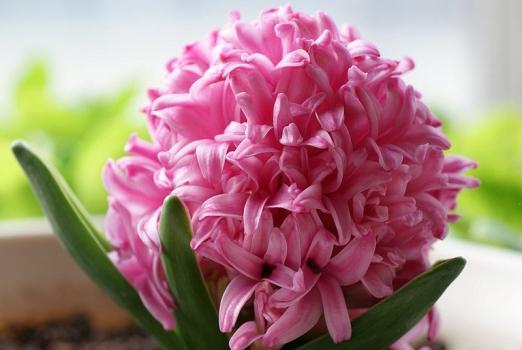
Hyacinth cultivation can be divided into soil culture and water culture. Below we will learn together the methods for growing hyacinths in soil and in water.
Soil Culture of Hyacinth
If your hyacinth is grown in soil, you need to pay attention to the following points:
1. Choice of soil:
For hyacinth, a well-drained, not-too-dry sandy loam is best. The soil should be fertile, high in organic matter, with good crumb structure, neutral to slightly alkaline, at a pH of 6-7. You can mix potting soil in the ratio of 5 parts leaf mold : 3 parts garden soil : 1.5 parts coarse sand : 0.5 part bone meal. Before planting, you can use chemical agents such as formalin; at a soil temperature of 10-15°C, apply the agent to the soil surface and immediately cover with plastic film. After 3 days of warm weather, remove the film, let it air for 1 day, and then plant, keeping the soil moist. Apply plenty of base fertilizer before planting. For field cultivation, avoid continuous cropping.
This is best done from October to November, and choosing well-drained soil is the most important condition. Apply plenty of base fertilizer before planting, add a thin layer of sand on top, then arrange the bulbs with a spacing of 15 cm-18 cm and cover with 5 cm-8 cm of soil. Also cover with grass to keep the soil loose and moist. Generally no other management is needed before flowering. After flowering, if you do not plan to collect seeds, cut off the flower stems to promote bulb development; cut as close to the top of the flower stem as possible. In early June, the bulbs can be dug out, spread out, graded, and stored in a cold storage room. The summer temperature should not exceed 28°C.
2. Potting:
Use a mixture of loam, leaf mold, fine sand, etc. as the growing medium. Generally, a pot with a diameter of 10 cm holds one bulb, and a pot with a diameter of 15 cm holds 2-3 bulbs. Then bury the pot in the soil and cover it with 10 cm-15 cm of soil. After 7-8 weeks, when the shoots have grown to more than 10 cm, remove the covering soil to let sunlight reach them. Generally plant from October to November, and they will bloom in March.
3. Fertilizing:
During the autumn and winter growing period, apply 1 to 2 topdressings mainly of phosphorus and potassium. No fertilizing is needed during the flowering period. Apply one topdressing before and after flowering, and apply plenty of base fertilizer before planting in pots or in the ground.
4. Watering:
Hyacinth likes sunlight and is fairly cold-tolerant, and it grows best in a cool, moist environment. Therefore, water it frequently and keep soil moisture at 60-70% to support the growth and propagation of the hyacinth.
5. Light and temperature:
After planting the hyacinth, place it in a sunny spot and let it receive 1 to 2 hours of scattered light each day, so that the leaves and flower stems grow strong. Turn it to a different direction every day so it does not lean to one side due to phototropism. If light is insufficient, or if the winter is dry for a long time, flowering will be poor. If you see that the emerging flower stem is too short to extend, you can place the potted plant in a dark place for several days to encourage the stems and leaves to elongate, and after the flower stem extends, return it to normal care. The temperature required for forcing is 5-10°C.
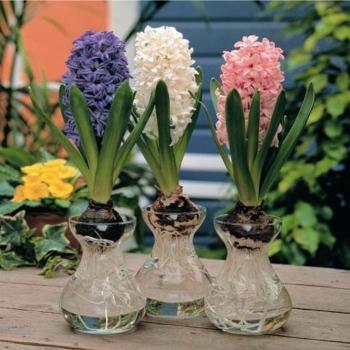
Water Culture of Hyacinth
If your hyacinth is grown in water, you need to pay attention to the following points:
1. Requirements for the vase and water:
You can choose a wide-mouthed glass bottle with a grid, a plastic bottle, etc. The water should be clean, and the water should be changed once a week. If nutrient solution has been added, decide how often to change the water according to how cloudy it becomes. Also add water frequently to keep the bulb submerged.
2. Cultivation method:
There should be a 1-2 cm gap between the water surface and the bulb; never let the water cover the bottom of the bulb. Then place it in a dark place and cover the bottle with black cloth to promote root development. After the roots have grown to about 10 cm, move it to a warm south-facing windowsill with plenty of scattered light.
3. Requirements for water temperature and light:
The water temperature should not be too high; 15-20°C is best. When the leaves and flower buds emerge, let it receive 1 to 2 hours of scattered light each day so that the leaves and flower stems grow strong. Turn it to a different direction every day so it does not lean to one side due to phototropism. No fertilizing is needed, and in March or April of the second year it will produce a plant of bright, fragrant hyacinth flowers.
4. Room temperature requirements:
Keep the room temperature at 17-20°C, and you will enjoy the process of bud formation, growth, and color development. But do not place it directly near a heat source; this way, the beautiful hyacinth flowers will stay open longer.
Notes on Growing Hyacinth
1. Choose the bulbs carefully, because the nutrients needed for hyacinth flowering mainly come from the nutrients stored in the bulb scales and leaves. Therefore, only by choosing bulbs with undamaged skin, fleshy scales that are not excessively shrunken, and that are fairly hard, heavy, and plump can you produce abundant, beautiful flowers.
2. Hyacinth growth only needs light above 5000 Lx to maintain normal physiological activity. If light is too weak, the plant will become spindly, the stems too long, the buds small, the flowers will fade early, and the leaves will turn yellow. You can use an incandescent lamp about 1 m away to supplement light. But too strong light can also cause scorching of the leaves and petals or shorten the flowering period.
3. When the temperature is too high, even above 35°C, flower bud differentiation will be inhibited, growth will become deformed, and the rate of blind flowers will increase. If the temperature is too low, the flower buds will suffer frost damage.
4. When changing the water for a water-cultured hyacinth, be extremely careful, because hyacinth roots are very fragile and easily broken, which can damage the roots and affect the growth and flowering of the hyacinth.
5. The bulb is toxic. If swallowed by mistake, it can cause symptoms such as dizziness, stomach cramps, and diarrhea, so be sure to prevent children from eating it by mistake.