Spider Plant Introduction and Complete Growing Guide
Spider Plant
Agavaceae
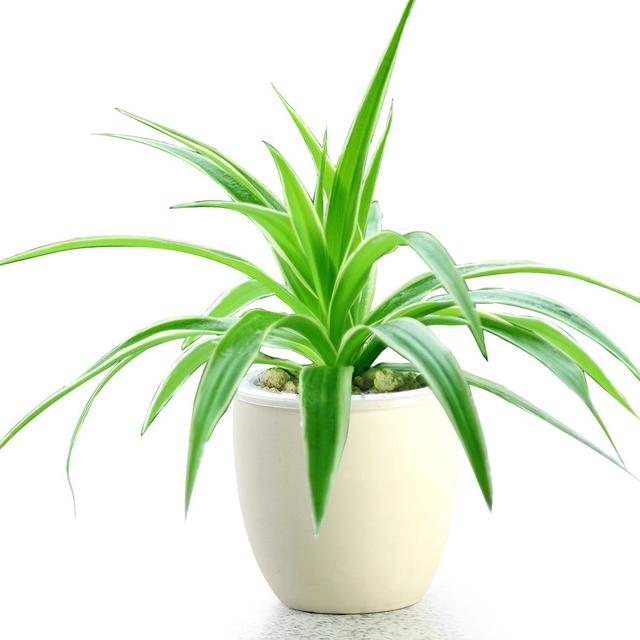
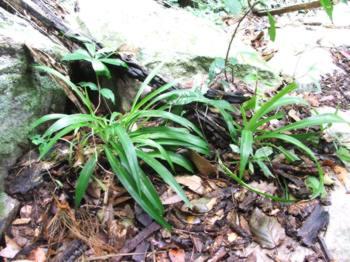
Spider plant is a perennial lily-like plant with tuberous roots, bearing spreading to recurved soft leaves from a central rosette and an elongated raceme with small white flowers. This is probably the most widely cultivated indoor pot plant in the world, especially the cultivar.
Description
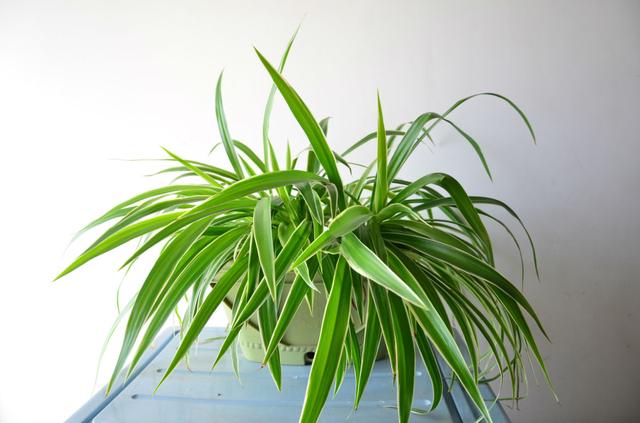
Perennial evergreen herbaceous plant, up to 1 m high, 1 m in diameter, from a spreading (horizontal at first, then growing upward) rhizome about 150 mm long, often with old leaf bases. Roots fleshy, tapering at both ends (fusiform), fleshy, up to 10 mm in diameter. Linear, growing in a dense basal rosette, bright green, smooth (glabrous) with a prominent midrib, and arching, about 300 mm long, 20 mm wide, ending in a softer tip, while the margins are entire at the base. Inflorescence loose, longer than the leaves, spreading, borne from the centre of the rosette, up to 1 m long. The peduncle (flower stalk) is 2-4 mm in diameter, with linear-lanceolate bracts forming a point.
Flowers
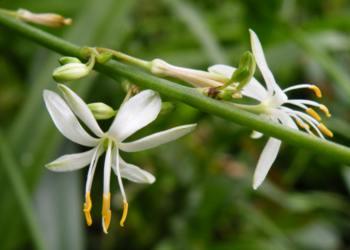
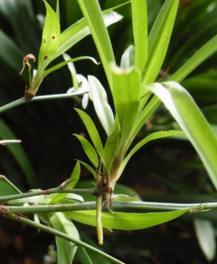
The flowers are usually replaced by plantlets borne on the flower stalks (propagation), which serve for vegetative reproduction. Flowers grow in axillary clusters. Individual flowers are star-shaped (stellate), white and up to 20 mm in diameter with 6 stamens. The tepals are oblong, about 10 mm long, becoming reflexed. The style is smooth and small with a minute point (stigma). The fruit is a 3-angled capsule and its seeds are flat, glossy black. Flowering time: summer months.
Spider plant is one of 38 spider plant species in South Africa, easily distinguished by its spreading inflorescences whose plantlets root when the inflorescence touches the ground.
Conservation Status
Spider plant is widespread and not threatened in its habitat. Therefore, there is no need to include it in the Red List (Raimondo et al. 2009).
Distribution and Habitat
Spider plant is widely distributed from the Western Cape to Swellendam and the Soutpansberg in Limpopo Province (Western Cape, Eastern Cape, KwaZulu-Natal, Mpumalanga and Limpopo). It occurs from sea level to over 1 000 m in altitude, where it grows in forest river valleys in understory, on mountains and in scrub, on steep embankments, flat terrain and cliffs.

It grows in various soils (volcanic or sedimentary) derived from sandstone, shale, or granite. The soil is usually acidic. The winter climate ranges from hot to cold, and where frost occurs it is mild. Rainfall ranges between 500 and 2000 mm per year, occurring mainly in spring and summer, but in the Western Cape it also occurs in winter.
Name and Historical Derivation
The common name spider plant refers to the plant's leaves and derives from the Greek word for yellowish-green). Although this may be true for some species, the vegetative parts are green, not yellowish-green. The specific epithet comosum also refers to the leaves.
Spider plant was first collected by Carl Thunberg (known as the father of South African botany). During one of his expeditions near Langekloof in the eastern interior, and was named by him in 1794.
Ecology
Spider plant usually grows in moist river valley forest where it is dominant. This is due to effective asexual reproduction through the plantlets that root on the spreading inflorescences. The fleshy roots adapt the plant to dry winter conditions. The small white flowers are insignificant and are pollinated by insects. The small, persistent seeds mature in capsules in summer and autumn. The mature capsules are held in an upright position. The plant is variable with several local forms. In the Eastern Cape, near Mboyeti, the plants have wavy or undulating leaf margins. At Kuga Dam, on steep cliffs, plants with stems and leaves up to 300 mm long are encountered.
Uses
The plant has medicinal use among the Nguni, especially for pregnant women and as a charm to protect mother and child. The plant is placed in the room where the mother and child stay. The root is soaked in a bowl of water, and the mother drinks it daily, as it is believed to protect the baby. Small babies are also given an infusion as a laxative.
Because of the plant's drought tolerance and relative resistance to pests and diseases, the plant is popular in cultivation. In South Africa, they are grown as pot plants, in hanging baskets or as ground cover under trees. The hanging plantlets on the extending inflorescences are very decorative. The species is also very effective on steep embankments for combating soil erosion.
Different cultivars have been named - see below. The first two are very popular and grown worldwide. The third is a relatively new cultivar:
Spider plant 'Vittatum'. This form has white margins.
Spider plant 'Variegatum'. In this cultivar the central part of the leaf near the midrib is white.
Spider plant 'Mboyeti'. This cultivar has undulating leaf margins.
Growing Spider Plant
Spider plant grows very well in cultivation. Its ornamental, gracefully arching leaves that spread from the central rosette to the downward-curving leaf tips make it so popular.
. Many "pups" or plantlets are usually given away by owners, which has led to this species being the most commonly grown and popular plant worldwide. The black-and-white striped cultivar may be easier to grow than the original plant. In the garden it is best grown under trees or on shady embankments, especially in gardens along the Indian Ocean coastal belt. It is a fast grower. Elsewhere in the world it can also be grown outdoors, but it is best planted in Mediterranean-style gardens where frost is not too severe (California and parts of the Mediterranean). This plant likes partial shade, especially in hot, dry climates. It should therefore be protected from full sun. The plant should reach flowering size within a year.
Propagation
Propagation
Spider plant is very easy to propagate by division or from the plantlets on the inflorescence. The plantlets can be transferred directly to small containers. It can also be grown from seed, best sown in spring or summer in a warm, shady position in sandy, slightly acidic soil. Cover with a thin layer of sand and keep moist. Germination usually occurs within 3 weeks. The seedlings grow fast, the fastest once they are large enough to handle. The plant responds well to organic feeding (compost or any other liquid fertilizer). Spider plant can be grown all year round.