What are the key points for growing dragon fruit in greenhouses in northern China?
Dragon fruit (pitaya) is originally a tropical and subtropical fruit. It likes light but tolerates shade, tolerates heat and drought, likes fertilizer but tolerates poor soil, and grows rapidly in a warm, humid environment with sufficient light. The optimum temperature is 25-35°C, and the soil is best as neutral soil or slightly acidic soil that is rich in humus and has good water- and fertilizer-retention capacity.
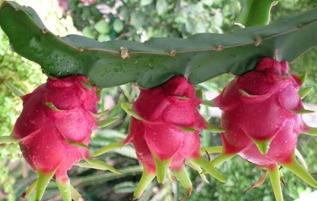
As a plant that originally grows in the tropics and subtropics, to grow it in North China where winter temperatures are cold, it is necessary to do a good job in building greenhouses, inserting and building cement columns, soil management, seedling management, water and fertilizer management, agronomic management, and other aspects of the work.
I. Greenhouse construction
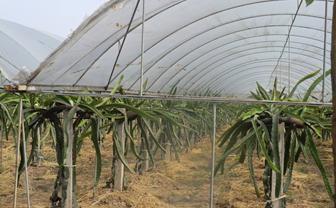
Depending on the scale of planting, small-scale planting generally uses standalone greenhouses that are convenient to build and lower in cost; large-scale planting uses connected greenhouses that are convenient to manage. Dragon fruit plants are generally 1.5-1.8 m tall, so for future management and to ensure sufficient growing space, the greenhouse height can be 2.5-3 m. Vents and ventilation devices need to be set up on the roof and around the sides to facilitate temperature and humidity regulation in summer. For the roof covering film, choose a film with good light transmission performance, and cleaning and replacement work needs to be done well to prevent reduced light transmission rate and reduced insulation performance caused by film damage.
II. Inserting and building cement columns
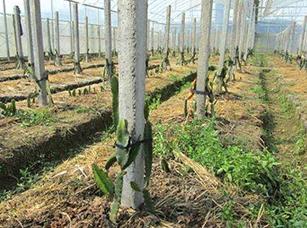
First make ridges and beds, 30-1000px high and 1.5-2 m wide, then insert and build cement columns on the bed surface at intervals of 1.8-2 m, and connect the tops of the cement columns with iron wire, used for tying the later branches and fruiting branches of dragon fruit.
III. Soil management
Dragon fruit is best suited to neutral or slightly acidic soil with high humus content and strong water- and fertilizer-retention capacity, so when choosing a planting site, try to choose such soil, or apply Youjibao (organic matter >=70%) to the soil and use Mianshengeng to adjust the soil organic matter content and soil structure to the range suitable for dragon fruit.
IV. Seedling management
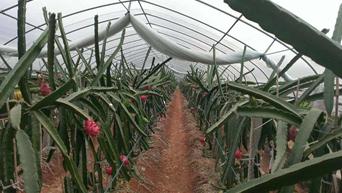
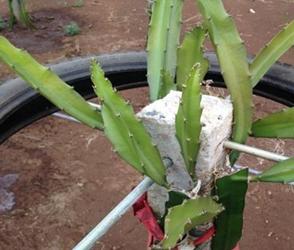
Dragon fruit is generally propagated by cuttings. The cutting time is generally chosen in spring. Select robust stem segments and cut them into small sections of 15-500px, wait for the wounds to air-dry, then directly insert them beside the cement columns. The cutting depth is about 125px. Insert one section on each side of the cement column, fix them well with rope, and water after about 10 days.
V. Water and fertilizer management
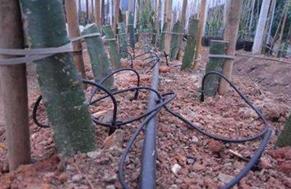
Dragon fruit is drought-tolerant but not waterlogging-tolerant. A soil moisture content of 70-80% is enough to meet growth needs. If the soil moisture content is too high, it will cause root rot, so water should be supplemented appropriately according to the soil moisture content, with the bed surface kept moist as the standard. Remember not to supplement water frequently and in large amounts. At the same time, dragon fruit also has a relatively large demand for fertilizer during the growth and development stage. At this time, Chaoguan nitrogen-phosphorus-potassium >=500g/L (170-170-170) can be applied by flushing with water; generally, if cuttings are taken in spring of the same year, fruit can be produced the next year. During the fruit expansion stage, Jieneng potassium nitrogen-phosphorus-potassium >=850g/L (K2O>=450g/L) can be applied by flushing with water to meet the large demand for potassium.
VI. Agronomic management
Temperature control: in summer, when the temperature inside the greenhouse is above 35°C, pull open the shade net on the shed surface or open the vents for shading or cooling;
Pinching: when the cutting seedlings grow to 1.3-1.4 m tall, pinch them to promote branching and let the branches droop naturally;
Hand pollination: there are few pollinating insects in the greenhouse, so pollen needs to be collected manually for hand pollination. Generally, some other varieties of dragon fruit are interplanted, which can improve the success rate of pollination;
Post-harvest management: after harvesting fruit each year, prune the fruited branches to facilitate the production of new branches.