Hubei University's first female PhD uses 3D printing technology to detect pesticide residues
Wuhan Evening News Media · Wuhan Evening News, February 11 (correspondent Duan Mengyao, reporter Hu Yihua) Recently, Wang Yijia, a doctoral student in the first "1+4" integrated master's-doctoral program at Hubei University, majoring in material preparation and detection technology, published an article in Analytical Chemistry (the highest-ranking journal in the field of analytical chemistry), using 3D printing technology to detect pesticide residues, which attracted widespread attention.
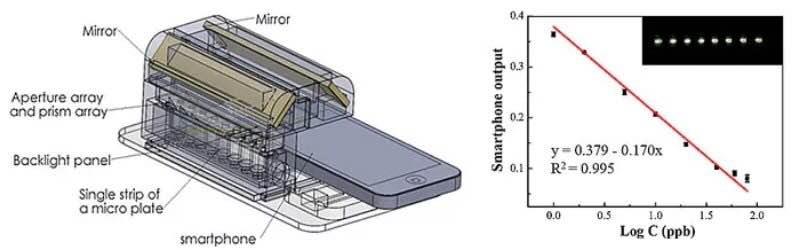
Concept diagram of the technical model
It is understood that Wang Yijia's team, under the guidance of Professors Lin Yuehe and Du Dan at Washington State University, used a smartphone as an information capture device and, with the help of 3D printing technology, designed and printed a small optical detection platform that can monitor and transmit optical information in real time, achieving real-time monitoring at room temperature of residues of the pesticide 2,4-dichlorophenoxyacetic acid in food, ecological water sources or human metabolic fluids.
It is reported that pesticide residues in food and the environment have a great impact on human health and environmental protection. When pesticide residues on the surface of grains and vegetables or in drinking water are ingested by the human body, they can have a major impact on health. High concentrations of pesticides can even cause acute poisoning, nausea, vomiting and other adverse reactions in humans.
Traditional pesticide detection methods are mostly time-consuming and labor-intensive, and sometimes require expensive large-scale instruments to effectively detect pesticide residues. Wang Yijia's team, however, combined the increasingly developed smartphone with its built-in voice control system, high-definition camera with adjustable parameters, and temperature sensor to detect pesticide residues using 3D printing technology.
"Before a plan succeeds, it is failure. 99% of our experiments failed," Wang Yijia said. "With every failure, we also kept revising the plan, slowly exploring and optimizing the experimental conditions, until we obtained good results."
The top journal knowledge platform X-MOL gave high praise to the device: "The device is not only highly sensitive, but also low-cost, small in size and light in weight, and can even achieve real-time monitoring of pesticide residues in environmental samples. The device is compact and portable, which not only saves detection costs, but also provides accurate and reliable results, realizing the convenient application of smartphones in daily life and having important significance for promoting the development and construction of smartphone detection devices."
[Editor: Li Shaowen]
Operations staff: Tang Jun MX002