Potted jujube tree planting methods and daily care tips
Fruit Bang (WeChat ID: shuiguobangv)
Introduces various potting techniques for fruits, flowers and more, as well as all kinds of home creativity ideas. We advocate green, ecological and eco-friendly living, and being an urban farmer!
The tree fruits early, has small leaves, attractive branches and red fruit, and jujube fruit is rich in nutrients. Some ornamental jujube varieties are especially suitable for pot cultivation, flowering and fruiting in the very year they are planted, offering both high ornamental value and a certain economic value. Potted jujube trees can be grown in open ground with good light conditions, in courtyards, on building balconies and so on. The key points of potted jujube tree planting and management techniques are as follows:
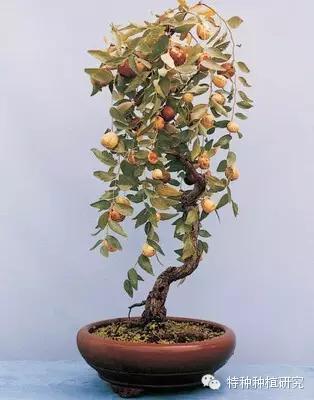
(1) Pot and potting soil. For potted jujube trees, clay pots, ceramic pots, plastic pots and so on can be used. For placement in a home room or on a balcony, a clay pot with an inner diameter of 25~45cm and a height of about 20~25cm can be chosen; if placed along roads, in flower beds and similar locations, a larger clay pot should be chosen. Jujube trees are highly adaptable to soil, but because potted jujube trees grow and develop in a limited amount of soil, the potting soil should be loose and fertile, with good permeability and strong water- and fertilizer-holding capacity, to suit root growth. You can use 4 parts garden soil, 2 parts leaf mold or humus soil, 2 parts barnyard manure and 2 parts sandy soil, mix them thoroughly by volume ratio, and sieve the mixture for use as potting soil.
(2) Varieties and seedlings. For potted jujube trees, choose varieties that fruit early, have a high fruit-setting rate, a long fruiting period, uniform and attractive fruit shape, bright and clean fruit surface, strong stress resistance, a compact tree form, and branches and fruit with special forms and ornamental value, such as Longzhao jujube, Hulu jujube, Chahu jujube, Tailihong and so on. To improve the ornamental effect, several varieties can be grafted onto a single seedling. Choose healthy jujube seedlings with a well-developed root system, many fibrous roots, a relatively thick and sturdy trunk, evenly distributed branches and an attractive branch form.
(3) Potting time and method. Generally, potting is best done in spring just before bud break. At this time roots develop quickly and survival is easy. Before potting, first cover the drainage hole at the bottom of the pot with a broken tile piece with the convex side facing up, then spread about 2cm of furnace slag, and then add the growing medium for planting. Before planting, prune the seedling roots, trim the wounds smooth, cut off diseased roots, damaged roots and the overly long parts of thick roots, and retain as many fibrous roots as possible. When planting, spread the roots out and make them fit closely with the potting soil. The planting depth should preferably be level with the original soil mark on the jujube seedling. Press the soil firmly and compactly, and leave a 2cm rim to make watering convenient. After potting, water thoroughly in time, then place the pot in a wind-sheltered, sunny spot and keep the soil in the pot moist.
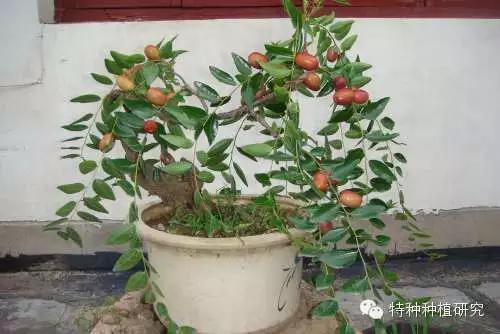
(4) Watering and fertilizing. The amount and timing of watering should be determined according to changes in potting soil moisture, the water requirements of jujube trees and the season. If the weather is dry and the temperature is high, water frequently and generously; if the tree is small with few branches and leaves, water less; if the tree is large with many branches and leaves, water more. In early spring and late autumn, water in the afternoon when the temperature is higher; in summer, water before 10 a.m. or after 4 p.m., so as to avoid drastic changes in potting soil temperature that affect root growth. Covering the potting soil with materials such as wood shavings can preserve moisture, reduce the number of waterings, and keep the potting soil at a constant temperature, which is beneficial to the growth and fruiting of jujube trees.
Fertilizing potted jujube trees should be based mainly on organic fertilizer, with an appropriate amount of chemical fertilizer as a top dressing. For organic fertilizer, use fermented cake fertilizer. Organic fertilizer can be applied when repotting, or well-rotted organic fertilizer can be diluted and poured into the potting soil; apply small amounts more often, on average once a week. Applying too much fertilizer at one time will cause reverse osmosis, leading to shrinking of the fruit tree leaves and even death of the fruit tree plant. Take special care not to apply raw fertilizer. Applying fertilizer that has not been fully rotted gives off a foul odor, pollutes indoor air, and during fermentation in the flower pot generates high temperatures that damage the roots. Therefore, soybean cake, hoof pieces, or inedible internal organs of chicken, duck, fish and so on, as well as chicken and duck manure and rabbit manure, should first be soaked in water in a vat, placed in the sun to ferment fully, and only applied after they are rotted. Also do not apply fertilizer around the root crown; fertilizing around the root crown is not conducive to absorption by the moon tadpoles and easily burns the root crown area of the fruit tree, causing the leaves to gradually turn yellow and fall off, affecting normal growth. The correct method is to bury rotted organic fertilizer or chemical fertilizers such as urea and potassium dihydrogen phosphate into the soil at the edge of the flower pot, or apply them at a place relatively far from the root crown, cover them with a layer of soil, and then water.
During the fruit development period, foliar feeding can be used. For foliar spraying, the concentration of urea and potassium dihydrogen phosphate is 0.3%-0.5%, the concentration of superphosphate extract is 2%-3%, the concentration of wood ash extract is 2%-5%, the concentration of boric acid or borax is 0.2%-0.3%, the concentration of ferrous sulfate is 0.2%-0.5%, and the concentration of zinc sulfate is 0.3%-0.5%.
(5) Flower and fruit management. Girdling during the flowering period can increase the fruit-setting rate. When 30%-40% of the flowers on the tree have opened, girdle the base of the main trunk, generally with a girdling cut of 0.2cm. Jujube trees like light, so potted jujube trees should be placed in a location with good ventilation and light transmission to favor fruit setting. Spraying 10~15ppm gibberellin during the flowering period can increase the fruit-setting rate. Pinching the jujube heads and secondary branches during the flowering period can increase the fruit-setting rate. When there is too much fruit on a potted jujube tree, or when fruit set is unevenly dense and sparse, fruit thinning should also be carried out. Thin out part of the poor-quality, smaller fruit in overly dense areas.
(6) Training and pruning. Potted jujube trees are mainly for ornamental purposes, so tree forms such as the central leader form and the open-center form can be chosen, with a trunk height of about 20~30cm and about 3~5 main branches. Training and pruning should focus on summer pruning. Shape the tree through pruning methods such as bud rubbing, pinching, branch bending and branch twisting, and increase the fruit-setting rate through methods such as girdling (bark ringing) and ring cutting during the flowering period, so as to achieve the goal of controlling tree growth.
(7) Pest and disease control. The main insect pests of potted jujube trees include stinging caterpillars, tortoise wax scale insects, jujube leaf roller moths, jujube inchworms and so on. When the number of insects is small, they can be captured manually, or low-toxicity, low-residue insecticides and acaricides can be used for control. The main diseases are rust disease and anthracnose. From late June onward, fungicides such as double-strength Bordeaux mixture, carbendazim and chlorothalonil can be sprayed for prevention.
(8) Repotting or soil replacement. After growing in a pot for 3~4 years, a potted jujube tree should be moved to a larger pot, and repotting should be done before bud break in spring. After pulling the jujube tree out of the pot, remove the root pad and a small amount of roots. The pruning amount should be controlled at 20%-30%, ensuring the potting soil does not fall apart, and move the whole root ball into the newly replaced larger pot. Add an appropriate amount of nutrient soil around it and water thoroughly. If a potted jujube tree is not moved to a larger pot, the nutrient soil should still be replaced about once every 3~4 years to benefit its growth. After pulling the jujube tree out and removing the root pad and a small amount of roots, add nutrient soil and place the original jujube tree with its soil into the pot, then add enough nutrient soil and water thoroughly.
(9) Winter protection against cold. To prevent potted jujube trees from losing water in the roots and dying due to long periods of wind and drought in winter, measures to retain water, keep warm and prevent freezing should be taken. First, move the potted jujube tree indoors at a temperature of about 0~7°C, or into a corridor or onto a balcony, and water it regularly; second, place the potted jujube tree in a greenhouse to overwinter safely. In regions where winter is not too cold, the pot can also be covered with some grass and left on the ground to overwinter. In winter, also check frequently whether the potting soil is dry; if the potting soil is dry, water thoroughly to ensure the potted jujube tree overwinters safely.