Is it really true that Taiwan tea is never sprayed with pesticides? A 70-year-old tea farmer tells the truth
Recently, friends have often chatted with Youdao Jun about Taiwan tea. Quite a few friends believe that mainland tea is seriously polluted, pesticides are rampant, and it is hard to tell the real from the fake; while Taiwan tea grows at high altitude, has less pollution, and is not sprayed with pesticides, so it is safe and reassuring to drink. Is this really true as they say?
These past few days, the Beijing International Tea Expo has been in full swing, and many well-known tea companies were there. Youdao Jun also went to take a look. At a booth for Taiwan tea, Youdao Jun happened to meet an old tea master from Taiwan in his 70s. I asked the old man: "Many people on the mainland now say that Taiwan tea is not sprayed with pesticides and is basically all organic tea and high-mountain tea. Is that really the case?"
Hearing this, the old man reacted strongly, waving his hand repeatedly and saying: "How could that be?! To tell you the truth, at least 98% of Taiwan tea is sprayed with pesticides." The old man introduced the tea at his own booth to Youdao Jun and said: "You see, here I only have these three teas that are completely unsprayed with pesticides. More than 300 tests found no pesticide residue. This kind of tea, I only make a few hundred jin of each year."
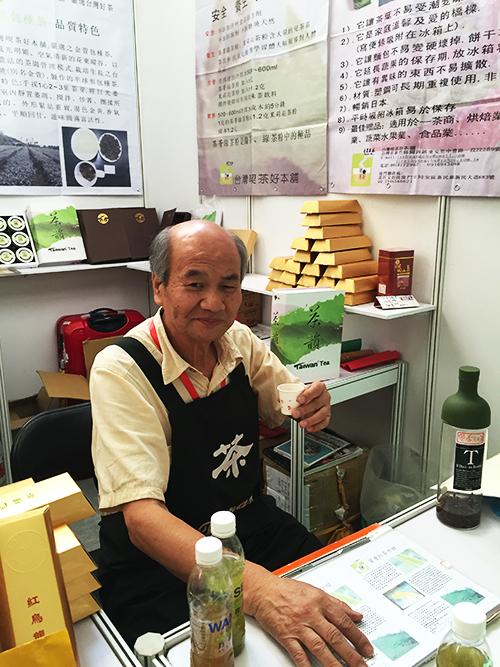
When it comes to Taiwan tea, the old man simply cannot stop
According to the old man, most tea in Taiwan is also sprayed with pesticides; it is just that before it goes on the market it must pass inspection by government departments, and as long as pesticide residues are within the prescribed limits, the tea can still go on the market. Tea gardens that have been sprayed must wait at least 7 days before tea leaves can be picked. After being made into maocha, random sampling and testing must be carried out once again to further ensure the safety of the tea.
Because tea trees suffer from damage by diseases and pests, tea farmers in routine tea garden management must spray a certain amount of pesticides permitted for use on tea trees to eliminate these diseases and pests and ensure tea yield, thus causing a certain amount of pesticide residue in the tea.
But there is no need for us to turn pale at the mere mention of "pesticide residue in tea." Most pesticides used on tea trees are water-insoluble (fat-soluble) pesticides. When brewing tea, the vast majority of pesticide residues remain in the infused leaves, so the pesticide residue content in tea is low, reaching the ppm level (parts per million) or ppb level (parts per billion), while our daily tea consumption is at most just a few dozen grams. Therefore, as long as the pesticide residue on the tea does not exceed the standard, it is safe for us.
In addition, incidents of excessive pesticide residue in Taiwan tea are not nonexistent, and they have occurred more than once. According to a China News Service report, as of May 6 this year, Taiwan's "Food and Drug Administration" had confirmed 33 cases of tea with excessive pesticide residues, and a total of 35.67 tons of non-compliant tea had been removed from shelves and sealed across Taiwan.
Youdao Jun wrote this short article not to suppress Taiwan tea either - because there is no profit motive, haha! I just want to remind everyone that no matter what tea we drink, we should not be superstitious. The mainland has good tea and also bad tea, and the same is true of Taiwan and foreign countries. When buying tea in daily life, it is best to choose through channels you trust: first, look at the character of the person making the tea; second, personally experience the tea's appearance, aroma, taste, and even its source. (This article is exclusively and originally created by the "Drinking Tea Has a Way" self-media. If it needs to be reprinted, it must not be abridged, and the source must be indicated.)
"Drinking Tea Has a Way" self-media personal WeChat: hyn365. Tea lovers are welcome to exchange and learn together.