Detailed guide to onion growing techniques, teaching you how to grow onions well
The explanation of the onion growing process, broadly speaking, is carried out in the following way:
1. Site selection, land preparation, sowing: choose a plot with loose soil, fertile soil and good drainage. Prepare the land and apply fertilizer, select good improved varieties, sow at the right time, apply enough basal fertilizer and water thoroughly when sowing; after preparing the land and sowing, spray the soil surface with New High-Fat Film, which can preserve soil moisture and prevent water evaporation, resist sun and drought, keep warm and prevent freezing, prevent soil crusting, suffocate and isolate sources of disease and insects, and increase the emergence rate.
2. Fertilizing, watering, weeding, and disease and pest control; water at any time to keep the soil moist, fertilize reasonably, cultivate and weed, and spray targeted disease and pest control agents plus New High-Fat Film, which greatly improves the utilization rate of the effective components of pesticides and fertilizers, is not afraid of evaporation under the hot sun, can regulate the amount of water absorbed, and prevents drought and rain damage.
3. When the onions reach harvest time, prepare to harvest the onions. Then begin selling the onions according to market conditions.
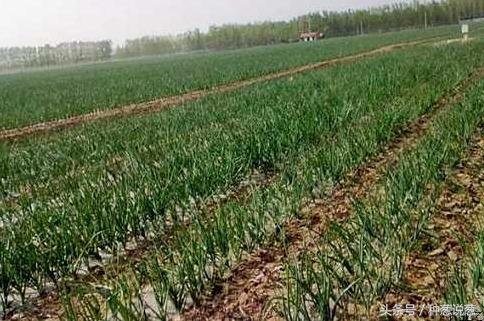
Onion field
So specifically, what should be done when growing onions?
I. Sow at the right time
1. Onion sowing is generally around the Start of Autumn; the method can be drilling in rows or broadcasting, and uniform sowing is required. The seeding rate is about 1.8-2.25 kg per hectare (adjust as appropriate according to the germination rate). A seedbed of one hectare can provide seedlings for transplanting about 15 hectares.
2. Seedling stage management. The onion emergence period is about 7-10 days. After most onions have emerged, irrigate according to soil moisture. After 2 leaves have grown, apply 105-108 kg/ha of urea as a topdressing together with cultivation and weeding, then irrigate. Generally irrigate once every 10 days.
II. Temporary planting of onion seedlings
1. Lift the seedlings in mid-November, tie onion seedlings of the same seedling quality into small bundles, remove seedlings without roots or that are too short, place the tied bundles of onions row by row in a shaded place, and after a row is full, cover the base to the middle-upper part of the onion seedlings with moist soil, then set up the second row and again cover with moist soil for temporary planting to overwinter.
2. Soil treatment. In the following year, the onion planting plot must undergo chemical soil treatment for underground pests and weeds before winter, and be irrigated thoroughly with winter water. For soil treatment of underground pests, spray 3750-6000 ml of phoxim emulsifiable concentrate per hectare on the ground (because it is easily decomposed by light, it should be done in the evening), and evenly turn it into the soil, or evenly apply 22.5-33.75 tons of 5% phorate granules into the soil. For weed soil treatment, spray 2250 ml of Tianpu herbicide or 48% trifluralin per hectare, or spray 2250-3000 ml of 50% acetochlor or 1875-2250 ml of Caicaotong, and evenly turn it into the soil.
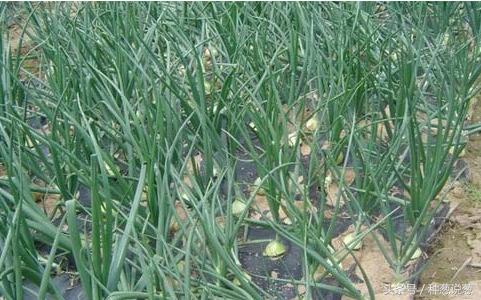
Onion growing
III. Apply enough basal fertilizer and plant at a reasonable density
The onion root system is a fibrous root system composed of string-like adventitious roots. The root system is not well developed and is relatively weak. The root mass is mainly concentrated in the soil at a depth of 20 cm, and its ability to absorb fertilizer and water is weak, so it has relatively high requirements for soil. Onions should not be continuously cropped, and are generally rotated once every 3 years.
1. Land preparation and fertilization. During land preparation, deep plowing is required, and the plowing depth should not be less than 20 cm. The plot should be level, convenient for small-water irrigation (flood irrigation) without water accumulation, and land preparation must be very meticulous. Generally, for medium-fertility fields (bean stubble, corn and other dryland stubble are better), apply 30 cubic meters of high-quality decomposed organic fertilizer per hectare and 450-600 kg of diammonium and phosphorus-potassium compound fertilizer as basal fertilizer. The planting method should preferably use flat beds; generally the bed width is 0.9-1.2 m (depending on the width of the plastic film), and the ditch width is 0.4 m for easy operation.
2. Mulching. Mulching can increase ground temperature and increase yield. Before mulching, irrigate the plot; after the soil dries slightly, harrow and mulch immediately to help preserve soil moisture, and press the film edges tightly. After mulching and before planting, punch holes at a row spacing of 20 cm x 15 cm. The hole-punching tool can be homemade, punching 12 holes at a time.
3. Planting. In February of the following year, when the surface soil thaws about 5 cm, onions can be planted. The planting depth should be such that the heart leaves are not buried and the seedlings do not fall over. Watering should be done so that the seedlings do not fall over and the bed surface does not accumulate water. Plant the seedlings straight and shallow (about 2 cm), with the roots and soil tightly combined. If planted too deep, it easily affects the bulbing of the bulb. After planting, onions enter the seedling recovery stage. Where conditions permit, water after planting; when the seedlings have recovered and grown new leaves, water again.
4. Reasonable close planting. Density is an important factor constituting yield. Onions have few leaves and strong upright growth, so they are suitable for close planting. Experiments show that reasonable close planting can increase onion yield per unit area. The planting density depends on the characteristics of the variety, soil conditions and production goals. Generally, medium-maturing varieties are 330,000-600,000 plants per hectare. If the row spacing is 20 cm x 15 cm, then 495,000 plants are planted per hectare.
IV. Field management
After planting, the relative soil humidity should be kept at 60-80%. If it is lower than 60%, water is needed, limited to when the soil begins to dry. Watering and topdressing should also depend on seedling condition and soil fertility, and generally "frequent light irrigation" should be used. Fertilizer and water management should grasp the principle of "control before the new year, promote after the new year". During the growth period, in addition to basal fertilizer, topdressing is also needed to ensure seedling growth. For plots with poorer fertility, 105-150 kg of urea per hectare can be applied together with watering.
1. Vigorous leaf growth period. When onions have 6 leaves and 1 heart, they enter the vigorous growth period. At this time, the fertilizer requirement is relatively large. Per hectare, 300 kg of urea can be broadcast on the film surface, plus 300 kg of 48% nitrogen-phosphorus-potassium compound fertilizer, which can meet the nutrient needs of onions during the vigorous growth period.
2. Bulb expansion period. When the aboveground part of the onion reaches 9 leaves, it enters the bulb expansion period. The plant no longer grows taller, leaf assimilates are transferred to the bulb, and the bulb expands rapidly. This period is another peak of fertilizer demand, especially the demand for p and k fertilizers increases significantly. Practice has proved that applying 450 kg of 48% nitrogen-phosphorus-potassium compound fertilizer per hectare can ensure normal bulb expansion.
3. Disease and pest control. Onions are susceptible to downy mildew, purple blotch and rust. In rainy and humid weather, downy mildew and purple blotch are more serious. For downy mildew and purple blotch, spray 600x dilution of 75% chlorothalonil or 500x dilution of 64% sandofan; 600x dilution of 25% ridomil or 65% mancozeb can also be sprayed for control. For rust, spray 1500-2000x dilution of 15% triadimefon for control, once every 10-15 days, for 3-5 consecutive sprays. The last use of the above pesticides should be 7-10 days before the harvest period. For onion thrips, spray 800x dilution of 40% omethoate or 300 g/ha of 10% imidacloprid for control. These two insecticides may be used only once during the growth period, and should be spaced more than 15 days from the harvest period.
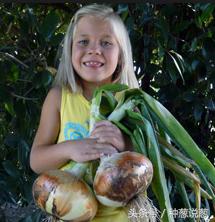
Onion harvest
V. Timely harvest
1. Before harvest, while the leaves have not yet withered and turned yellow, spray the leaf surface with 500 mg/kg of maleic hydrazide (mh), which can prevent sprouting during storage.
2. Stop watering 7-10 days before harvest to prevent the onion bulbs from absorbing enough water while in the field and thus storing poorly.
3. The suitable harvest time is after 30% of the aboveground tubular leaves have naturally fallen over. At this time, the first and second leaves at the base of the plant are withered and yellow, the third and fourth leaves still have some green, the false stem has lost water and become soft, and the aboveground part has naturally fallen over. Harvesting should be done on a sunny day. Pull out the main plant with roots, dry it in the field for 1-2 days; during drying, use the leaves to cover the onion bulbs, drying only the leaves and not the bulbs. The yield is 60-90 t per hectare. To improve the marketable rate and reach the market early, it can also be harvested early.
Onions sold on the market are required to have large bulbs, a crisp and tender texture, fine and dense tissue, and excellent quality. For contract purchases, grading is carried out according to contract requirements. Generally, grade I bulbs have a transverse diameter of more than 8 cm, grade II have a transverse diameter of 6-8 cm, and substandard bulbs have a transverse diameter of less than 6 cm. Keep 1-1.5 cm of the false stem on the bulb and cut it evenly. The onion bulbs are required to be intact, with a clean surface, free of disease and insect mold spots, free of mechanical damage, and free of shriveling or softening.
Finally, I wish everyone can grow onions they like, and I also hope everyone can sell their onions for a good price next year.