Detailed Explanation of Violet Cultivation and Planting Methods and Techniques
Violet, also known as herbaceous violet or herbaceous stock, belongs to the genus Matthiola in the Brassicaceae family, and is a biennial or perennial herbaceous flower. It is native to the Mediterranean coast of Europe, and is commonly cultivated in gardens of various countries. It prefers a cool environment with ample light, and also tolerates partial shade slightly. The optimal growth temperature is 15°C-18°C during the day and about 10°C at night. In winter it can withstand low temperatures of -5°C. It requires loose, fertile, moist, deep neutral or slightly acidic loam soil. Perennial herbaceous flowers are often cultivated as biennials. Sowing propagation is done in autumn, with an optimal germination temperature of 16°C-18°C, and germination occurs in about 4 days. It overwinters in a cold frame, and is planted out in the open field in the following spring, flowering around May 1. Annual varieties can be sown in all four seasons in cool summer regions, and can supply flowers year-round. Cultivation should not be too dense, and attention should be paid to fertilization during the growth period. If maintained properly, it can bloom in mid-April. After flowering, cut off the flower branches and apply topdressing 1-2 times, and it can bloom a second time in June-July.
Violets are generally sown in autumn of the previous year and bloom in spring of the following year. This flower grows 30-50 cm tall, with erect stems and many branches, and the base is slightly woody. The leaves are broad, long elliptical or oblanceolate, with rounded obtuse tips. The raceme is terminal and axillary, the pedicels are thick and sturdy, and the flowers come in colors such as purple-red, pale red, pale yellow, and white. Single-petaled flowers can produce seeds, while double-petaled flowers do not produce seeds. The fruit is a cylindrical silique, and the seeds are winged. The flowering period is March-May, and the fruit ripening period is June-July. The fruit is a silique, which splits open when mature.
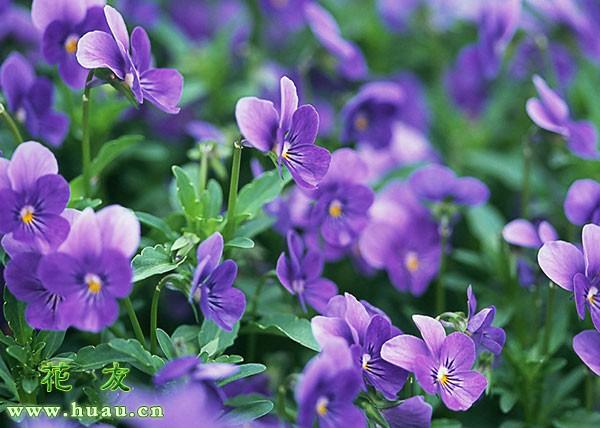
Violet flowers are abundant, with bright colors and a rich fragrance. Violets have a long flowering period, and the inflorescence is also long. They are loved by many flower growers, suitable for potted viewing, suitable for arranging flower beds, steps, and flower paths, or as potted flowers or cut flowers.
Violets are native to southern Europe, and are currently widely cultivated in the southern regions of China. This flower prefers cool conditions, is cold-resistant but not shade-tolerant, and fears waterlogging. It is suitable for growing in environments that are elevated, exposed to sunlight, and well-ventilated with good drainage. It must absolutely avoid muggy heat; during moldy rainy weather that is hot with poor ventilation, it is prone to damage from pests and diseases.
Violet propagation is mainly by sowing. In the central regions of China, sowing is generally done in the open field in mid-September. For seed collection, single-petaled flowers should be selected as the mother plant, because double-petaled flowers lack pistils and cannot produce seeds. Seeds collected from potted mother plants yield a higher proportion of double petals in the second generation. Before sowing, the potting soil should be relatively moist. After sowing, cover with a thin layer of fine soil and do not water again. If the potting soil dries out within half a month, the pot can be placed half-submerged in water so that water enters from the bottom of the pot to moisten the soil. After sowing, pay attention to shading, and seedlings will emerge in about 15 days.
Before the true leaves of the seedlings unfold, they can be transplanted into the seedbed at a spacing of 6×8 cm between plants and rows. When pulling up the seedlings, be careful not to damage the root hairs, and keep a soil ball. Before planting out, some dry pig or chicken manure should be applied to the soil as base fertilizer. After planting out, water thoroughly to settle the roots, and provide shade without making it stuffy; potted plants should be moved to a cool, airy place, and after they survive, moved to a place with ample sunlight, watered once every other day, and given a decomposed liquid fertilizer once every 10 days, stopping immediately after flowering. For tall varieties, after flowering it is advisable to cut off the flower branches and apply diluted liquid fertilizer 1-2 more times, which can promote new side branches. Before the first frost arrives, field-planted ones should be dug up with a soil ball, heeled in in a sunny bed, or placed in flower pots indoors to overwinter.
For more flower-growing experience, succulent cultivation, bonsai appreciation, and to communicate with fellow flower lovers, please go to the Flower Friends Micro Community: http://m.huau.cn, or follow the WeChat public account: huaucn. To join the Flower Friends WeChat group, please add the WeChat private account: wwwhuaucn.