How to Grow Eggplants for High Yield: A Detailed Guide to Cultivation Techniques
I. Variety Introduction
Superior varieties are the prerequisite for obtaining relatively high economic returns, and choosing good seed is an economical and effective means of preventing disease and controlling pests.
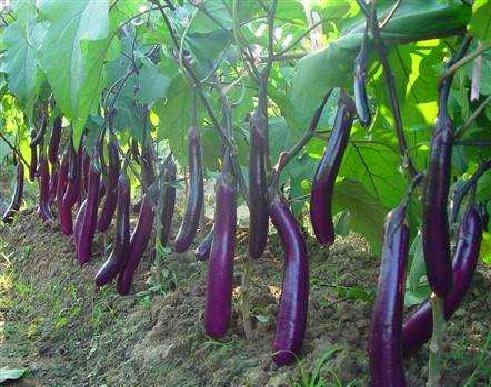
The superior eggplant varieties currently relatively suitable for cultivation in our county are: Changfeng No. 2 Purple Long Eggplant, with a yield of about 4000 kg per mu. Qiong No. 2 Purple Male Eggplant, with a yield of about 3000 kg per mu. Zigui Ren Purple Long Eggplant, with a yield of about 3000 kg per mu. Among them, Changfeng No. 2 has the largest cultivation area.
II. Soil Conditions
Loam or sandy loam with deep, fertile, soft and loose soil and good drainage and irrigation is best; compacted soil and soil with a leaking bottom layer must be avoided.
III. Suitable Sowing Time and Specifications
For winter planting, the suitable sowing time is from early September to the end of November.
For seedling raising and transplanting, the seeding rate is about 25 grams per mu, and about 900 plants are planted per mu.
Plant spacing 60-70 cm, row spacing 90-100 cm.
IV. Seed Treatment
1. Hot water seed soaking method
First soak in clean water for about 8 hours, then soak the seeds in 55°C warm water for 20 minutes to kill pathogens on the seed surface.
2. Pesticide treatment method
Soak the seeds in a 500-fold dilution of 50% carbendazim for 15 minutes; after soaking, rinse 3-4 times and then the seeds can be germinated.
V. Preparation of Seedling Nutrient Soil
Mix 2 parts garden soil, 1 part pig and cattle manure residue (after fermentation), 1 part rice husk ash, and 1 part compound fertilizer; mix together thoroughly several times and then sieve before use for seedling raising.
VI. Disinfection of the Seedling Bed
Spray the seedling bed with a 500-fold dilution of 50% carbendazim + a 500-fold dilution of 58% metalaxyl, then cover with plastic film for 3-4 days before uncovering the film for seedling raising.
The nutrient soil must never use soil that has previously grown eggplants. For seedling raising, it is better to use nutrient bags in most cases, which helps the transplants survive.
VII. Soil Preparation
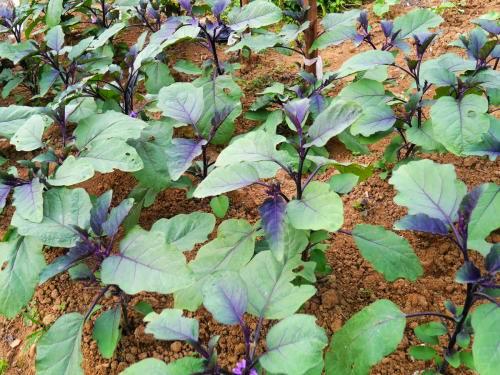
In order for eggplants to grow early and develop quickly after planting, soil preparation must be done well before planting; three ploughings and three harrowings are required so that the soil becomes fine and crumbly, and at the same time the work of making beds and applying sufficient base fertilizer must be done well.
VIII. Adjusting Soil pH and Applying Sufficient Base Fertilizer
Most soils are acidic or slightly acidic, which favors the occurrence of bacterial wilt, so it is required to add 50 kg of lime per mu to neutralize the soil. The lime should be broadcast on the surface during the first ploughing and turned under for about 15 days; at the same time, sufficient base fertilizer should be applied. The amount of base fertilizer should be determined according to the target yield and the abundance or deficiency of soil fertility. Generally, it is required to apply 2000 kg of pig and cattle manure per mu plus 50 kg of calcium magnesium phosphate fertilizer + 50 kg of compound fertilizer, mixed and composted before application.
IX. Germination and Sowing
After seed treatment, soak the seeds in clean water for 6-8 hours, then wrap them well in wet gauze and place them in a warm bed maintained at 24°C-30°C, keeping the temperature and generally turning them once every 6 hours, and replenishing water in time.
When the temperature is relatively low, use electric lights to control the temperature. When 80% of the seeds have white sprouts showing, germination can be stopped and sowing can begin.
The transplanting time for eggplant seedlings is generally when the seedling age is 28-30 days; they can be transplanted at the 8-10 true leaf stage. Transplanting seedlings that are too young makes survival difficult, while seedlings that are too old are difficult to grow early and develop quickly.
X. Plant Training
For varieties with relatively vigorous growth, following the principle of improving ventilation and light penetration and increasing photosynthetic productivity, the natural open-center pruning method is generally used; that is, at each layer of branching, keep the two symmetrical branches that grow diagonally opposite or horizontally, remove all other branches, especially those growing upward, and remove overly dense leaves, especially old leaves.
XI. Topdressing Management
1. Apply light fertilizer to promote seedling growth.
2. Apply heavy fertilizer after fruit set.
3. Apply fertilizer skillfully to strengthen fruit development.
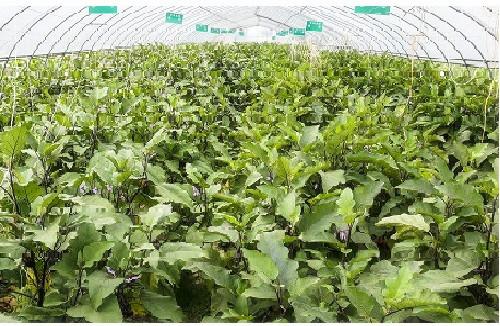
The specific practices are as follows: the seedling-promoting fertilizer is applied about one week after planting, when the root system is not yet well developed, using about 10 kg of compound fertilizer per mu, diluted with water and poured on. During the vigorous growth period, topdress 3-5 times. When the first eggplant on the plant swells, apply a relatively large amount of organic fertilizer and compound fertilizer once. Use 500 kg of organic fertilizer plus 50 kg of compound fertilizer, and during the fruiting period apply 15 kg of compound fertilizer once every 10 days. During the fruit-bearing period, focus mainly on nitrogen and potassium to promote nutrient transport and coordinated growth.