What growing environment conditions does walnut cultivation require?
. 1. Growth characteristics of walnut
Walnut is a light-loving, sun-demanding tree species, suitable for growing in sheltered, sunny places with neutral to slightly acidic soil. In Yunnan Province, it is cultivated from 21°08'32" to 29°15'08" N and 97°31'39" to 106°11'47" E, at altitudes of 700-3200 m. The average annual temperature in its distribution area is 6.1-20.6°C, with 12.4-15°C being more suitable; in places where the annual temperature is below 12°C, the walnut shell becomes thinner and may even show exposed kernels. When the winter temperature drops to around -10°C, the branches of young walnut trees suffer cold damage.
2. Analysis of walnut conditions
Walnut has a long cultivation history; in the eastern mountainous areas there are old walnut trees that have grown for over a hundred years. At present, the whole county has a total of 200,000 mu of walnuts, with the main varieties consisting chiefly of five new early-fruiting hybrid walnut varieties (Yunxin 301, Yunxin 303, Yunxin 306, Yunxin Gaoyuan, Yunxin Yunlin), Yangbi Dapao walnut, Dayao Santai walnut and other fine varieties. In the course of walnut development, it has successively withstood various natural disasters, but most of the surviving trees have already borne fruit.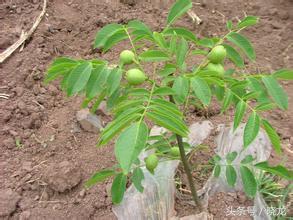
Walnut
Northern subtropical plateau monsoon climate type, dry in winter and wet in summer. The climate is characterized by mild conditions all year round, with no severe cold in winter and no extreme heat in summer, warm and dry springs, cool and humid autumns, concentrated rainfall, and a clear distinction between dry and wet seasons. The average annual temperature is 14.8°C; the average temperature in January, the coldest month, is 7.5°C; the average temperature in June, the hottest month, is 41%, and at this time there is also little rainfall, accounting for only 16% of the annual total, with relative humidity of only 62%, and only 50% in March, the lowest month. Sunshine duration is greater in the dry season than in the rainy season, and within a year it is greatest in spring, at 729.5 h, accounting for 32.5% of the annual total.