What are dental implants? Let's take a closer look and find out

The youth we once had has gradually drifted away from us. After the age of forty, ever greater changes take place in our appearance, physiology and body in every respect. At this tail end of youth, oral and dental problems become the key issue.
If you lose a front tooth, your mouth will look aged and unnatural, which affects your appearance and also lets air escape when you speak; if you lose a molar, your chewing function will deteriorate, which in turn affects your appetite and digestive health. So how do you deal with these annoying oral "troubles"? Dentists say that with the growing maturity of "dental implant" technology, patients no longer need to worry about missing teeth.
The youth we once had has gradually drifted away from us. After the age of forty, ever greater changes take place in our appearance, physiology and body in every respect. At this tail end of youth, oral and dental problems become the key issue.
If you lose a front tooth, your mouth will look aged and unnatural, which affects your appearance and also lets air escape when you speak; if you lose a molar, your chewing function will deteriorate, which in turn affects your appetite and digestive health. So how do you deal with these annoying oral "troubles"? Dentists say that with the growing maturity of "dental implant" technology, patients no longer need to worry about missing teeth.
Advantages of dental implants:
1. Comfortable and attractive
Dental implants do not need structures such as bases or clasps to hold them in place; in appearance and function they are exactly like real teeth. A successful dental implant leaves no foreign-body sensation in the mouth, helps maintain oral hygiene, and is comfortable and attractive, letting you forget that dentures are even there. Of course, dental implants must also be cared for as carefully as real teeth if their lifespan is to be extended as much as possible.
2. A wider range of indications
With the continuous development of dental implant technology, the indications for dental implants keep expanding, and almost any missing tooth can be restored with an implant. Because a dental implant is an independent implant body that does not need to rely on the base or clasp of an adjacent tooth, even when the alveolar bone volume is insufficient, this can be solved through bone grafting; even in the case of a completely edentulous mouth, artificial tooth roots can still be implanted to give patients with full-mouth tooth loss the chance of fixed denture restoration.
3. Protecting adjacent teeth
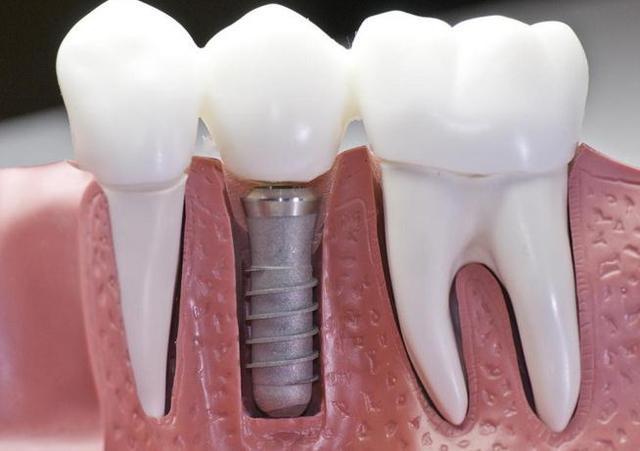
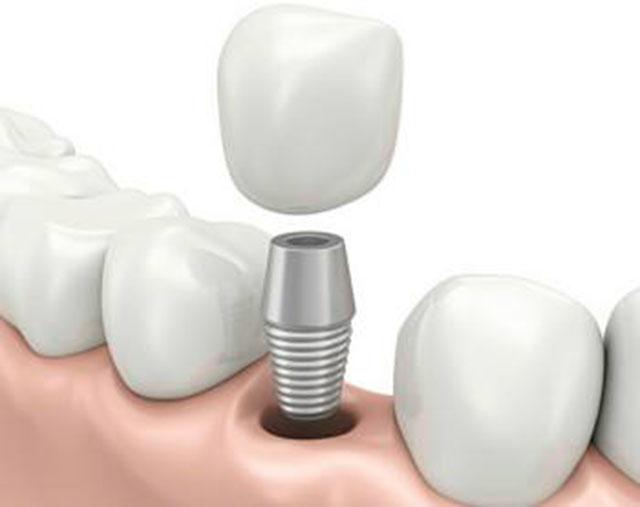
A dental implant places an artificial tooth root into the alveolar bone at the site of the missing tooth and fits a porcelain-fused-to-metal crown onto that artificial root. It has its own independent root for retention and does not need to rely on adjacent teeth for support. It does no harm at all to healthy adjacent teeth, and can also prevent the shifting of adjacent teeth or loosening of teeth caused by a missing tooth.
4. Stable and secure
Like a real tooth, a dental implant consists of two parts, the root and the crown. The implant (that is, the artificial tooth root) is made of pure titanium metal with excellent biocompatibility and is connected to the alveolar bone through osseointegration. It is very firm and can take root in the patient's mouth just like a real tooth, deep-rooted and therefore stable.
5. Protecting the alveolar bone
Dental implants do a good job of protecting the entire alveolar bone. Human teeth are like a big tree: only when the tree is deep-rooted can it flourish. After teeth are lost, the alveolar bone is like soil suffering erosion, and the alveolar bone undergoes varying degrees of disuse atrophy and resorption. The artificial tooth root of a dental implant is planted deep in the alveolar bone, so it can effectively prevent alveolar bone atrophy and alveolar bone resorption.
6. Scientific principle
Natural teeth transmit the chewing pressure in the mouth to the alveolar bone through the tooth root, while dental implants transmit chewing pressure to the alveolar bone through the artificial tooth root (the implant). The biomechanical principle is the same, so they can withstand great force, and chewing efficiency is greatly improved compared with traditional dentures.
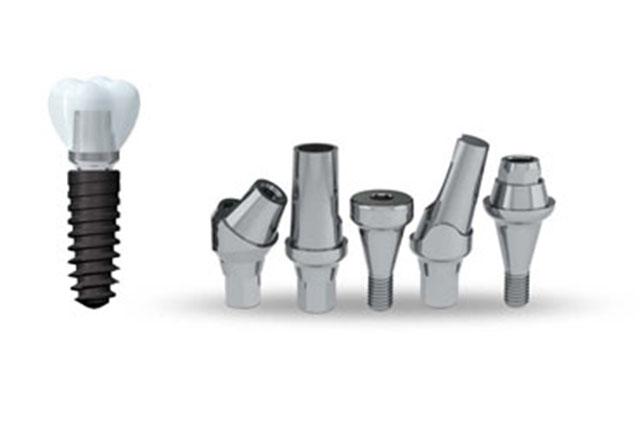
Besides dental implants, the tooth-loss restoration methods people are familiar with also include removable dentures and fixed bridge restoration, but these two restoration methods can hardly achieve the feel of natural teeth. Only dental implants come closer to natural teeth.
One of the greatest functions of teeth is chewing and grinding food, so the bite force of teeth is very important. According to statistics, removable dentures can restore only 30~40% of the bite force of natural teeth, and fixed bridges can restore only 60% of the bite force of natural teeth. Dental implants, however, can fully achieve the bite force of natural teeth. Of course, while paying attention to bite force, giving customers an attractive dental restoration and satisfying them in both function and appearance is also the future prospect of implant restoration.