How to Grow Blueberries: A Detailed Guide to Cultivation Methods
In recent years, with the development of protected agriculture, greenhouse cultivation techniques have been widely applied to blueberry growing. Growing blueberries with greenhouse technology can improve the regional adaptability of blueberry cultivation, increase yields and enhance the commercial value of the fruit. So, how do you grow blueberries? The key technical points for greenhouse blueberry cultivation are introduced below.
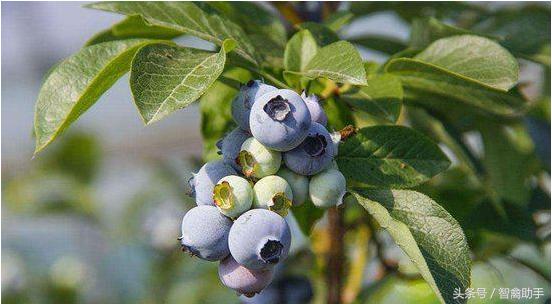
Image: Blueberry cultivation
I. Construction of the solar greenhouse
1. Site selection for the greenhouse:A solar greenhouse should be built on a site with flat terrain, good light, high soil organic matter content, convenient drainage and irrigation, and no pollution of soil, water or air. When choosing a planting plot, the soil pH and organic matter content should be determined or measured. If the site is mountainous, choose the middle and lower parts of a sunny slope as far as possible; the slope should not exceed 15°, and if it is greater than 15°, terraces at least 8 m wide should be built.
2. Specifications and standards for the greenhouse:The greenhouse span is generally about 8-10 m, the wall thickness is 1 m, the ridge height is 4 m, and the rear wall height is 3 m. In the rear wall, at a height of 1.5 m above the ground, a 60 cm x 60 cm vent is set horizontally every 4 m; the length of the greenhouse is unlimited. The rear wall of the greenhouse may be either earth-mounded or brick-built. There should be a certain spacing between greenhouses, no less than 1.8 times the greenhouse height, on the principle of not shading one another. For the film, two types can be used: PE drip-free plastic film made mainly from polyethylene and PVC drip-free plastic film made mainly from polyvinyl chloride. The temperature most suitable for blueberry growth inside the greenhouse is 20-25°C; it must not exceed 30°C at the highest or fall below 12°C at the lowest.
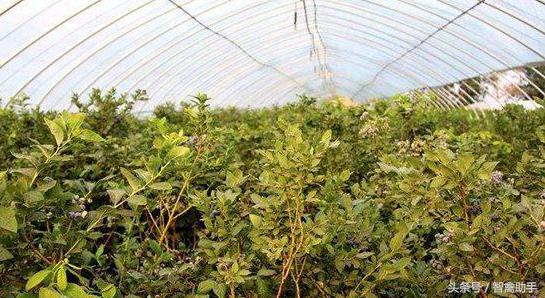
Image: Blueberry cultivation
II. Soil conditions and soil improvement for greenhouse blueberries
Soil conditions such as pH, organic matter content, water retention, aeration and drainage have a major impact on blueberry growth and are an important prerequisite for whether blueberries can be grown successfully.
1. Soil acidity and alkalinity:Blueberries prefer acidic soil. Most blueberries can grow normally in acidic sandy soil with a pH of 4.3-5.3, but different blueberry varieties require different soil pH ranges. For highbush, the suitable soil pH is 4.3-4.8, with 4.5 being the best; its lower pH limit is 3.8, and below 3.8 it causes damage to plant growth. The soil pH selected should be below 7.0, with 4.0-6.0 being the most suitable.
2. Soil organic matter content:Blueberries are suited to growing in soil with an organic matter content of 3%-15%. Highbush blueberries especially need soil with high organic matter content and must be grown in soil with an organic matter content above 3% to grow healthily.
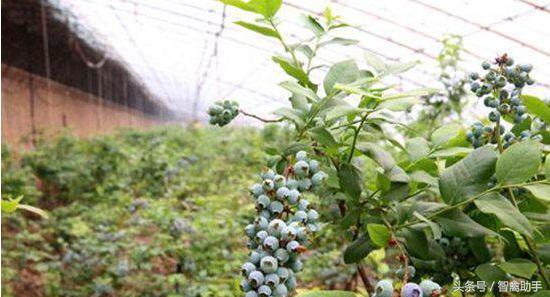
Image: Blueberry cultivation
3. Soil aeration and water retention:The effective soil layer for blueberry cultivation should generally be maintained at about 50 cm. Ensuring soil aeration and water retention is crucial in blueberry cultivation; highbush blueberries in particular require better aeration and water retention. For general soil, a three-phase distribution of 45%-50% solid phase and 20%-30% each of gas and liquid phases is relatively ideal, but for blueberry cultivation sites a combined gas and liquid phase value of 55%-60% is the most ideal. To achieve a relatively reasonable three-phase soil state, deep tillage of 30-40 cm can be carried out, then according to the soil conditions, decomposed moss, sawdust, cow manure, etc. can be appropriately added and mixed into the soil; afterward, when planting the seedlings, 30 cm-high ridges should be made. In this way, the basic requirements for blueberry growth can be met.
4. Methods for adjusting soil acidity and alkalinity:The main problem with soil in most parts of China is that the pH is too high. In greenhouse cultivation, organic soil suitable for blueberry growth can be prepared before planting, but it is still difficult to fully meet the soil pH requirements of the varieties, so the soil acidity and alkalinity must be adjusted before planting. At present, the most commonly used soil adjustment method at home and abroad is applying sulfur to adjust soil pH. The main feature of sulfur in adjusting soil pH is that its effect is long-lasting and stable. After sulfur is applied to the soil, it needs 30-50 d to decompose before it can act to adjust soil pH. The target for soil pH adjustment should be set at 4.5. If the expected target is not reached after adjustment, a second adjustment can be made by spraying 90% water-soluble sulfur. Under sandy soil conditions, for every 1 percentage point reduction, 15 g/sq m of water-soluble sulfur can be used as the standard; for other soil types, the amount is twice that for sandy soil. However, the amount of water-soluble sulfur applied each time should not exceed 178 kg/hm2; if it must be applied in excess, it should be split into 2 applications in spring and autumn.
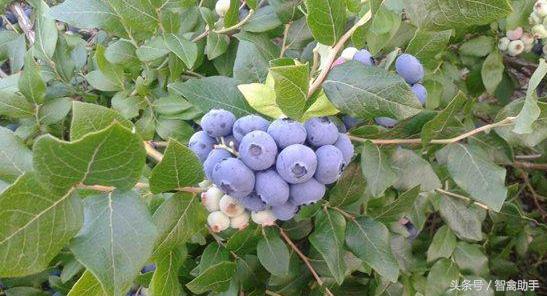
Image: Blueberry cultivation
III. Planting density and variety combinations for greenhouse blueberries
1. Planting density:In open-field cultivation, highbush blueberries generally use a spacing of 1.0 m x 2.0 m between plants and rows. For forcing cultivation in greenhouses, the planting density is generally required to be slightly higher than in open fields, and a spacing of 0.5 m x 1.5 m between plants and rows is generally more suitable.
2. Land preparation:For general open-field planting, the planting hole specifications are 1.0 m x 1.0 m x 0.5 m. After the planting holes are dug, mix the removed soil with crushed pine bark and peat or humus soil from under pine forests, etc.; after mixing evenly, backfill it into the holes. The backfilled soil should be 20-30 cm above the ground. If the soil acidity is insufficient, an appropriate amount of sulfur powder can be mixed in. Greenhouse cultivation can refer to the land preparation methods for open-field cultivation, but the depth and degree of land preparation must be greater than in open-field cultivation. Generally, it is best to prepare the land comprehensively, using 50% garden soil and adding 50% peat, leaf mold, etc. to increase the soil organic matter content and aeration. After land preparation, make beds 20-30 cm high, and the seedlings can be planted directly at planting time.
3. Variety arrangement and planting time:Highbush blueberries can set fruit through self-pollination, but combining several varieties can significantly increase the fruit-setting rate. Therefore, when carrying out forcing cultivation of blueberries in greenhouses, it is best to arrange two or more highbush blueberry varieties for mutual pollination to improve yield and quality. The ratio of the main planted variety to pollinizer trees is generally 2-3:1. The planting depth for 1-year-old seedlings is 15-20 cm. For each additional year of seedling growth, the general planting depth should be increased by 5 cm, and the soil should be covered and pressed firm. If potted seedlings are used, they can be planted in all four seasons.
Image: Blueberry cultivation
IV. Production management techniques for greenhouse blueberries
1. Fertilization:Blueberries have a very low demand for fertilizer. When soil acidity is adequate, generally only a small amount of N fertilizer needs to be applied; excessive fertilization often leads to fertilizer excess that harms the tree and affects yield. Nitrate N is prohibited; urea is better. When applying K fertilizer, never apply KCL; K2SO4, etc. can be used. In production, organic fertilizer and farmyard manure such as pig and cow manure should be applied as much as possible. Green manure such as white clover can also be sown. The fertilization method is generally trench application, which can effectively reduce the loss of fertilizer and water. When applying chemical fertilizer, the trench width is 20-25 cm and the trench depth is 10-15 cm; when applying farmyard manure or green manure in autumn and winter, the trench width is 30-35 cm and the trench depth is 35-40 cm; green manure is buried in the soil by digging and turning under. Fertilization time is generally divided into 3 applications: at budding, at fruit ripening and after harvest.
2. Irrigation:The blueberry root system is shallow and prefers moisture, so timely irrigation is very necessary. Irrigation requires attention to water source and water quality. Deep well water generally has a high pH and high sodium and calcium content; long-term use will affect blueberry growth and yield. During irrigation, sulfuric acid can be used to adjust the pH to about 4.5 before watering, but after every 3 irrigations, 1 application of acid water should be given.
Image: Blueberry cultivation
3. Temperature control:The key to forcing cultivation is to break the blueberry flower bud differentiation period and dormancy period. The temperature most suitable for blueberry growth inside the greenhouse is 20-25°C; it must not exceed 30°C at the highest or fall below 12°C at the lowest. The chilling requirement of highbush blueberries must be accumulated over 800-1200 h at low temperatures of 0-7.2°C. When the chilling requirement is insufficient, it causes poor sprouting and insufficient flowering, affecting fruit yield and quality. The key to achieving off-season blueberry production is to adjust the dormancy time of blueberries at the right time. It is worth noting that whether entering dormancy early into the low-temperature state or shifting to the growth period after dormancy is completed, temperature control must be carried out slowly, and the temperature difference must not be too great within a short time, so as not to affect blueberry growth and development. The greenhouse is in a sealed state, and because blueberry respiration and the decomposition of soil organic matter can greatly change the gas composition inside the greenhouse, which affects blueberry growth, appropriate ventilation must be carried out every day. Generally, without letting the greenhouse temperature drop below 12°C, open the vent at 11:00 each day and close it at 16:00.
4. Shaping and pruning of greenhouse blueberries:Pruning in the young tree stage. In this period, the main task is removing flower buds, with the aim of expanding the canopy, increasing the number of branches and promoting root development. In the 2nd and 3rd spring after planting, thin out weak and small branches; in the 3rd and 4th years, the main focus is still expanding the canopy, but a moderate amount of fruiting is allowed. Generally, in the 3rd year the yield per plant should be controlled below 1 kg, with fruiting mainly on strong branches. Pruning of mature trees. At this time, pruning is mainly to control tree height and improve light conditions, mainly by thinning branches, removing overly dense branches, thin and weak branches, diseased and pest-damaged branches, and root suckers. For varieties with a more spreading root habit, when thinning branches, remove the weak and keep the strong; for upright varieties, remove the central leader, open the top, and keep medium branches. The best fruiting age for large branches is 5-6 years old; beyond that, they should be renewed by timely heading back. For weak and small branches, wipe out the flower buds to make them grow stronger. Adult trees have a large number of flowers, so some flower buds should be cut off; generally keep 4-6 flower buds per strong branch.
Image: Blueberry cultivation
V. Pollination of greenhouse blueberries
When growing blueberries in greenhouses, the best pollination method is to combine honeybee pollination with artificial pollination. One beehive can be placed in each greenhouse during the flowering period, and pollination is carried out by honeybees, but some spots may be missed. At this time, artificial pollination is needed as a remedy, and low-concentration gibberellin can also be sprayed to promote fruit expansion. Experimental results show that keeping honeybees is currently the most economical, efficient and high-yielding method.
VI. Harvesting greenhouse blueberries
The fruit ripening period of highbush blueberries is not uniform, and harvesting generally lasts 3-4 weeks, so harvesting should be done in batches, generally once every 1 week. After harvesting, put the fruit into plastic food boxes, then place them in shallow trays and transport them to market for sale. Try to avoid squeezing, exposure to the sun, wind and rain, etc.
[Editor's Conclusion]Using greenhouse cultivation technology to grow blueberries is an important measure for achieving high yield, high quality and high efficiency in blueberries, and it is of great significance. The above has introduced the key technical points for greenhouse blueberry cultivation, and we hope it will be helpful to everyone!