Detailed Explanation of Castor Bean Planting Methods and Technical Key Points
Castor bean is an annual or perennial herbaceous plant of the genus Ricinus in the spurge family (Euphorbiaceae). Its cultivation value is extremely high, and planting in more than 30 countries worldwide has reached industrial scale. The output from countries such as India, China, Brazil, the former Soviet Union, Thailand, Ethiopia and the Philippines accounts for nearly 88% of the world's total castor bean production.
It is cultivated throughout China. It is distributed from Hainan to south of 49° north latitude in Heilongjiang. It is most abundant in North China and Northeast China, followed by Northwest China and East China, with scattered planting elsewhere. In tropical regions, there is semi-wild perennial castor bean.
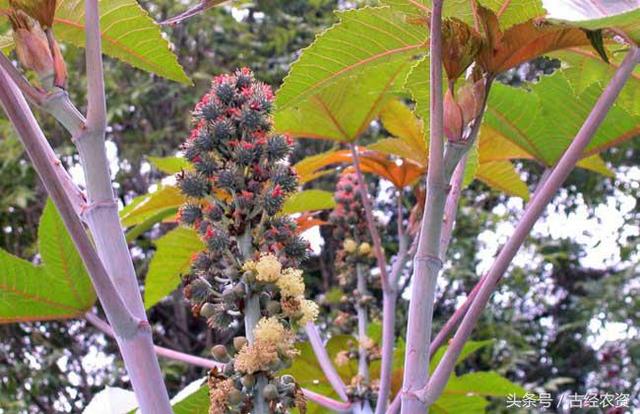
The best preceding crops for castor bean are legumes, wheat and barley; it should not be planted on sweet potato land. A rotation of more than 4 years is generally adopted. Deep plowing requires a plowing depth of more than 33 cm, and clayey soil should be plowed even deeper. Autumn plowing should be adopted, and after plowing, timely harrowing and rolling should be done to preserve soil moisture. On sandy dunes and saline-alkali land, more organic fertilizer should be applied as base fertilizer. Generally, the base fertilizer per mu should not be less than 1500 kg to maintain a balanced supply of nutrients throughout the entire growth period.
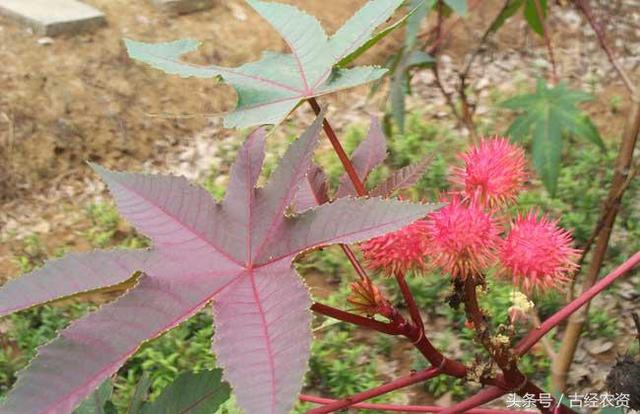
The main ear or the ears on the first-order branches, and the earlier-maturing seeds of castor bean are superior seeds. Seed selection methods such as screening and winnowing can be adopted, and then on a sunny day the selected seeds should be spread in a thin layer and dried for 2 to 3 days, being turned 2 to 3 times each day.2 to 3 days before sowing, soak the seeds in 45°C warm water for 4 hours, or soak them in 25°C warm water for 1 day and night, during which hot water should be added to maintain the water temperature, and they should be stirred 5 to 6 times. After soaking, place the seeds in a 25°C greenhouse to germinate for one day and night, turning them several times. Once the seed coat is seen to split, they can be sown.
Plots with poor soil moisture should be sown early to take advantage of the moisture from April 15 to 20, while plots with better soil moisture should be sown around the end of April, with a sowing depth of 5 to 7 cm being suitable. Place 2 to 3 seeds per hole, and cover with soil after sowing. Sowing density should be reasonably determined according to variety characteristics and local natural conditions. If the humidity is relatively high at sowing time, the soil should first be "air-dried for moisture adjustment," and when the surface is dry, then compacted. When soil moisture is moderate or insufficient, the grid can first be treaded, and after sowing, the soil should be compacted in time.
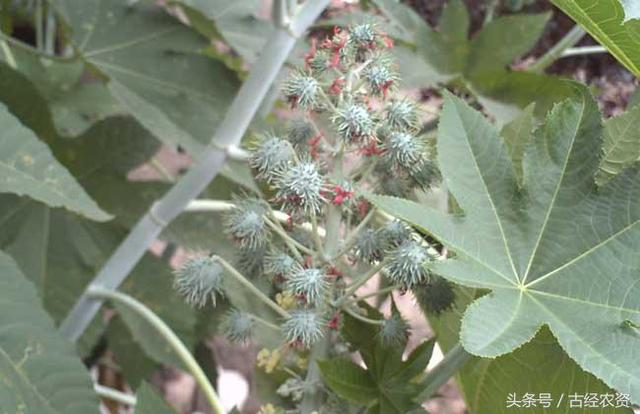
Castor bean transplants easily during the seedling stage (before 3 true leaves), and if missing plants are found, they should be transplanted and filled in promptly. Final thinning is carried out at the 3 to 4 true leaf stage, leaving 1 plant per hole. If final thinning is too late, weak seedlings will form and affect yield. For planting on barren hills and slopes, final thinning can be postponed somewhat. On poor land with little base fertilizer, topdressing should be done in two applications, with 15 kg of diammonium phosphate or ammonium nitrate, or 7.5 kg of urea, applied per mu each time at the final thinning stage and the ear formation stage.
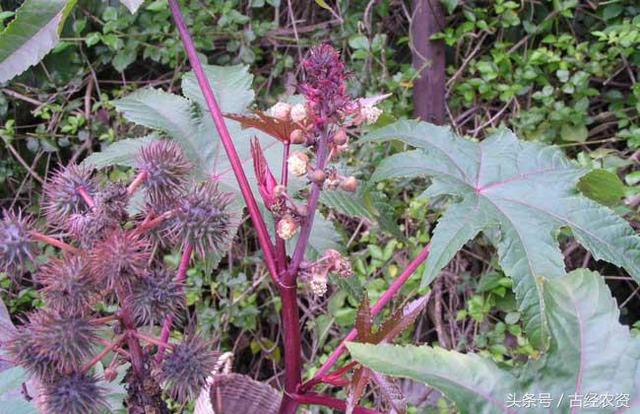
In castor bean cultivation, cultivation is generally done once in early June, once in mid-June, and once in early July. Before the second and third cultivations, the field should be hoed once each time, and after that, one autumn ridging should be done. Cultivation and topdressing can be carried out together. Note that after cultivation, if drought occurs, irrigation must be done promptly to ensure robust growth of castor bean.
When castor bean has formed 5 to 6 true leaves, choose a sunny day to remove the terminal bud of the main stem of the plant, and afterward control the number of ears according to the variety type. For branches at all levels that only grow leaves and do not bear fruit, remove them all during pruning. Pruning cannot be interrupted, and the number of branches retained depends on the growth condition. Another method is to retain the terminal bud of the main stem and control the number of ears retained according to the variety type.
Medicinal value
Leaves: reduce swelling and draw out toxins, relieve itching. To treat sores, ulcers, swelling and toxins, pound fresh leaves and apply externally; to treat eczema and itching, decoct in water and wash externally; it can also kill maggots and mosquito larvae.
Root: dispel wind and invigorate blood, relieve pain and calm the mind. Used for rheumatic joint pain, tetanus, epilepsy, and schizophrenia.