High-Yield Potato Cultivation and Management Techniques and Integrated Pest and Disease Control
The potato is currently the most important food crop in the world, after cereals, used as a staple food for humans, with its underground tubers being the main part consumed. It is widely cultivated around the world, and thousands of varieties have been developed. Today let us learn about potato cultivation techniques.

Potato Cultivation Techniques
1. Cutting seed potatoes and sprouting
20 days before sowing, sprouting is started around early March. When cutting the seed potatoes into pieces, each piece should have at least one eye. 10-15 pieces per jin is ideal. After cutting, sterilize and disinfect by dry-mixing with plant ash or soaking the seed pieces in a 1:200 dilution of carbendazim powder in water. After the seed pieces are air-dried, start sprouting them in a seedbed. There are two methods:
One is to sprout them in sand in a corner of a room at a room temperature above 15°C, with one layer of sand and one layer of seed pieces;
The other is to dig a pit outdoors in a ventilated, sunny spot running east-west for sprouting, with a pit depth of about 25 cm, one layer of sand and one layer of seed pieces, preferably 3 layers, then cover with an arched shed film, and add straw curtains at night for insulation. During the sprouting period, both methods require sprinkling water 1-2 times to prevent drying out. When the sprouts grow to 0.5-1.0 cm in length, begin sowing.
2. Land preparation and trenching
Before planting, check the soil moisture. If the moisture is poor, consider irrigating the trenches to build up moisture, preferably 7-10 days before planting. Potato planting generally uses double-trench planting; when trenching, a large row spacing of 50 cm and a small row spacing of 40 cm can be used.
3. Sowing and covering with film
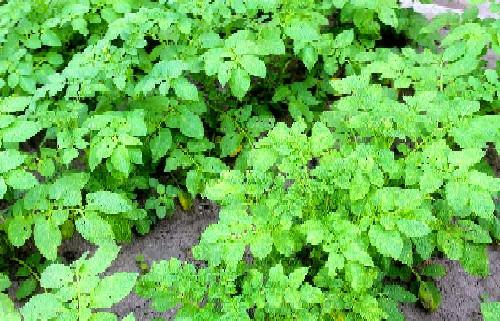
The best period is from the Spring Equinox to Qingming. It should be especially noted here that virus-free potatoes can be sown earlier, completed before the Spring Equinox, with plant spacing controlled at 20 cm. Before sowing, first spray the trenches with a 1:10000 dilution of phoxim in water to prevent underground pests. Organic fertilizer can be spread directly into the trenches or applied during land preparation; chemical fertilizer can be applied into the trenches or scattered between the seed pieces (note that it must not come into direct contact with the seed pieces). When sowing, there are two ways to place the seed pieces into the trenches: one is with the sprouts facing down, which produces potatoes with long roots and strong seedlings, fewer potatoes but larger tubers, though the seedlings emerge 2-3 days later; the other method is with the sprouts facing up, which produces potatoes with relatively shorter roots, smaller but more numerous tubers, and the seedlings emerge 2-3 days earlier. After planting, take soil from both sides within the large rows to cover the potato trenches and the spaces in the small rows, then rake level, cover tightly with micro-film, and press firm.
4. Emergence, ventilation, and seedling-stage management
After Qingming, about 20 days after sowing, the seedlings emerge from the soil. At this time, break open the micro-film at the seedling positions to let air in, to prevent the seedlings from being scorched. When the seedlings grow to 10 cm tall, press soil firmly around the seedlings over the film to retain moisture and suppress weeds. In the early stage of potato growth, do not water; water only after flowers appear. If there is drought with no rain, water once every 10 days; generally 2-3 waterings are enough for the potatoes to mature, and stop watering 10 days before harvest. During the seedling stage, prevent pests such as aphids and thrips.
5. Rational fertilization
Potatoes respond well to farmyard manure, preferably 4000-5000 jin per 666.7 sq m, and when applying chemical fertilizer appropriately, nitrogen, phosphorus, and potassium should be used in combination. Potatoes have a high demand for potassium; the scientifically reasonable ratio of nitrogen, phosphorus, and potassium is 1.85:1:2.1. Potatoes like to absorb ammonium nitrogen and absorb relatively large amounts of sulfur. According to experiments, for every additional 1 kg of potassium sulfate fertilizer applied, potato yield can increase by 100-150 kg.
Pest and Disease Control of Potatoes
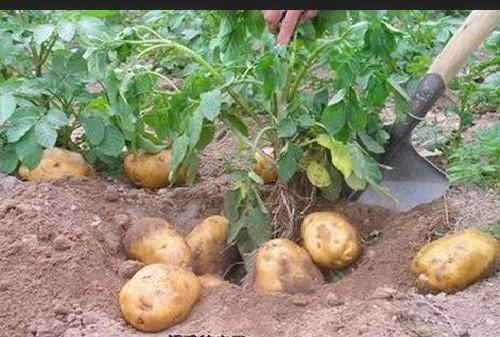
1. Ring rot. After seedlings become diseased, they grow slowly, leaflets wrinkle, and leaves curl; in severe cases, the seedlings die. At flowering, the diseased plant wilts from bottom to top, then dies. When a diseased tuber is cut open, a milky-white or brown ring-shaped rot can be seen. Ring rot is mainly carried by seed potatoes; control mainly involves selecting disease-free seed potatoes and paying attention to disinfecting cutting tools during cutting to prevent transmission.
2. Viral disease. Symptoms include stunted plants, slow growth, downward-curling leaves, and dark green leaf color. Control of viral disease should be carried out in three aspects: 1. When planting, choose disease-resistant varieties; whole tubers or true potato seed can also be used for planting. 2. Timely control aphids to avoid their spread of the virus; spray with 40% omethoate at 1000 times dilution. 3. After disease onset, spray with 25 g of virus A mixed with water at 500 times dilution.
3. Insect pests. The main insect pests of potatoes are the 28-spotted ladybird and white grubs, among others. Ladybirds can be killed by spraying 80% trichlorfon wettable powder or 80% dichlorvos emulsifiable concentrate each at 1000 times dilution, or 2.5% deltamethrin emulsifiable concentrate or 10% cypermethrin emulsifiable concentrate at 3000 times dilution, once every 10 days. White grubs are generally controlled by integrated methods, such as not applying undecomposed fertilizer, manual capture, and using black light traps to kill adults.
Chemical control mainly targets larvae; use 50% phoxim, water, and seed in a ratio of 1:50:600, mix with seed, air-dry, then sow. Or use 80% trichlorfon wettable powder plus 15 kg to 20 kg of fine soil to make medicated soil and scatter it in the sowing trenches.
The above has introduced potato cultivation techniques and pest and disease control methods. We hope it is helpful to everyone.