What are the key points to remember when growing monk fruit? Keep these essentials in mind
This article mainly explains the key points to remember when growing monk fruit in detail from the aspects of monk fruit introduction, growth habits, site selection, sowing and seedling raising, seed storage, planting, field management, pest and disease control, etc., to help you grow large, plump monk fruit.
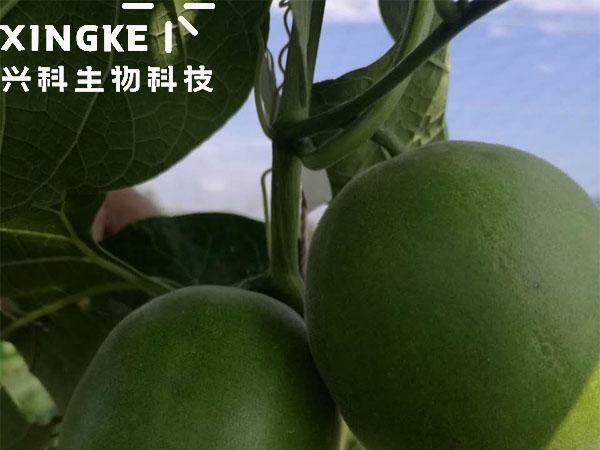
Introduction to Monk Fruit
Monk fruit (Siraitia grosvenorii) is a perennial deciduous vine plant in the class Dicotyledoneae, order Cucurbitales, family Cucurbitaceae, genus Siraitia. Monk fruit was a tribute item for imperial courts throughout the dynasties and is praised as the "Oriental Divine Fruit," the "Divine Fruit of Longevity," and the "Immortal Fruit." Monk fruit is rich in nutritional value, and because it has both medicinal and edible uses, it was announced by the Ministry of Health as a precious Chinese medicinal herb.
Monk fruit is rich in nutritional value, containing natural fruit sugar and a variety of trace elements, vitamins, proteins, and amino acids essential to the human body. Monk fruit is sweet in taste and cool in nature, with effects of clearing heat and moistening the lungs, relieving cough and dissolving phlegm, and moistening the intestines to relieve constipation. It is commonly used for conditions such as dry cough due to lung fire, sore throat and loss of voice, and constipation due to intestinal dryness. It is also an excellent cooling beverage.
The most valuable component of monk fruit itself is mogroside, which is 300 times sweeter than sucrose, produces no calories, and is a precious raw material for the beverage, candy, and other sugar-containing industries. As people pay more and more attention to healthy eating, the market share of mogroside will gradually increase and is very likely to replace sucrose and become the first choice of businesses. Modern medicine has proven that regularly drinking monk fruit tea can prevent many diseases, has significant effects on diseases such as bronchitis and hypertension, and can also help prevent and treat coronary heart disease, vascular sclerosis, and obesity.
Growth Habits of Monk Fruit
Monk fruit grows at altitudes of 300-1200 m in subtropical mountain forests, among shrubs, and in wet places by rivers. Its growth and development process requires a fairly long period of high-temperature conditions. It is suitable for growing under warm climate conditions with a long frost-free period and large day-night temperature differences, usually with an optimum temperature range of 18°C-32°C. Monk fruit is a plant that likes light but cannot tolerate strong light. During the seedling stage it fears strong light and grows and develops well under semi-shaded conditions. For mature plants, only 6-8 hours of light per day can meet their growth and development needs. However, under shaded conditions, mature plants have slender vines, long internodes, few fruits, and low yield. As is well known, monk fruit is widely grown in the Guangdong-Guangxi region of China, especially in Guangxi. Through 6 years of scientific research by scientists at Xingke Biotechnology, monk fruit varieties with stronger adaptability have been bred, and large-scale cultivation of monk fruit has now begun in Cangxi, Sichuan and Huaihua, Hunan.
Planting Monk Fruit
The monk fruit tree is a plant that likes light but cannot tolerate strong light. During the seedling stage it fears strong light and grows and develops well under semi-shaded conditions.
Monk fruit cultivation can be considered from the following aspects:
1. Site selection
Monk fruit does not have very strict soil requirements, and it can grow normally in ordinary soil, but it is best to plant it in loam with deep soil layers, rich in humus, loose and moist, and well drained.
2.Sowing and seedling raising
Monk fruit propagation can use two methods: seed seedling raising and vine layering. The seedling raising site should be chosen in a semi-shaded, semi-sunny place with fertile soil that is loose and moist. Plow the land in the winter of the previous year and plow and harrow it multiple times so that the soil layer is loose and fine. Apply 2500 kg of fertilizer per mu as base fertilizer, and make beds 20 cm high and 100 cm wide.
There are two methods for seed storage:
(1) Fruit storage:
Monk fruit used for seed should retain the fruit stalk and keep the skin undamaged. After harvesting, first soak it in a 500-fold diluted thiophanate solution for 10 minutes to disinfect and eliminate pathogens on the fruit surface, then hang it in a ventilated place to dry. This method is beneficial to the after-ripening of the seeds, and the seed germination rate can reach as high as 70-80%.
(2) Bag storage:
Remove the peel from the harvested fruit first, put it into a hemp bag, rub and wash it clean in clear water, select the seeds, dry them indoors, and then store them in a bag for later use. Seeds preserved by this method have a lower germination rate than those preserved by fruit storage.
Seed seedling raising:
After the fruit ripens each year in August-September, select fully developed, mature fruits free of pests and diseases, dry them in the sun, and keep them for seed. Around Qingming the following year, crack open the fruit shell to take the seeds, rub and wash the seeds clean in water, dry them, and set aside. When sowing, open sowing furrows on the prepared seedling land at a row spacing of 20 cm and a depth of about 2 cm, evenly scatter the seeds into the furrows, cover with soil level with the bed surface after sowing, and cover with grass and sprinkle water. They generally germinate in 15-30 days, with a seed germination rate of about 40%. Strengthen management during the seedling stage, carry out timely cultivating and weeding, and topdress fertilizer. In the spring of the second year, when the tuber grows to a diameter of 3 cm and a length of 5 cm, it can be planted. This propagation method has the advantages of convenient transport, the ability to obtain a large number of seedlings, and easy selection and breeding of improved varieties, but the plants bear fruit slowly and there are more male plants, so it is currently less used in production.
Vine layering propagation:
From July to October, select vines that are thick and strong, have long internodes, and hang down from the trellis as layers. Dig holes 15-18 cm deep and 15-18 cm wide in the ground nearby, bend and press the tips of 3-5 vines into the holes, with the pressed top seedlings 12-14 cm long. The hole spacing is about 3 cm, cover with soil 8-10 cm above the ground, and maintain moisture. To increase monk fruit yield, it is best during the peak fruiting period of the plants to select high-yielding individual plants from them and keep them as mother plants for layering. These individual plants are not allowed to go up the trellis and bear fruit. In September, select vines that are thick and strong, have short internodes, and have flower buds for layering. Alternatively, among high-yielding plants, in July keep 2-3 lateral vines at the base of the main vine, wait until they grow to September, and then carry out layering. Water frequently to keep the soil in the holes moist. After about 10 days roots can grow, and after 30 days they swell into small tubers. In frost-free areas they can overwinter in place, while in frost areas they should be stored in dug soil pits, covered with one layer of soil and one layer of seed tubers, and kept moist.
3.Planting
When planting generally in March-April, care should be taken to place female and male plants separately. When planting, match 1 male plant for every 20 female plants, and distribute them evenly to facilitate artificial pollination. For planting density, open holes at a plant spacing of 1.3-1.7 m and a row spacing of 1.7 m. Seed tubers must not come into contact with fertilizer. First cover the fertilizer in the hole with a thin layer of soil, then place the seed tubers on the soil. Place 1.2 seed tubers per hole, with a plant spacing of 30 cm between the 2. When placing them, the buds should face upward and be exposed above the soil surface, facing the same direction for easy management, and finally cover with soil 7-10 cm thick.
4.Field management
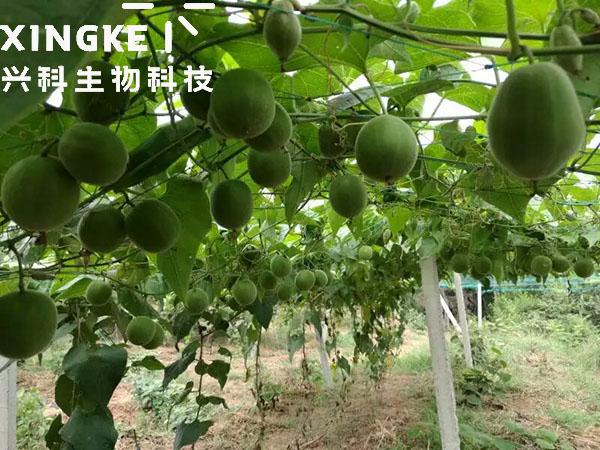
Building trellises, training vines, and removing lateral buds:
After planting, begin building the trellis. Generally, bamboo and wood are used as supports, with a trellis height of about 1.7 m. Small bamboos or branches are laid on top of the trellis, and then a small bamboo is inserted beside the plant so that the stems and vines can climb upward. When the seedlings are 17-20 cm high, remove the lateral buds growing on the vine stems, keep the main vine for cultivation, and tie and guide it onto the trellis. Guide the main vine onto the trellis. After the main vine is on the trellis, remove all lateral vines growing from the main vine below the trellis in order to cultivate a thick, strong main vine. The first- to third-order lateral vines of monk fruit are the main fruiting vines. After the main vine is on the trellis, keep 10-15 nodes and pinch off the top to promote the sprouting of 6-8 first-order lateral vines. Keep 20-25 nodes on the first-order lateral vines and pinch off the tops to promote each to sprout another 2-4 second-order lateral vines. Keep 25-30 nodes and pinch off the tops to sprout 2-4 third-order lateral vines, forming a natural fan-shaped structure with a single main vine and multiple lateral vines, which is conducive to stable and high yields.
Promoting early opening of male flowers:
Monk fruit is dioecious, and female flowers open 10-16 days earlier than male flowers. In production, flowering periods may fail to coincide, causing certain losses to yield. The measures to promote early opening of male flowers are: keep vines overwinter. When pruning old vines in winter, select robust male plants 2-4 years old, keep the main vine 1-1.5 m long, apply wax to the cut, and wrap the main vine with straw for overwintering. In March of the following year, when the temperature rises above 18°C, remove the straw and strengthen fertilizer and water management. This can enable male plants to go up the trellis early and bloom early, achieving the goal of coinciding the female and male flowering periods.
Artificial pollination: All cultivated varieties of monk fruit must be artificially pollinated.
The method is: when the plants bloom from June to July, at 6-7 in the morning, first pick male flowers that are well developed and slightly open, place them in a bamboo tube or lunch box, and keep them in a dry place for later use. When the female flowers open, use a bamboo stick to scrape pollen from the anthers and gently apply the pollen to the stigma. When pollinating, the movement must be gentle, and do not injure the ovary and stigma of the female flower. Generally, each male flower can pollinate 10-12 female flowers. The suitable pollination time is 7-10 in the morning.
5.Pest and disease control:Mainly taking root-knot nematode disease, blister leaf witches' broom disease, and bud blight as examples
1) Root-knot nematode disease:
A disease caused by root-knot nematodes, and it is currently the main disease of monk fruit. It is especially severe in monk fruit planted and cultivated in plains, low hilly areas, and sandy soil. After the plant is damaged, tumor-like growths of varying sizes form on the fibrous roots, often in a bead-like arrangement, while tumor-like lumps form on the tuber.
Control methods:
① Select disease-free, robust, superior plants as seedlings. ② Newly reclaimed monk fruit land should avoid old cultivated land previously planted with host plants such as melons, beans, and vegetables, and instead choose wasteland with good drainage. At the same time, reclaim and plow the land early, and after reclamation, plow, harrow, and sun the soil repeatedly many times. ③ Strengthen field management. Apply more organic fertilizer or phosphorus and potassium fertilizer to enhance plant resistance; pay attention to orchard sanitation, promptly remove diseased plants, and burn them in a centralized manner. ④ Chemical control. Tea seed cake powder, lime, and the like have a certain control effect on plots with light root-knot nematode occurrence. The relatively ideal pesticide is Miral, with a dosage of 2.5 kg per mu, mixed evenly with fine soil and applied in pits or furrows, applied twice each year before monk fruit sprouting and during the summer peak period of root-knot nematode infection. The use of highly toxic and high-residue pesticides such as carbofuran, isazofos, and chloropicrin is prohibited.
2) Blister leaf witches' broom disease:
An aboveground plant disease caused by compound infection by mycoplasma-like organisms and viruses. In affected orchards, the rate of empty plants reaches 13-40%, and the number of fruits decreases by 50%. Affected plants have deformed leaves, with incisions or linear shapes, shortened and uneven leaf veins, bulging blister-like leaf mesophyll, curled leaf margins, thick, coarse, and hard leaf mesophyll, early sprouting of axillary buds forming witches' brooms, and finally yellowing of the leaves. This disease is transmitted by artificial grafting, wound friction, diseased seeds, and the vector insect woolly apple aphid.
Control methods:
① Agricultural control. Cultivate virus-free seedlings, implement isolated planting, and remove weeds in the field. ② Promptly eliminate aphids to prevent disease. In aphid occurrence seasons, spray the young stems and leaves of monk fruit with 40% Ke Ya Xing 600-fold solution or 50% pirimicarb 2500-fold solution, etc. ③ Chemical control. In the early stage of plant disease, spray with 1.5% Zhi Bing Ling 800-fold plus 20% virus; 600-fold solution, spraying once every 7 days for 4-5 consecutive sprays.
3) Bud blight
Bud blight is a new disease that has appeared in China's main monk fruit production areas in recent years. This disease is not a parasitic disease caused by pathogenic microorganisms, but a physiological disease caused by boron deficiency. It generally begins from mid-to-late June each year. When the disease occurs, the young leaves of the plant turn yellow and the terminal buds die. Before dying, the terminal buds are brownish red, brittle, and easy to break. After dying, the terminal buds are brown to dark brown, upright or bent downward. After the disease occurs, axillary buds quickly grow out, but the newly grown axillary buds also die before long. This phenomenon can occur repeatedly on the same plant, and in severe cases causes the entire plant to die from top to bottom. Cutting open the tuber of a diseased plant, browning of its internal tissues can be observed.
Control methods:
① Use borax or boric acid solution at a concentration of 0.05% to soak seedlings for 5-6 hours, then plant; ② Use 0.1%-0.2% borax or boric acid solution and spray once every half month during the monk fruit growing period; ③ When applying base fertilizer, at a dosage of 0.5-1 kg per mu, mix borax or boric acid into other fertilizers, stir evenly, and apply together. It should be noted that when supplementing boron, the dosage must be appropriate and the application must be uniform. If excessive or uneven, it is easy to cause toxicity. Proper application of lime can reduce toxicity caused by excessive or improper dosage.
Shenzhen Xingke Biotechnology Co., Ltd. is a full-industry-chain innovative agricultural enterprise integrating research and development of deeply processed monk fruit products, biological breeding, planting, processing and production, and sales. For more information about monk fruit, please follow the WeChat public account: Luo Xiaoguo
This article comes from Sina Blog: http://blog.sina.com.cn/u/5617262271. Please indicate the source when reprinting.