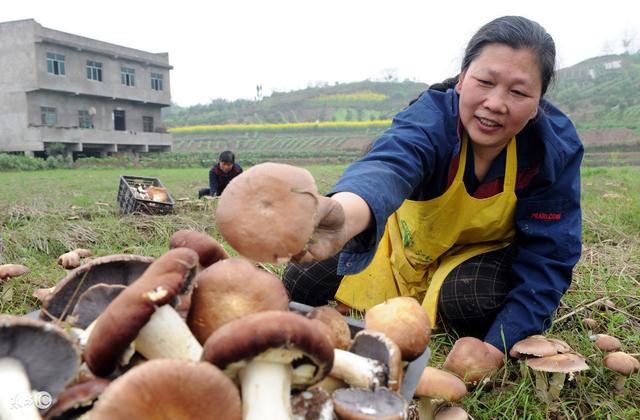
High-yield cultivation methods and technical key points for edible fungi
The edible fungi currently cultivated on a large scale, such as oyster mushroom, shiitake, enoki mushroom, lion's mane mushroom, wood ear, silver ear, and button mushroom, can be roughly divided into the mycelium stage and the fruiting body stage, or two growth and development periods. The conditions required by each mushroom in these two stages have similarities and also differences. This is determined by their biological characteristics. If the good conditions they need can be created, high yield and high quality can be achieved.
I. Nutrients, mainly carbon, nitrogen, and mineral elements
1. Carbon nutrients are the main components that make up the mycelium and fruiting bodies, and are also the source of energy needed for their growth and development. Carbon substances account for about 50%-65% of the mushroom body composition (dry matter). The culture media used in cultivation, such as cottonseed hulls and sawdust, are the main source of carbon.
2. Nitrogen nutrients are the main raw materials for proteins and nucleic acids. They are likewise major components of the mycelium and fruiting bodies, and are also the material basis for the fragrant and delicious taste of edible fungi, especially the abundant amino acids (as many as 18 kinds), which cannot be formed without nitrogen.
For the normal development of edible fungi, carbon and nitrogen nutrients not only need to be present in sufficient quantity, but their ratio must also be reasonable, commonly called the carbon-to-nitrogen ratio. For various mushrooms, this ratio is suitable at 20:1 during the mycelium growth stage and 30-40:1 during the fruiting body development stage. In production, because the types of culture materials differ, sometimes wheat bran, corn flour, soybean cake powder, ammonium nitrate, urea, and so on are added to adjust the carbon-to-nitrogen ratio. Regardless of the mushroom type, applying the same formula uniformly, or even not using materials according to the original formula and changing them arbitrarily, lacking this or that, makes it difficult to achieve high yield and high quality.
3. Mineral elements The normal growth of edible fungi also requires mineral elements and trace elements such as calcium, magnesium, phosphorus, potassium, iron, and zinc. Although these substances are needed only in small amounts, they are all important. Generally, the content in the main materials can meet the need. Sometimes substances such as magnesium sulfate, plant ash (potassium), and chicken manure (phosphorus) are also added.
II. Water and humidity
Water is one of the main components of the mycelium and fruiting bodies, and more importantly, metabolism, the life activity, cannot proceed without water. Fresh mushroom bodies contain as much as 85%-90% water. The water in the culture medium is the main source of water needed for the growth and development of edible fungi, but too much water is instead harmful. The suitable water content is 65%-75%. The degree is that the material has absorbed enough water so that when squeezed by hand, water appears between the fingers but does not drip down. Taking cottonseed hulls as an example, the weight ratio of material to added water is roughly 1:1.2-1.5. Adding too much will hinder mycelial growth.
Humidity usually refers to relative air humidity. This not only has a direct relationship with the growth and development of edible fungi, but also affects the release of water within the material. Especially during the fruiting body development period, if humidity is insufficient, yield will certainly be reduced. If it is below 60%, the fruiting bodies will not grow; if below 45%, primordium differentiation stops, and even existing primordia may die. The suitable air humidity is 85%-93% (during the fruiting body growth period). During cultivation, adding water by spraying to increase relative air humidity is a necessary measure. Especially in the later stage, injecting water into the culture medium or soaking the culture medium can also correspondingly increase yield.
III. Temperature
Various mushrooms all require certain temperature conditions for normal growth and development. The temperature requirements of the mycelium and fruiting bodies during growth and development are different, and some even "like" alternating temperature conditions. For example, if oyster mushroom can be given a 10°C temperature difference stimulus every day, it is beneficial to the formation and development of fruiting bodies. For the several mushrooms cultivated more commonly listed above, the suitable temperature for mycelial growth is roughly around 25°C (30°C for wood ear), and the suitable temperature for fruiting body development is generally around 15°C. Straw mushroom likes warmth; its mycelium develops better at 35°C, and its fruiting bodies develop well at 30-32°C.
Temperature is an important factor affecting the growth and development of edible fungi. In production, natural seasonal cultivation is currently mostly used, mainly arranging production according to natural temperature conditions (artificial air conditioning also mainly creates temperature conditions). With the progress of science and technology, edible fungus varieties are now being improved, and changing their temperature characteristics is one of the main goals. For example, for oyster mushroom and shiitake, varieties have already been bred that are low-temperature type, medium-temperature type, high-temperature type, and even wide-temperature type with less strict temperature limits. Thus, corresponding varieties can be selected according to the temperature conditions of the cultivation period, expanding the cultivation period.
IV. Oxygen and carbon dioxide
If oxygen is insufficient, the mycelium of various edible fungi will grow poorly, and the fruiting bodies will also grow poorly. Because during growth and development the edible fungi themselves also release carbon dioxide, the cultivation site must be ventilated and exchange air.
V. Light
Edible fungi do not have a strong requirement for light, and the mycelium can grow under dark conditions. During fruiting body differentiation and growth, a certain amount of scattered light is needed, and direct strong light should be avoided. In complete darkness, fruiting body development is poor and slow. Light can increase their color; without light, the color is pale. Light is also related to temperature. In the north, when using greenhouses to cultivate edible fungi, sunlight is needed to raise the temperature, but attention must be paid to preventing excessively high temperatures. When the light is too strong, straw curtains and similar materials are mostly used for shading.
VI. pH
Edible fungi mostly prefer a slightly acidic environment. Generally the pH value does not exceed 7 (neutral), and is about between 5.5-6.5, but oyster mushroom is relatively tolerant of alkali and can also grow at pH 8. Lion's mane mushroom is acid-tolerant and can also grow at pH 5. During cultivation, adding substances such as sugar that will become acidic, and the high-temperature sterilization process, will also make the culture medium acidic. Attention should also be paid to the local water quality, that is, its pH value. When mixing materials, attention should be paid to creating a suitable pH environment. In some cases lime or acidic fertilizers such as ammonium nitrate are added, which first increases
calcium and nitrogen, and second can adjust the pH value of the culture material.
To prevent excessive acidity or alkalinity, adding a certain amount of gypsum can play a buffering role.