How do you determine which category a hidden pesticide ingredient belongs to?
Generally speaking, "special-effect" pesticide samples all have distinctive characteristics, such as what insect they kill, what disease they prevent, or what weed they control. For samples requiring analysis, the first thing to provide should be the price, that is, the price per ton. This allows a preliminary positioning of the sample's status in the current pesticide market: whether it is a new pesticide, and possibly which category of pesticide it belongs to.
Provide the target of control: is it used for killing insects, controlling weeds, or sterilization? Which pest, which fungus, or which weed does it kill? In this way, based on the type of pest, disease, or weed controlled, the range of pesticides can be preliminarily judged. For example, if it is cotton aphid, then aphicides can be considered. If it is for controlling cotton bollworm (Lepidoptera, Noctuidae), then insecticides with good efficacy against Lepidoptera should be considered, such as chlorantraniliprole, etc.
Efficacy characteristics of the pesticide. Different types of insecticides produce different poisoning symptoms. First, based on the pest's poisoning symptoms, the type of pesticide can be preliminarily judged. If the pest is poisoned, curls up, excretes water, and convulses, the sample may be an organophosphorus insecticide. Second, the speed of insect kill is also an important basis for helping to identify the type of insecticide. Among insecticides, carbamates, pyrethroids, and organophosphorus compounds act relatively quickly, while chitin inhibitors act slowly and require 3 days to show effects. Next are the appearance and odor of the insecticide. For example, organophosphorus compounds have a garlicky odor, a foul odor, or a sulfurous smell. Pyrethroid insecticides can irritate human eyes and skin during application. Neonicotinoid insecticides such as acetamiprid and abamectin cause symptoms in armyworm poisoning such as anesthesia and feigned death, without shriveling or water excretion, and they can still move when touched. The above characteristics can serve as reference when qualitatively identifying pesticides.
Combine with simple bioassays, supplemented by sample qualitative identification. If it is an insecticide, 3 pests - armyworm, aphid, and red spider mite - can be simply used for preliminary efficacy testing. Based on the efficacy, the control direction of the sample can be roughly determined, and then instrumental analysis can be used for qualitative identification. Special attention should be paid to the fact that the stomach-poison test results for armyworm should be observed for 4 days before calculating mortality, to prevent chitin-type insecticides from being missed.
Attached table: Reference for analysis of some insecticides
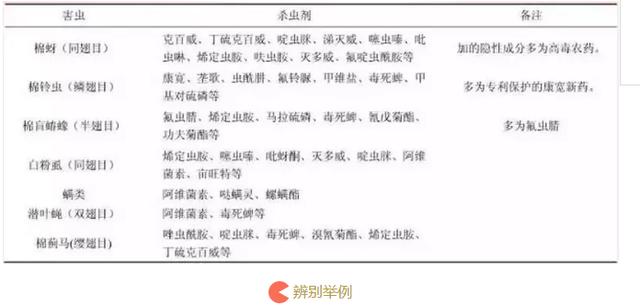
Examples of identification
1. "Special-effect" emulsifiable concentrate for cotton aphid. This sample was a product sent by a large cotton grower, and it was a product with no brand, no manufacturer, and no approval number. They also stated that this variety kills insects quickly. Based on experience in cotton aphid control, it was believed that a highly toxic insecticide might have been added. HPLC determination showed that carbofuran was indeed present in it.
2. Analysis of a herbicide for cotton fields. Three bags of sample: one large bag and two small bags. The large bag was labeled as quizalofop-p-ethyl, and the other two small bags were labeled as synergists, with the control targets being grassy and broadleaf weeds. Quizalofop-p-ethyl is only effective on grassy weeds, has poor efficacy on broadleaf weeds, and has no effect on cotton growth. Its characteristic of killing broadleaf weeds should be related to sulfonylurea herbicides. HPLC analysis showed that it was a sulfonylurea herbicide, and the other small bag was a penetrant.
3. Insecticide for controlling leafminer. The label was abamectin. Based on experience: abamectin itself has very good efficacy against leafminer, and there should also be an organophosphorus insecticide. HPLC analysis showed that one organophosphorus insecticide was present. Considering that when most organophosphorus insecticides are mixed with abamectin, abamectin decomposes, the author does not advocate mixing these two pesticides. In fact, analysis already proved that abamectin had decomposed, and the content did not reach the labeled content.
4. The special-effect pesticide for killing cotton bollworm, "Two Weeks Leisure."It is known that chlorantraniliprole has outstanding efficacy against cotton bollworm, and the reported price also matches. HPLC analysis proved that it was indeed chlorantraniliprole, but its content was very low.
5. Long-acting agent for controlling cotton mirid bug.The labeled active ingredient was Bacillus thuringiensis (BT), indicating that it should be produced under a borrowed registration certificate; BT does not control cotton mirid bug at all. Actual analysis showed it was high-content fipronil.
6. "Omethoate" emulsifiable concentrate for one-spray three-prevention.Its instructions said it could simultaneously control wheat aphid, powdery mildew, and dry leaves. Gas chromatography analysis, when using a large-bore capillary column, can reduce the decomposition of omethoate. The results showed that omethoate had decomposed and its content was very low, and the fungicide triadimefon added at the same time was also almost gone.
7. Emulsifiable concentrate for controlling whitefly. Sent from the cotton planting base of Hejian Guoxin Agricultural Research Association, saying it had good efficacy against whitefly. HPLC analysis showed that the active ingredients were 3 pesticides: acetamiprid, dinotefuran, and abamectin.
Operations personnel: Wei Yubo MX008