Progress in the Development of Green Pesticides in China and an Overview of Major Developed Varieties
Author: Pesticide Express, Modern Pesticides
Early pesticide application mostly aimed at effectiveness, with generally large dosages. With the long-term, excessive, and frequent use of pesticides, pesticides have caused many impacts on the ecological environment. Food security, food safety, and ecological security have become major issues in today's world, and replacing traditional pesticides with green pesticides has become an urgent national need.
Professor Li Zhong of East China University of Science and Technology gave a report titled "Progress in the Development of Green Pesticides in China" at the information conference of the "33rd China Plant Protection Dual-Exchange Conference." Taking insecticides as an example, he introduced the concept of green pesticides. Pesticides that are ultra-high-efficiency (dosage less than 5 g per mu), low-toxicity (LD50 greater than 2,000 mg/kg), and safe (environmentally safe; low toxicity to bees, birds, fish, and silkworms; meeting international pesticide production license standards such as environmental toxicity) are called green pesticides.
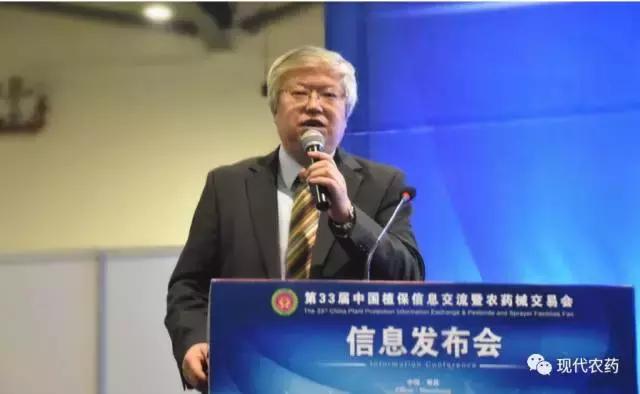
Professor Li Zhong of East China University of Science and Technology
As is well known, pesticide development is a very complex, multidisciplinary integrated systems engineering effort, with huge average costs and long timeframes. For many years, global pesticide development has been led mainly by the United States, Japan, Germany, Switzerland, the United Kingdom, and others. In 2002, the concept of pesticide development changed from "environmentally harmonious pesticides" to "green pesticides." China was the earliest proposer of green pesticides. In 2003, green pesticide development was formally included in the National Key Basic Research Development Program (973 Program), marking the recognition of green pesticide development in China. Professor Li Zhong divided China's green pesticide development into 3 stages: 2003-2008, discovery and research of lead structures and action targets of green chemical pesticides; 2010-2014, innovative research on molecular target-oriented green chemical pesticides; 2017-2020, discovery of agricultural biopesticide molecular targets and green drug molecule design.
In the 973 Program, important achievements were made in areas such as the green chemical pesticide molecular design platform and the construction of comparative biochemistry and chemical biology platforms. Professor Yang Guangfu of Central China Normal University proposed pesticide-likeness research, pesticide molecule design theory based on target conformational flexibility, target-oriented pharmacophore fragment-linking molecular design and virtual screening, and target resistance prediction regarding differences between sensitive targets and resistant targets; Professor Xi Zhen of Nankai University proposed a design method for highly selective PPO inhibitors based on target species structural differences and a quantitative structure-activity method for selective prediction of target mutation-resistant pesticides. Professor Yang Xinling of China Agricultural University proposed a design method for odorant binding protein-oriented insect behavior regulators; Academician Qian Xuhong of East China University of Science and Technology built a pesticide molecular target information database; Yang Qing of Dalian University of Technology explored potential targets based on sequence and structural differences and potential targets based on physiological and functional characteristics, and determined the structures of potential targets and complex structures.
At the conference, Professor Li Zhong focused on introducing a number of important green developed varieties that emerged from the 973 Program.
(1) Antiviral immune activator dufulin.Dufulin was developed by Guizhou University and later transferred to Guangxi Tianyuan Biochemical Co., Ltd. for industrial development. Dufulin was obtained by using natural aminophosphonic acids and amino acids as templates and introducing F atoms and heterocyclic structural units. This variety is the world's first immune-inducing crop viral disease regulator, is environmentally friendly, and conforms to the green pesticide development approach.
(2) Fungicides PMDD-5Y and PMDD-19.Both were developed by China Agricultural University. PMDD-5Y uses plant-derived active compounds as a lead and has inhibitory effects on mycelial growth, spore germination, and so on. It has a broad activity spectrum and excellent control efficacy against rice sheath blight and wheat take-all. PMDD-19 belongs to the natural quinoline class and is effective against rice sheath blight, cucurbit Pythium rot, tomato gray mold, rice bakanae disease, tomato early blight, corn southern leaf blight, pepper anthracnose, and rapeseed sclerotinia, with particularly special efficacy against apple Valsa canker.
(3) Green insecticide guadipyr.Guadipyr was developed by China Agricultural University and has inhibitory effects on both nAChR and sodium ion channels, with extremely high efficacy against piercing-sucking mouthpart pests. Its toxicity is extremely low, and its toxicity to environmental organisms such as bees and earthworms is far lower than that of neonicotinoid insecticides such as imidacloprid, and it is easily metabolized and degraded, with minimal environmental and ecological impact. Guadipyr is an ideal substitute product for neonicotinoid insecticides, but its toxicity to Trichogramma is extremely high.
(4) Fungicide pyrimorph.Pyrimorph was also developed by China Agricultural University and has a dual mechanism of affecting the polar distribution of newly synthesized cell wall materials and inhibiting cellular energy synthesis (complex III). It is environmentally friendly, has low toxicity to bees, silkworms, and so on, and has a relatively low resistance risk. Pyrimorph is suitable for controlling downy mildew, various blights, damping-off, black shank, rice blast, rice false smut, anthracnose, and so on in many crops.
(5) Green fungicide benzothiostrobin.Benzothiostrobin is a high-efficiency, low-toxicity, low-residue green fungicide developed by Central China Normal University and has been transferred to Jiangsu Sevencontinent Green Chemical Co., Ltd. for industrial development. At a dosage of 1-3 grams per mu, it has broad-spectrum fungicidal activity against many major diseases such as powdery mildew, downy mildew, brown spot, anthracnose, and scab, and its production cost is low.
(6) Green fungicideschlorbenzamide and flubenzamide.Both were developed by Central China Normal University and have now been transferred to Beijing Yanhua Yongle Biotechnology Co., Ltd. for industrial development. Both are novel succinate dehydrogenase inhibitors with systemic conductivity and resistance to rain washing. At a dosage of 5-7 grams per mu, chlorbenzamide has excellent control efficacy against gray mold and rice sheath blight, and also has good control efficacy against soybean rust, rapeseed sclerotinia, corn rust, wheat leaf blight, and so on. Its control efficacy and cost against gray mold are clearly superior to boscalid. At a dosage of 5-7 grams per mu, flubenzamide has outstanding control efficacy against rice sheath blight, and is also effective against powdery mildew, soybean rust, corn rust, wheat leaf blight, and so on. Its control efficacy and cost are clearly superior to those of the similar fungicide thifluzamide.
(7) Ultra-high-efficiency herbicides quinotrione and methyl quinotrione.Both were developed by Central China Normal University and have been transferred to Shandong Cynda Chemical Co., Ltd. for industrial development. Both are HPPD inhibitors with a novel skeleton (quinazolinone) and show high herbicidal activity and good rapid action against many broadleaf weeds and grass weeds. Quinotrione is a sorghum-specific selective ultra-high-efficiency herbicide with a broad weed-killing spectrum and low dosage (5-7.5 grams per mu), has special efficacy against foxtail and wild millet, and its control efficacy is significantly superior to the similar herbicide mesotrione. It shows high safety to sorghum and is also very safe to corn and wheat. At an extremely low dosage (1-2 grams per mu), methyl quinotrione shows outstanding control efficacy against foxtail, significantly superior to topramezone (Baowei) and mesotrione. It is safe to corn, but its safety coefficient is not as good as Baowei.
(8) Novel candidate fungicidal compound zolamide sulfonate ester.Zolamide sulfonate ester was developed by Central China Normal University and has a novel mechanism of action that differs from those of existing fungicides. It has special efficacy against downy mildew, with activity basically comparable to amisulbrom and significantly superior to cyazofamid, and it also has a certain control efficacy against bacterial diseases such as rice bacterial leaf blight.
(9) Fungicides coumoxystrobin and pyraoxystrobin.Both are strobilurin fungicides developed by the Shenyang Research Institute of Chemical Industry. Coumoxystrobin is composed of 2 natural product fragments and contains only 3 elements: carbon, hydrogen, and oxygen. It has the characteristics of low toxicity, low residue, safety, and environmental friendliness, and has excellent activity against apple Valsa canker. Pyraoxystrobin has broad-spectrum fungicidal activity; crops treated with pyraoxystrobin grow well, have good disease control, and show significant yield increases.
(10) Herbicide SYP-3356.SYP-3356 is a uracil herbicide under research and has very good control effects against both broadleaf weeds and grass weeds, and is effective against resistant weeds such as goosegrass and horseweed fleabane.
(11) Fungicides SYP-3810 and SYP-3773.SYP-3810 and SYP-3773 are pyrimidinamine fungicides under research; both have relatively low toxicity and very good control effects against cucumber downy mildew.
(12)Novel plant induced disease resistance activatorfluorozole acibenzolar.Fluorozole acibenzolar was developed by East China University of Science and Technology and is now transferred to Jiangsu Nantong Taihe Chemical Co., Ltd. for industrial development. Fluorozole acibenzolar is an artificially synthesized disease resistance activator with a new mechanism; after simple foliar spray application, it activates the plant immune system against plant diseases and soilborne diseases.
(13) Paichongding and cycloxaprid were both developed by East China University of Science and Technology, and both are cis-neonicotinoid insecticides.Paichongding was industrialized by Jiangsu Kesheng Group Co., Ltd. and has now also obtained registration in China. It is a novel agonist for pests, has systemic conductive activity, is safe for bees, and has a long duration of efficacy. Cycloxaprid has very good control effects against Lepidoptera pests and significant activity against imidacloprid-resistant pests. The Insecticide Resistance Action Committee (IRAC) listed cycloxaprid as a potential future insecticide, and this is also the only domestically independently developed insecticide selected.