Mushroom Talks Part Two: Introducing the World of Fungi
The Morphological Structure of Edible Mushrooms
We know that edible mushrooms are macrofungi, composed of two main parts:the mycelium and the fruiting body.Edible mushrooms rely on mycelium to absorb nutrients from the substrate. Once the mycelium has grown to a certain stage and accumulated enough nutrients, it can grow into a large, edible fruiting body.
Mycelium: The mycelium is the vegetative body of edible mushrooms, composed of individual tubular hyphae, and the hyphae are multicellular. According to different developmental stages, they can be divided into primary mycelium and secondary mycelium. Spores germinate to form primary mycelium, and primary mycelium undergoes pairing to form secondary mycelium, which contains two nuclei and is called binucleate hyphae. Only binucleate hyphae have the ability to produce fruiting bodies. Generally, edible mushrooms with thin hyphae, such as shiitake mushroom and wood ear, have clamp connections on their binucleate hyphae, while edible mushrooms with thicker hyphae, such as straw mushroom, have no clamp connections on their binucleate hyphae.
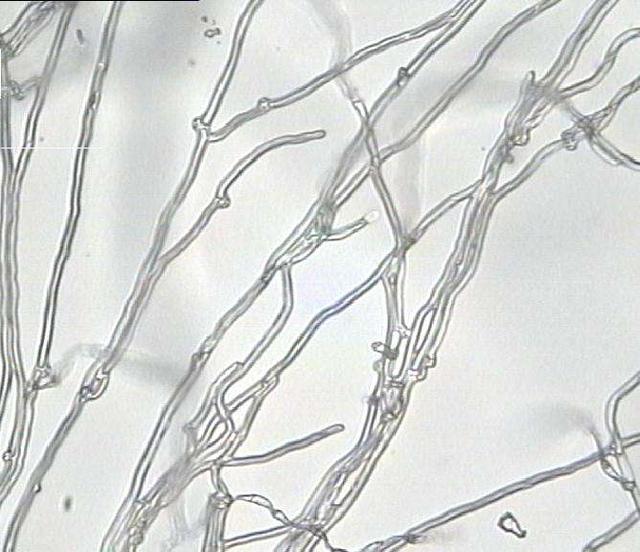
Clamp connection
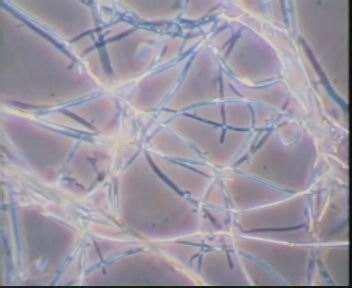
Mycelium
Fruiting body: It is the reproductive organ of edible mushrooms. It is the edible part that we commonly call "mushroom" or "wood ear." Fruiting bodies come in diverse shapes: some are ear-shaped (wood ear), some are head-shaped (lion's mane mushroom), and some are umbrella-shaped (straw mushroom). What we usually eat is the umbrella-shaped fruiting body, which typically consists of a stipe, a cap, gills and other appendages.
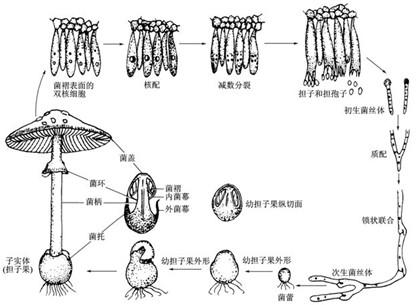
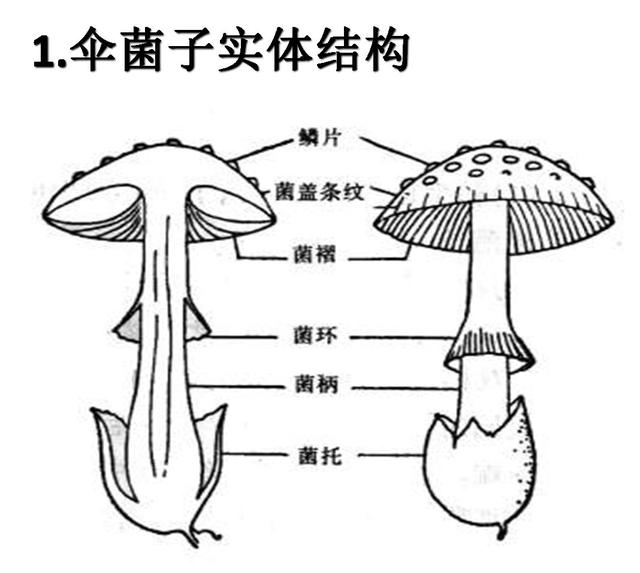
Morphological structure of edible mushrooms
Developmental process of edible mushrooms
Stipe: Also called the mushroom stalk or mushroom foot, it is the organ that supports the cap and transports nutrients. Some grow at the center of the cap and are called central (straw mushroom), some are eccentric (shiitake mushroom), and some are lateral (golden oyster mushroom). On the stipe there are often two kinds of appendages, the annulus and the volva, though not every edible mushroom has them. The annulus grows on the stipe and is a membranous ring-shaped structure; the volva grows at the base of the stipe and is cup-shaped, sac-shaped, etc.
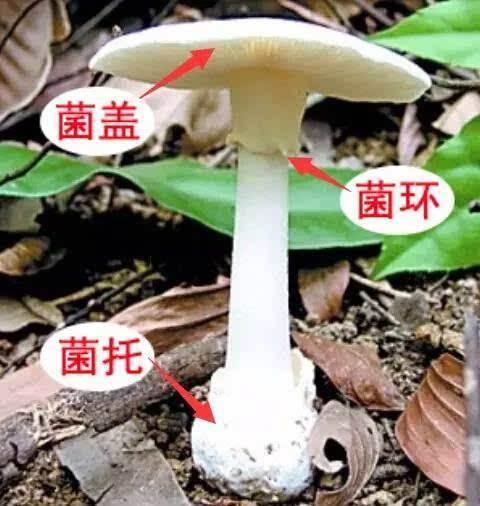
Stipe and cap
Cap: Also called the mushroom cap or mushroom umbrella. It is where the gills are attached, and it is the protective tissue of the reproductive organ.
Gills and tubes: Located beneath the cap, those that are blade-shaped are called gills, and those that are tube-shaped are called tubes. They are the place where basidiospores are produced.
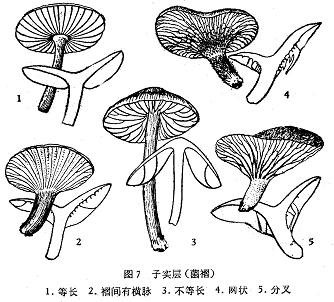
Gills
Tubes
5. Spores: Divided into basidiospores and ascospores, produced by basidia and asci respectively. They are sexual spores and the basic unit of reproduction for edible mushrooms.