Detailed Guide to Making a Trident Maple Bonsai
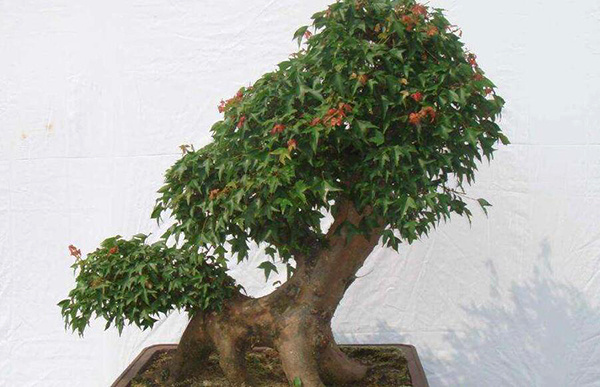
1. According to the shaping needs of the trident maple, cut off unnecessary branches and trunks, and at the same time appropriately reduce and trim the roots. After it survives in the second year, shorten and cut again, use metal wire to bend and shape, keep the branch tips, and after 2-4 months of wiring, when the branches have basically taken shape, the metal wire can be removed.
2. Within 2-4 years, during the growth season of the trident maple, cut off the top branches, and the lower branches should be wired in time into the required form, and combined with growing out and wiring the branches. Shorten and prune 2-3 times each year. In this way, after several times it can basically take shape. After shaping, dig it up in February to March of the year before potting, shorten the long roots that would affect potting until they just touch the pot surface, then plant it in the ground to grow. After one year, after new roots sprout at the cut root sites, pot it. This way it is relatively easy to survive.
Trident Maple Bonsai Making Tutorial, Complete Collection of Trident Maple Bonsai Pictures
☂☂☂More HomePlant Bonsai☂☂☂
→Relieve Eye Fatigue: Green Asparagus Fern Bonsai
→Just How Tiny Is It: Making a Miniature Bonsai
→What Is Ethnic Is Also National: Analysis of the Characteristics of Chinese Bonsai Schools
Trident maple is also called maple, and is a deciduous tree of the genus Acer in the family Sapindaceae under the order Sapindales. It is a relatively common natural plant in our lives. Today someone discovered that the bonsai made from it is very exquisite and beautiful, and immediately fell in love with it, and the bonsai made from it is naturally the trident maple bonsai. This has aroused the curiosity of many friends: how exactly is the trident maple bonsai made, and is the effect of the bonsai actually good? Below let us take a look at the trident maple bonsai making tutorial.
¤ Introduction to Trident Maple Bonsai
Trident maple bonsai, in simple terms, is a kind of plant bonsai made by using trident maple, and it is still relatively common in our lives. Trident maple is originally a very beautiful deciduous tree, commonly known in our daily lives as duck-foot tree, and it is very common. Some people, because they love trident maple, made it into bonsai, and the resulting bonsai has an unexpectedly good effect. In early spring the bonsai is full of tender buds on the branches, looking tempting, while in midsummer it is emerald green and lush, making people linger, with very high ornamental value.
(Trident Maple Bonsai Picture Appreciation - Figure 1)
¤ Making Trident Maple Bonsai
As a kind of plant bonsai, the making method of trident maple bonsai is actually not difficult, because it is relatively similar to the making methods of most flowering and woody bonsai. So what is the specific making method?
1、Conventional Collection and Digging: To make a bonsai, the first thing needed is the verified material. You can dig it from the forests of nature. Note that when cutting the roots and trunk, it must be done in one step, and some sprouting branch nodes should be reserved on the collected trident maple.
2、Field Cultivation: Newly collected trident maple cannot immediately be used to make bonsai; it needs a period of care and cultivation first. Use the method of shallow planting and high mounding for care, and pay attention to water permeability and root slurry coating. Do not prune in the first year, and proper pruning in the second year is enough.
(Trident Maple Bonsai Picture Appreciation - Figure 2)
3、Transplanting and Potting: When the trident maple has grown to the second or third year, it can be potted. It is best to pot in February to March of spring, which is the best season. When potting, choose loose, breathable, fertile leaf mold soil rich in humus for planting.
4、Pruning and Shaping: After the trident maple has been potted and planted for a period of time, it can be properly pruned and shaped. Because the plant's trunk is relatively robust and well developed, choosing the raised-root style or root-on-rock style is relatively good. When shaping, wiring should be the main method, with proper pruning being enough, and because the plant's branches are brittle and hard, the movements during wiring should be gentle.
(Trident Maple Bonsai Picture Appreciation - Figure 3)
¤ Complete Collection of Trident Maple Bonsai Pictures
Trident maple bonsai is a kind of plant bonsai with quite high ornamental value. Its greatest feature lies in the fact that the plant can emit different charms with the changes of the four seasons. In spring, the leaves of the trident maple bonsai are red, looking very attractive; when summer comes, the plant's leaves turn green, lush and verdant, full of greenery; when autumn arrives, the leaves turn from green to yellow, drifting and scattering, very elegant; when winter comes, the leaves then fall, looking very elegant and noble, making people unable not to love it.
(Trident Maple Bonsai Picture Appreciation - Figure 4)
Summary:Trident maple bonsai is indeed a very rare kind of plant bonsai, but it still needs people's meticulous care to emit infinite natural charm, so if you have a pot of trident maple bonsai at home, you must take good care of it.
What Are the Key Points of Trident Maple Bonsai Potting? Trident Maple Bonsai Potting Techniques
Trident maple is a deciduous tree, up to 30 m tall. It can be planted alone or in groups on lawns, or mixed with other trees on hillsides and beside ponds. In China it can be planted in gardens as a shade tree. Because of its unique ornamental value, the cultivation of trident maple bonsai is gradually favored by people today, such as trident maple and red maple used as bonsai. Therefore today the editor will talk about trident maple bonsai potting techniques.
(1) Transplanting: Choose robust young trident maple trees without pests and diseases as transplanting seedlings. The young tree seedlings are required to be no more than 60 cm tall. The transplanting time is preferably late winter or early spring.
(2) Preparation of bonsai cultivation soil: Choose an open-mouth pot container, and lay a mixture of perlite, river sand, peat and rice husks at the bottom of the container to a height of 1/4 of the container height. After laying, cover it with a layer of fallen leaf fragments and leaf mold, and then cover with a layer of plastic film with ventilation holes. Apply base fertilizer on the film, and cover with a mixture of mountain soil, pond mud and sorghum husks to a height of 3/4 of the container height. Then seal the container mouth with a wooden lid, place it in a refrigerator at minus 5 degrees to 0 degrees, treat for 2-3 hours, then take it out and leave it at room temperature for later use. (Among them, the mass ratio of perlite, river sand, peat and rice husks is 1:4:3:2; the mass ratio of fallen leaf fragments and leaf mold is 1:3; the mass ratio of mountain soil, pond mud and sorghum husks is 2:2:1; the base fertilizer consists of the following substances by mass: 25% bean fertilizer, 30% green fertilizer, 20% nitrogen-phosphorus-potassium compound fertilizer, 15% decomposed manure, 3% trace elements, 1% microbial fermentation bacteria, and the balance eggshell powder; the trace elements are a mixture of iron, calcium, cobalt, zinc and selenium in a mass ratio of 1:3:1:3:1; the humidity of mountain soil and pond mud is 45%.)
(3) Potting treatment: Fill the bonsai cultivation soil prepared in step (2) into a pot to 5 cm from the pot rim using moist river sand mixed with chlormequat, paclobutrazol and coconut shell activated carbon. Disinfect the bonsai cultivation soil one day before planting. Choose February as the planting time. Before planting and potting, prune the seedling branches and root system. After planting, water thoroughly and keep the surface soil moist.
(4) Staged pruning treatment: Young plants should be topped and pinched to promote side branch growth. In early summer, cut off 1/3 of the main trunk. When the branching branches grow more than 20 cm, prune once, and after pruning apply a plant growth retardant to the wounds. At the same time, promptly prune trailing branches to keep it upright and elegant, with appropriate density. (Among them, the plant growth retardant is a mixture of 0.3% daminozide and hydrogen peroxide in a mass ratio of 2:5.)
(5) Fertilizer and water management: Trident maple potted plants should be watered frequently to keep the pot soil moist. At the same time, apply organic fertilizer once each before sprouting in spring and before leaf expansion. Do not fertilize in autumn, and in winter apply liquid compound fertilizer once. (Among them, 2% trace elements are added to the liquid organic fertilizer, and the content of nitrogen-phosphorus-potassium compound fertilizer in the liquid compound fertilizer is not less than 30%.)
(6) Temperature and light management: The suitable growth temperature for potted trident maple is 30 degrees. In winter, manage with full sun, and in summer, manage with half sun.