Pruning Methods and Care Tips for Trident Maple Bonsai
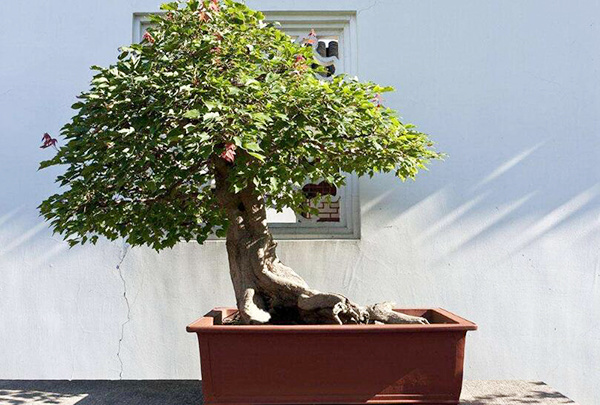
How to Prune and Care for Trident Maple Bonsai
Normally, the branches of trident maple reach about one meter in length by late May. At this time, branch selection for styling must be carried out, because the trident maple itself grows relatively fast, so its branches grow straight upward. Therefore, at this time, manual techniques should be used to pull the branches to the ideal angle. When the plum rain season arrives, new branches will grow to about one cm, and in order not to be broken by strong wind and heavy rain, they must be secured. At the same time, useless branches should be pruned so that all nutrients will be concentrated and supplied to the needed branches. When pruning, be sure to pay attention to the trunk or watch for places all over the tree where small buds tend to appear, and prune and trim frequently, so as to maintain the tree's shape.
How to Care for Trident Maple Bonsai
Trident maple bonsai is generally placed in a well-ventilated, light-transmitting, and relatively humid place. In summer, it should be placed in the shade of trees or in a cool spot to prevent withering from exposure to the blazing sun; in winter, it should be placed indoors for care.
Because the trident maple has strong growth vigor, it must be pruned regularly to maintain its shape, and in winter it can be pruned and reshaped just once.
Pests are a major natural enemy of plants, so in spring, insecticide should be sprayed for prevention.
Overwintering Care and Management of Flowers and Bonsai
Low temperatures and frosty weather in winter can pose a serious threat to flowers and trees. To help flowers and trees overwinter safely, the principle of "do not bring in during winter, do not take out in spring" must first be observed. "Do not bring in during winter" means that when the weather has just turned cold and there is no frost, for most flowers, do not rush to move them indoors. "Do not take out in spring" means that when the weather turns warm, do not rush to move them outdoors; wait until after the last late frost of spring, when the weather has completely improved, before starting to move them outdoors.
Five Key Elements and Precautions for Overwintering Care and Management of Flowers and Bonsai
I. Understand the cold tolerance temperature of flowers:
Different cold-proof and warmth-preserving measures should be taken according to the different low-temperature tolerance of different flowers and trees, either moving the flowers and trees directly indoors, covering the flower pots with plastic film, directly wrapping the flowers and trees with plastic bags, or temporarily setting up a simple small greenhouse for insulation. Flowers and trees with strict light requirements should be placed on an indoor windowsill or near a windowsill in a place with ample sunlight; those without strict light requirements or that can tolerate shade can be placed in a cool place without light, but all must be noted for ventilation and air permeability. It is best to open windows for ventilation at noon on sunny days, but cold wind must not be allowed to blow directly on the flowers and trees.
1. For flowers that can tolerate cold and cool temperatures (5-12°C, below 5°C), such as pomegranate, Chinese rose, wintersweet, osmanthus, palm, Chaenomeles speciosa, and crape myrtle, they can be placed in an outdoor courtyard or on a sunny balcony.
2. For flowers that need to be kept at medium temperature (12-20°C), such as white orchid, camellia, rhododendron, banana shrub, clivia, fuchsia, and wax begonia, they must be moved indoors before the temperature drops to 10°C.
3. For flowers that can only grow normally at high temperatures (18-30°C), such as: Aglaia odorata, hibiscus, jasmine, croton, narcissus, epiphyllum, nopalxochia, cactus, peace lily, spider plant, pothos, hibiscus, poinsettia, begonia, jasmine, Monstera deliciosa, ball cacti, and aloe, they must be moved indoors before the temperature drops to 12°C.
After plants are moved indoors, their placement also requires attention. They should be placed in a sunny and warm spot. Sun-loving plants should be placed in front, and semi-shade-tolerant or shade-tolerant potted flowers should be placed behind, and the orientation should also be changed from time to time. In the first week, windows should be opened for ventilation to let the plants gradually adapt to temperature changes. Potted flowers moved indoors should be pruned both for appearance and to ensure effective absorption of nutrients.
For plants placed outdoors, wind barriers can be set up for cold protection. Common cold protection measures include hilling soil around the roots and stems and covering with soil. Hilling soil around the roots and stems means building a small mound of soil at the root collar of the tree to prevent low temperatures from freezing and damaging the root collar and roots, while also reducing soil moisture evaporation. For flowers such as peonies that are planted in the ground and cannot be moved indoors, a large basket can be inverted to cover the entire plant, and the basket body can be smeared with a layer of mud, similar to a warm and humid small greenhouse.
II. Pruning before overwintering:
Before potted flowers overwinter, they should be pruned and trimmed in a timely manner to reduce nutrient consumption and reduce the indoor space they occupy during winter. For potted flowers moved indoors, pruning is indispensable both for appearance and to ensure effective absorption of nutrients. Cutting off withered leaves, overly dense branches, pest- and disease-infected branches, and weak branches can fully supply nutrients to effective branches and stems, enabling the potted flowers to grow vigorously and overwinter safely. For excessively leggy branches, the pruning intensity can be increased. Binding materials on bonsai that have been styled for 1-2 years can be removed, or removed and then re-bound, to prevent long-term binding at fixed positions from damaging the cambium of the branches and causing the branches and leaves to wither and die. For tree-stump bonsai placed on balconies, such as Chinese elm, Chinese plumbago, trident maple, banyan, Buddhist pine, Chinese juniper, and dragon juniper, necessary pruning must be carried out. For jasmine, crape myrtle, pomegranate, and others, pruning can be done in late autumn to reduce nutrient consumption by the plant in winter, promote greater nutrient storage in potted flowers, and make them bloom more the following year. Dead branches, densely growing branches, pest- and disease-infected branches, overly old branches, and damaged branches can all be removed with a sharp knife or sharp shears; for those that bloom in spring, only appropriate thinning of autumn shoots without flower buds is suitable; for those that bloom on current-year branches, pruning should be strengthened to promote new shoots and prepare for flowering the following year; for those that have already been frozen but still have partial survival, heavy pruning can be carried out, while strengthening fertilizer and water management to help the flowers and trees quickly recover their growth vigor.
III. Fertilization precautions for overwintering:
Apply fertilizer once before overwintering and water thoroughly. During overwintering, flowers generally should stop being fertilized. For flowers and trees in dormancy or semi-dormancy, fertilization should be stopped to avoid root rot, and fertilization should wait until repotting in spring; for flowers and trees that bloom in autumn, winter, or early spring, as well as those sown in autumn, thin fertilizer should be applied. To improve the cold resistance of flowers and trees, fertilization should be reduced in late autumn, so as not to make the stems and leaves of flowers and trees tender and thereby reduce their cold resistance.
IV. Watering precautions for overwintering:
In winter, flowers and trees grow slowly, metabolism decreases, and most enter a dormant state, so water demand and evaporation are relatively reduced. The principle of watering is "better dry than wet"; never water before the potting soil is dry, especially for shade-tolerant flowers, which must not be overwatered, lest it cause leaf drop, root rot, or death. Generally, it is best to water thoroughly only after the potting soil has dried completely. The water temperature for watering is best close to room temperature, and warm water at 20-25°C can also be used to water flowers. Watering flowers with warm water will accelerate the decomposition of organic matter in the potting soil and promote the absorption of nutrients by root cells, thereby promoting flower growth. The best time to water is at noon when light is relatively good. If tap water is used to water flowers, it is best to let it sit for 1-2 days first, and use it after the chlorine in the water has volatilized. At the same time, avoid watering flowers with water containing soap or laundry detergent. Along with watering, a damp cloth can be used to carefully wipe dust off the leaf surfaces.
V. Ventilation precautions for indoor flowers:
Pay attention to regular ventilation, preferably on sunny days when there is sun, or at noon when the temperature is relatively high. When ventilating and exchanging air, it must also be noted not to let cold wind blow directly on the plants, so as to avoid adverse reactions.
VI. Pest and disease control for overwintering:
For flowers and trees whose leaves are prone to pests and diseases, such as crabapple types, roses, and camellias, collect and burn the dead branches and fallen leaves under the plants, which can reduce the occurrence of diseases the following year. At the same time, spray carbendazim for sterilization and disinfection. For ** disease, rust disease, and gray mold of primroses, triadimefon or thiophanate-methyl can be used in a timely manner for control respectively. For flower and tree species that often develop aphids on potted plants when ventilation is poor, such as white orchid and Aglaia odorata, imidacloprid can be used for control. For scale insects, of course, the highly targeted Jiebijiezhi must be used for control. Common diseases of flowers and trees in winter include powdery mildew and sooty mold, and common pests include aphids, whiteflies, scale insects, and others. Effective measures should be taken to control them during the dormant period, so as to reduce the occurrence of pests and diseases in the following spring.
Next spring, generally during the period from the Spring Equinox to Qingming, overwintered flowers can be moved outdoors one after another, and fertilizer water such as bio-organic fertilizer, Huangyebijiezhi, and trace-element water-soluble fertilizer can be applied, so that the flowers grow normally in spring.
Overwintering Care and Management of Flowers and Bonsai
News from the China Landscape Web on November 7: Low temperatures and frosty weather in winter can pose a serious threat to flowers and trees. To help flowers and trees overwinter safely, the principle of "do not bring in during winter, do not take out in spring" must first be observed. "Do not bring in during winter" means that when the weather has just turned cold and there is no frost, for most flowers, do not rush to move them indoors. "Do not take out in spring" means that when the weather turns warm, do not rush to move them outdoors; wait until after the last late frost of spring, when the weather has completely improved, before starting to move them outdoors.
Five Key Elements and Precautions for Overwintering Care and Management of Flowers and Bonsai
I. Understand the cold tolerance temperature of flowers:
Different cold-proof and warmth-preserving measures should be taken according to the different low-temperature tolerance of different flowers and trees, either moving the flowers and trees directly indoors, covering the flower pots with plastic film, directly wrapping the flowers and trees with plastic bags, or temporarily setting up a simple small greenhouse for insulation. Flowers and trees with strict light requirements should be placed on an indoor windowsill or near a windowsill in a place with ample sunlight; those without strict light requirements or that can tolerate shade can be placed in a cool place without light, but all must be noted for ventilation and air permeability. It is best to open windows for ventilation at noon on sunny days, but cold wind must not be allowed to blow directly on the flowers and trees.
1. For flowers that can tolerate cold and cool temperatures (5-12°C, below 5°C), such as pomegranate, Chinese rose, wintersweet, osmanthus, palm, Chaenomeles speciosa, and crape myrtle, they can be placed in an outdoor courtyard or on a sunny balcony.
2. For flowers that need to be kept at medium temperature (12-20°C), such as white orchid, camellia, rhododendron, banana shrub, clivia, fuchsia, and wax begonia, they must be moved indoors before the temperature drops to 10°C.
3. For flowers that can only grow normally at high temperatures (18-30°C), such as: Aglaia odorata, hibiscus, jasmine, croton, narcissus, epiphyllum, nopalxochia, cactus, peace lily, spider plant, pothos, hibiscus, poinsettia, begonia, jasmine, Monstera deliciosa, ball cacti, and aloe, they must be moved indoors before the temperature drops to 12°C.
After plants are moved indoors, their placement also requires attention. They should be placed in a sunny and warm spot. Sun-loving plants should be placed in front, and semi-shade-tolerant or shade-tolerant potted flowers should be placed behind, and the orientation should also be changed from time to time. In the first week, windows should be opened for ventilation to let the plants gradually adapt to temperature changes. Potted flowers moved indoors should be pruned both for appearance and to ensure effective absorption of nutrients.
For plants placed outdoors, wind barriers can be set up for cold protection. Common cold protection measures include hilling soil around the roots and stems and covering with soil. Hilling soil around the roots and stems means building a small mound of soil at the root collar of the tree to prevent low temperatures from freezing and damaging the root collar and roots, while also reducing soil moisture evaporation. For flowers such as peonies that are planted in the ground and cannot be moved indoors, a large basket can be inverted to cover the entire plant, and the basket body can be smeared with a layer of mud, similar to a warm and humid small greenhouse.
II. Pruning before overwintering:
Before potted flowers overwinter, they should be pruned and trimmed in a timely manner to reduce nutrient consumption and reduce the indoor space they occupy during winter. For potted flowers moved indoors, pruning is indispensable both for appearance and to ensure effective absorption of nutrients. Cutting off withered leaves, overly dense branches, pest- and disease-infected branches, and weak branches can fully supply nutrients to effective branches and stems, enabling the potted flowers to grow vigorously and overwinter safely. For excessively leggy branches, the pruning intensity can be increased. Binding materials on bonsai that have been styled for 1-2 years can be removed, or removed and then re-bound, to prevent long-term binding at fixed positions from damaging the cambium of the branches and causing the branches and leaves to wither and die. For tree-stump bonsai placed on balconies, such as Chinese elm, Chinese plumbago, trident maple, banyan, Buddhist pine, Chinese juniper, and dragon juniper, necessary pruning must be carried out. For jasmine, crape myrtle, pomegranate, and others, pruning can be done in late autumn to reduce nutrient consumption by the plant in winter, promote greater nutrient storage in potted flowers, and make them bloom more the following year. Dead branches, densely growing branches, pest- and disease-infected branches, overly old branches, and damaged branches can all be removed with a sharp knife or sharp shears; for those that bloom in spring, only appropriate thinning of autumn shoots without flower buds is suitable; for those that bloom on current-year branches, pruning should be strengthened to promote new shoots and prepare for flowering the following year; for those that have already been frozen but still have partial survival, heavy pruning can be carried out, while strengthening fertilizer and water management to help the flowers and trees quickly recover their growth vigor.
III. Fertilization precautions for overwintering:
Apply fertilizer once before overwintering and water thoroughly. During overwintering, flowers generally should stop being fertilized. For flowers and trees in dormancy or semi-dormancy, fertilization should be stopped to avoid root rot, and fertilization should wait until repotting in spring; for flowers and trees that bloom in autumn, winter, or early spring, as well as those sown in autumn, thin fertilizer should be applied. To improve the cold resistance of flowers and trees, fertilization should be reduced in late autumn, so as not to make the stems and leaves of flowers and trees tender and thereby reduce their cold resistance.
IV. Watering precautions for overwintering:
In winter, flowers and trees grow slowly, metabolism decreases, and most enter a dormant state, so water demand and evaporation are relatively reduced. The principle of watering is "better dry than wet"; never water before the potting soil is dry, especially for shade-tolerant flowers, which must not be overwatered, lest it cause leaf drop, root rot, or death. Generally, it is best to water thoroughly only after the potting soil has dried completely. The water temperature for watering is best close to room temperature, and warm water at 20-25°C can also be used to water flowers. Watering flowers with warm water will accelerate the decomposition of organic matter in the potting soil and promote the absorption of nutrients by root cells, thereby promoting flower growth. The best time to water is at noon when light is relatively good. If tap water is used to water flowers, it is best to let it sit for 1-2 days first, and use it after the chlorine in the water has volatilized. At the same time, avoid watering flowers with water containing soap or laundry detergent. Along with watering, a damp cloth can be used to carefully wipe dust off the leaf surfaces.
V. Ventilation precautions for indoor flowers:
Pay attention to regular ventilation, preferably on sunny days when there is sun, or at noon when the temperature is relatively high. When ventilating and exchanging air, it must also be noted not to let cold wind blow directly on the plants, so as to avoid adverse reactions.
VI. Pest and disease control for overwintering:
For flowers and trees whose leaves are prone to pests and diseases, such as crabapple types, roses, and camellias, collect and burn the dead branches and fallen leaves under the plants, which can reduce the occurrence of diseases the following year. At the same time, spray carbendazim for sterilization and disinfection. For ** disease, rust disease, and gray mold of primroses, triadimefon or thiophanate-methyl can be used in a timely manner for control respectively. For flower and tree species that often develop aphids on potted plants when ventilation is poor, such as white orchid and Aglaia odorata, imidacloprid can be used for control. For scale insects, of course, the highly targeted Jiebijiezhi must be used for control. Common diseases of flowers and trees in winter include powdery mildew and sooty mold, and common pests include aphids, whiteflies, scale insects, and others. Effective measures should be taken to control them during the dormant period, so as to reduce the occurrence of pests and diseases in the following spring.
Next spring, generally during the period from the Spring Equinox to Qingming, overwintered flowers can be moved outdoors one after another, and fertilizer water such as bio-organic fertilizer, Huangyebijiezhi, and trace-element water-soluble fertilizer can be applied, so that the flowers grow normally in spring.