How to Propagate and Root Spider Plants? Detailed Methods and Precautions
Runner propagation method
Cut a runner from the mother plant; it is best to cut a runner with many aerial roots, as this favors future growth. After flowering, the runner begins to grow new leaves, and then aerial roots appear.
Place it in water to cultivate, in a relatively small open-mouthed container, with the water level just above the aerial roots. In this way, the aerial roots all grow downward; with too many aerial roots, they may grow upward.
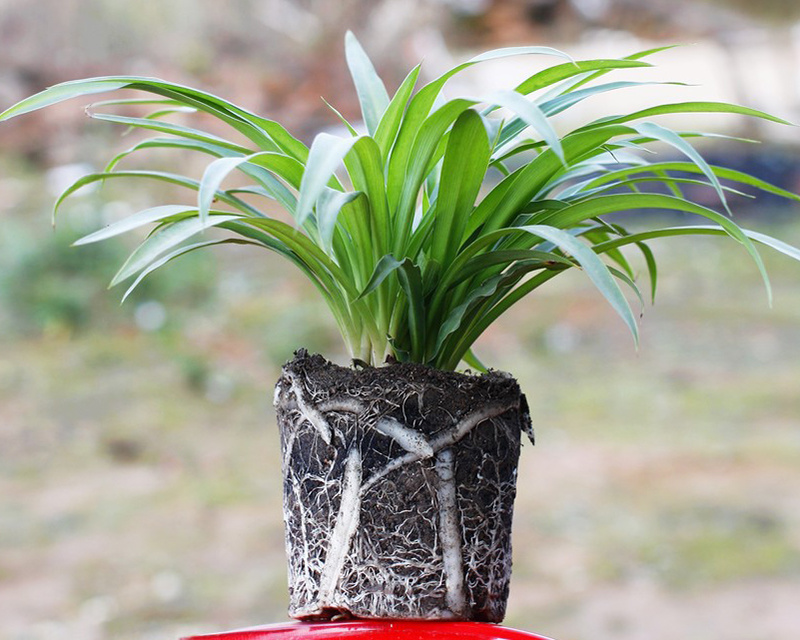
After about 15 days, the spider plant's roots have developed well, as shown in the picture. At this point, there are two choices: one is to use the hydroponic method to grow it; the other is soil cultivation. Soil cultivation method: There are no excessive requirements for the soil; one that drains well and is fertile is fine.
For the flower pot, plastic, ceramic, or other materials are all fine; there are no special requirements, because among all flowers, the spider plant is one of the easiest to grow and has particularly strong adaptability.
Spider Plant Growing Methods and Precautions; What Are the Growing Methods and Precautions for the Heartleaf Aptenia (Aptenia cordifolia)?
The original name of the heartleaf aptenia is heartleaf mesembryanthemum (Aptenia cordifolia); it is a perennial evergreen herb of the Aizoaceae family and the genus Aptenia. Because its vines are relatively soft and become semi-procumbent after extending, with the branches drooping, it looks very much like a spider plant, so people call it the heartleaf aptenia. The heartleaf aptenia is a begonia-type plant and can be used for potted ornamental display; placing it on a windowsill or on a desk as an accent is very nice. Today, everyone, come with the editor to learn about the growing methods and precautions for the heartleaf aptenia.
Introduction to the Heartleaf Aptenia
The heartleaf aptenia is a perennial evergreen herbaceous plant. Its stems lie slantingly and spread out, 30-60 cm long, branched, slightly fleshy, hairless, with small granular protrusions. The leaves are opposite, with heart-shaped ovate, flat leaf blades. The flowers of the heartleaf aptenia are solitary, terminal or axillary; most petals are red-purple and spoon-shaped. Its flowering period is from July to August each year. The branches of the heartleaf aptenia are about 20 cm long, fleshy and thick, bright green, with angular branches that become semi-procumbent after extending. The heartleaf aptenia blooms at the tips of the branches; after flowering, branches fork out, rose-red in color, with pale yellow at the center of the flower, somewhat like a chrysanthemum, with narrow, glossy petals, opening successively from spring to autumn.
How to Grow the Heartleaf Aptenia
The heartleaf aptenia likes sunlight and is a plant that should grow in a dry, ventilated environment. It dislikes high temperature and excessive moisture, and likes to grow in well-drained sandy soil. It is not cold-tolerant, and its suitable growing temperature is 15-25°C. The heartleaf aptenia does not have a very high demand for fertilizer and water. Generally, from March to September is its growing period, and during this time its water demand is relatively large. After September, the heartleaf aptenia enters a slow-growth period; generally during this time, watering should be reduced, and it should be moved indoors to overwinter.
Growing Methods for the Heartleaf Aptenia
Propagation Methods
Generally, propagation of the heartleaf aptenia uses cuttings, carried out in spring and autumn, and it is very easy to root. When propagating by cuttings, take a mature branch, let it dry briefly, then insert it into prepared potting soil, place it in a cool, ventilated place, and keep the soil slightly moist. After about a week, you can see its branches stand upright, which indicates that its new branches have begun to take root.
Temperature and Light
Except for needing shade at noon in summer, the heartleaf aptenia can be given sufficient light at other times, especially in winter. While ensuring temperature, it should also be placed in a sunny spot to receive sunlight.
Watering and Fertilizing
Because the heartleaf aptenia has thin woody and fibrous layers, its transport of water and nutrients is relatively slow, so during cultivation, when fertilizing, concentrated fertilizer must not be used; thin fertilizer must be applied frequently. In winter, it is better to keep it dry, and do not pour large amounts of water. From March to September each year is the peak growing season for the heartleaf aptenia. During this period, it needs a large amount of water, especially during high summer temperatures, when watering should be increased, but its potting soil must not be allowed to accumulate water.
Loosening Soil and Pruning
When the heartleaf aptenia enters winter, it stops growing and enters dormancy. At this time, promptly prune diseased and insect-damaged branches, overlapping branches, twin branches, thin and weak branches, aged branches, inward-growing branches, and leggy branches. Through thinning, heading back, and removal of tillers, the lifespan of the heartleaf aptenia can be extended. In winter, the soil layer also needs to be turned over so that the surface soil and deep soil are exchanged; repeated turning and sunning will make the soil loose and breathable.
Precautions for the Heartleaf Aptenia
1. If the heartleaf aptenia is placed in a place with insufficient light for a long time, it is easy for its leaf color to become pale, lacking vitality, and even for the leaves to drop, losing ornamental value.
2. During cultivation, excessive watering can cause root rot, and in severe cases, death may occur.
3. The heartleaf aptenia does not have a very high demand for fertilizer and water. During its peak growing season, applying thin fertilizer once every half month is enough. If too much fertilizer is applied, it will cause slow growth.
Summary: The above is the editor's introduction to how to grow the heartleaf aptenia and what the growing methods and precautions are. After reading the editor's introduction, I believe everyone has a relatively good understanding. In fact, the heartleaf aptenia can be used for potted ornamental display and can be used to accent windowsills or desks. Sometimes many people confuse it with Panax notoginseng because their appearances are relatively similar. The heartleaf aptenia is a begonia-type plant. Panax notoginseng should be a certain plant similar to Sedum spectabile in the Crassulaceae family.
Spider Plant Growing Methods and Precautions
Spider plants have an extremely strong ability to absorb harmful gases. If it is a newly renovated house, owners are generally advised to place several pots of spider plants at home to purify indoor air and absorb formaldehyde released by furniture and other items. But if you do not know the growing methods for spider plants, it is easy to kill them. Below is an explanation of the key points for growing spider plants.
Spider plants are known as green purifiers. Many people place a few pots of spider plants in a new home, but they do not know the growing methods for spider plants, resulting in yellowing and blackening leaf tips. Below is a detailed illustrated explanation of spider plant growing methods. As long as you understand the characteristics of spider plants, growing them well is very simple.

How Are Spider Plants Propagated?
Spider plants can be propagated by methods such as cuttings, division, and sowing. Cutting and division propagation can be carried out at any time from spring to autumn. Spider plants have strong adaptability and a high survival rate, and generally are very easy to propagate. When taking cuttings, simply take a runner 5-10 cm long with new buds and insert it into the soil; it can take root in about a week, and after about 20 days it can be transplanted into a pot, watered thoroughly, and placed in a cool place for care.
Analysis of the Key Points of Spider Plant Growing Methods:
The spider plant is a perennial evergreen herbaceous flower with fibrous roots. Its forms are diverse, and it is also highly shade-tolerant and easy to manage. It is often used as a hanging potted plant, for indoor decoration, or for garden landscaping. For its management, the following points should be mastered:
1. Light
Spider plants like a semi-shaded environment. In spring and autumn, avoid direct exposure to strong sunlight. In summer, the sunlight is especially strong, so they can only receive some slanting light in the morning and evening, and during the day 50%-70% of sunlight needs to be shaded, otherwise the leaf tips will dry up. Variegated varieties are especially afraid of strong sunlight. Golden spider plants grow more beautifully in weakly lit places, with the yellow edges more obvious and the leaves more glossy. But in winter, they should receive more sunlight so that the leaves can remain tender and fresh green. Household potted spider plants should be placed in front of a south-facing window, otherwise the leaves will lose their luster or even wither.
2. Temperature
The optimal growing temperature for spider plants is 15-25°C. In Guangdong, the temperatures in spring, summer, and autumn are all suitable for the growth of spider plants, but if the winter temperature is below 5-7°C, attention must be paid to cold protection and insulation.