What to Do When an Orchid Won't Bloom? Cause Analysis and Solutions
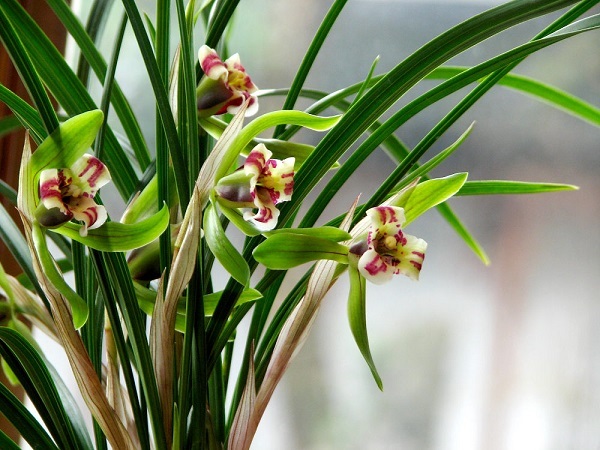
1. Light
Light is the main factor that prompts an orchid plant to develop flower buds. If the leaves are soft and glossy with a moderate green color, it means the light is normal; if the leaves are dark green and soft, it means more light is needed; if the leaves are pale yellow, it means light should be reduced.
2. Temperature
To encourage an orchid to bloom, the difference between day and night temperatures should be about 10°C, that is, it grows best and blooms more under the temperature conditions of 18°C-21°C during the day and 7°C-10°C at night. If the night temperature is high, the orchid leaves will become soft and the flower buds will drop. Too low a temperature will cause blind buds, and spots will also appear on the leaves. If the plant suffers low-temperature damage while blooming, brown spots will appear on the flowers.
3. Watering
The amount of watering is also a major condition for orchids to bloom, and the moisture must be controlled well. Too much moisture will cause the orchid plant to grow excessively and make it hard to produce flower buds.
4. Light fertilizer, applied frequently
Orchids like light soil fertility, so when fertilizing orchids, the principle of "light fertilizer, applied frequently" should be maintained, and a light fertilizer can be applied once a month. At the same time, in order to speed up orchid blooming, a little monopotassium phosphate or phosphorus fertilizer can be applied appropriately to promote the plant to bloom and produce buds.
What to Do When an Orchid Won't Bloom
There are many reasons why an orchid won't bloom, and orchid growers need to investigate and analyze them. A normal mature orchid, as long as it has a connected plant of two or three shoots or more, can generally bloom if cultivated properly (a small number of single-shoot orchids can also bloom; the Cymbidium kanran with thick roots and narrow leaves often shows this phenomenon).
1. The orchid plant is still small and does not yet have the reproductive genes. Some young seedlings that have not yet formed pseudobulbs need two years of vegetative growth to form pseudobulbs, then sprout new shoots two or three times, and only when three generations of branches grow together is it possible for them to bloom.
2. Dividing and planting separately will destroy the transmission habit of this reproductive gene, in which orchid generations grow together, so orchids are best planted in clumps. When planted singly, there are fewer leaves, less organic matter accumulates, and the reproductive genes cannot become active. Generally, without three pseudobulbs growing connected as three generations together, it is difficult for them to bloom.
3. Improper dry-wet conditions. Late spring and summer-autumn are the vegetative growth periods of orchids (but they need to avoid the plum rain and the impact of heavy rainstorms). If autumn is on the dry side, it will inhibit vegetative growth. Winter is its dormant period, and it should be kept on the dry side; if it is too wet, the potting soil can freeze and expand, squeezing and damaging the root mass, affecting the sprouting of new shoots in the following spring and summer, and even more affecting its normal reproductive growth.
4. Too little light means limited accumulation of organic matter, which cannot supply the needs of reproductive growth. Although orchids are shade-loving flowers, this does not mean they need no light at all; they only avoid strong direct light and long light exposure, and need diffused, scattered light (semi-shade). Plants growing in dark places often have dense, lush, dark green leaves, but it is harder for them and less likely for them to bloom; while plants growing in a south-facing position and in semi-shade in midsummer, although the leaf surface is slightly yellow-green, produce more flowers, and the flowers are pretty and fragrant.
There is also another situation in which an orchid cannot bloom because of its own special reasons, or in other words, a very small number of orchids do not much like to bloom. This phenomenon has appeared among various orchid species, and I have encountered it too: a Cymbidium ensifolium with plain buds collected locally in 2004 has been cultivated in this garden for six or seven years, and has grown to more than ten pots, and to this day it has never been seen to bloom. This is probably the infertility phenomenon of plants (orchids)!
[Reasons Why Orchids Won't Bloom] What to Do When an Orchid Won't Bloom
There are many reasons why an orchid won't bloom, and orchid growers need to investigate and analyze them. A normal mature orchid, as long as it has a connected plant of two or three shoots or more, can generally bloom if cultivated properly, but in reality orchids are not very easy to grow. During the cultivation process, if handled slightly improperly, orchids can easily rot at the roots or stems, or simply fail to bloom. Generally, if orchid stems and buds rot and are not treated, then the roots rot and the leaves turn yellow, and in the end the orchid will certainly not bloom.
5 Reasons Why Orchids Won't Bloom. 1. The orchid plant is still small and not yet capable of blooming.The orchid plant is still small and does not yet have the reproductive genes. Some young seedlings that have not yet formed pseudobulbs need two years of vegetative growth to form pseudobulbs, then sprout new shoots two or three times, and only when three generations of branches grow together is it possible for them to bloom.
2. Dividing the orchid destroys the reproductive genes.Dividing and planting separately will destroy the transmission habit of this reproductive gene, in which orchid generations grow together, so orchids are best planted in clumps. When planted singly, there are fewer leaves, less organic matter accumulates, and the reproductive genes cannot become active. Generally, without three pseudobulbs growing connected as three generations together, it is difficult for them to bloom.
3. Orchids Won't Bloom: Environment Not SuitableImproper dry-wet conditions. Late spring and summer-autumn are the vegetative growth periods of orchids (but they need to avoid the plum rain and the impact of heavy rainstorms). If autumn is on the dry side, it will inhibit vegetative growth. Winter is its dormant period, and it should be kept on the dry side; if it is too wet, the potting soil can freeze and expand, squeezing and damaging the root mass, affecting the sprouting of new shoots in the following spring and summer, and even more affecting its normal reproductive growth.
4. Orchids Won't Bloom: Too Little LightToo little light means limited accumulation of organic matter, which cannot supply the needs of reproductive growth. Although orchids are shade-loving flowers, this does not mean they need no light at all; they only avoid strong direct light and long light exposure, and need diffused, scattered light (semi-shade). Plants growing in dark places often have dense, lush, dark green leaves, but it is harder for them and less likely for them to bloom; while plants growing in a south-facing position and in semi-shade in midsummer, although the leaf surface is slightly yellow-green, produce more flowers, and the flowers are pretty and fragrant.
5. The Orchid Itself Does Not BloomAn orchid cannot bloom because of its own special reasons, or in other words, a very small number of orchids do not much like to bloom. This phenomenon has appeared among various orchid species, and I have encountered it too: a Cymbidium ensifolium with plain buds collected locally in 2004 has been cultivated in this garden for six or seven years, and has grown to more than ten pots, and to this day it has never been seen to bloom. This is probably the infertility phenomenon of plants (orchids)!
What to Do When an Orchid Won't Bloom. 1. Cultivate strong seedlings.Generally, Cymbidium goeringii grown for flower appreciation should not be divided into single shoots for propagation when repotting; it is best to plant three shoots connected together, so that strong seedlings can be produced.
2. Increase LightLight is the main factor affecting orchid growth and blooming. Plants rely on sunlight for photosynthesis and produce the nutrients indispensable for their growth, and both the growth of Cymbidium goeringii and the formation of flowers require sufficient light. Sunlight can help orchid leaves carry out photosynthesis and make “food” to support the growth and blooming of orchid seedlings. Apart from summer and early autumn, when Cymbidium goeringii must not be exposed to direct sunlight, giving it more sunlight in the other seasons can not only make the orchid seedlings healthy and sturdy, but also strengthen the pseudobulbs and promote shoot propagation. Vigorously growing orchids are relatively more likely to send out flower buds.
3. Master WateringWater is one of the material foundations of plant growth, but the amount of watering should have a limit. Watering should not be done at fixed times, but should seize the right moment. Water when dry, and water thoroughly; when the potting medium is dry, water it. This is the basic principle of watering. When watering, note that the water temperature should be as close as possible to the temperature inside the orchid pot at the growing site. In summer and early autumn, water in the morning and evening, while in winter water at noon, the purpose being to reduce the temperature difference between the water and the orchid pot. Cymbidium goeringii should generally be given a little water during the growth period, and before the flower buds have formed, watering should be strictly controlled.