How to Grow Spider Plants So They Look Beautiful and Lush
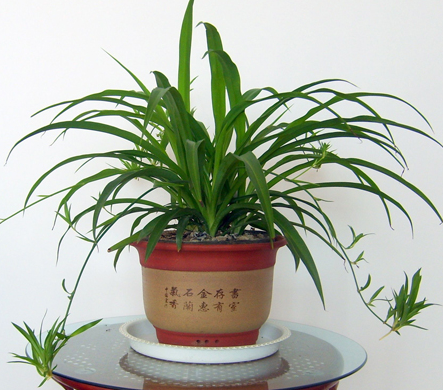
Temperature
We have already mentioned above the most suitable temperature for its growth, so in the three seasons of spring, summer and autumn, just try to keep it at the optimal degree. However, in winter, even if the optimal temperature cannot be guaranteed, it must still be above 5°C, otherwise it will not be able to survive the winter safely.
Water
Because it likes moisture, the potting soil is best kept in a consistently moist state. Especially in summer, be sure to water it thoroughly. In addition, you can also frequently spray some water on its leaves, so they will not become dry and withered. Ensuring sufficient moisture is of great importance to keeping the spider plant (Chlorophytum comosum) in a vigorous state.
Sunlight
It can be placed in a spot where it receives indirect light. In spring, summer and autumn, try to avoid direct sunlight as much as possible. In winter, it can get a bit more sun.
Soil
If we want the plant to grow vigorously, then the growing medium must be chosen with rich humus content. Therefore, we can choose leaf mold or peat soil and mix in a little base fertilizer.
How to Grow Spider Plants Fast
Spider plants are very easy to grow, so this time let's talk about how to grow spider plants fast. Many gardening enthusiasts find that their spider plants hardly grow at all after a day, a week, or even a month, while other people's spider plants grow vigorously. What is the reason for this?
The biggest reason our spider plants grow slowly or not at all is that the potting soil is not fertile enough or the pot is too small, which seriously hinders the growth of the spider plant. We know that spider plants have fleshy roots and a very well-developed root system, so we should choose a slightly larger pot. As for the soil, it is best to choose fertile soil. If the soil is not fertile enough, then we can supplement nutrients by fertilizing.
In addition, if you want spider plants to grow fast, light also needs a certain amount of control. According to practice, spider plants grow best under bright indirect light. If the light is too dim, spider plants tend to become thin and small. If the light is too intense, although the spider plant will be sturdy, its growth will not be fast enough.
The last thing is the issue of watering. The fleshy roots of spider plants can store water, so spider plants are relatively drought-tolerant. Therefore, we only need to keep the soil slightly moist. There is no need for it to be damp every day. When it dries out, just water it thoroughly, then leave it alone, and water again when it dries out again.
Finally, an important point: if conditions permit, you can give spider plants more foliage fertilizer, mainly by applying light fertilizer frequently. This allows spider plants to grow healthily and quickly.
How to Grow Spider Plants Better? There Are Techniques for Growing Spider Plants
Spider Plant
When spider plants are grown at home, under normal circumstances, problems such as dry leaf tips and leaves gradually losing their luster easily appear. So how should spider plants be grown to grow well? A gardening enthusiast who has grown spider plants for many years says that doing the following three things well is enough:
1. Spider plants like a semi-shady environment, and in autumn, strong direct sunlight should be avoided. Autumn sunlight is especially strong, and during the day 50%-70% of the sunlight should be blocked, otherwise the leaf tips will dry out. Variegated varieties are especially afraid of strong light. Golden spider plants (Chlorophytum comosum 'Variegatum') grow more beautifully in places with weak light; the yellow edges are more obvious and the leaves are more glossy.
2. Spider plants are foliage plants that are relatively tolerant of fertilizer. If fertilizer and water are insufficient, they easily age, the leaves turn yellow, and they lose their ornamental value. It is advisable to apply organic fertilizer liquid once every 7-10 days, but for variegated varieties such as golden-edged and golden-hearted spider plants, less nitrogen fertilizer should be applied, so as to avoid the variegated leaf colors fading or even disappearing, which affects their appearance. Appropriately applying organic fertilizer made by fermenting bone meal, eggshells, etc., and after full fermentation, taking an appropriate amount of diluted liquid and watering it once every 10-15 days, can make the variegated leaves bright and vivid.
3. Spider plants like a moist environment, and the potting soil should be kept moist regularly. In autumn, watering should be sufficient. Around noon and in the evening, water should also be sprayed on the branches and leaves to prevent the leaves from drying out. If a lot of dust accumulates on spider plants, it affects both their growth and their appearance, so the branches and leaves should be sprayed with water frequently to keep them bright and attractive. Dead leaves and yellow leaves at the bottom should be removed at any time. Normally, keep the humidity at a normal level; it should not be too dry, nor too wet.