A Detailed Guide to the Cultivation Methods and Precautions for Gerbera
1. When caring for Gerbera, pay special attention to the diseases that may affect it.
1. Phytophthora rot: The key to prevention and control is that continuous cropping soil must be disinfected with Vydate and formaldehyde, etc. See the instructions for usage and dosage; plant shallowly, with the root crown exposed 1cm above the surface; prevent the soil from being too wet. When soil below 10cm of the surface layer is placed in the palm of the hand and squeezed hard without forming a ball, it is ready for watering. In the early stage of the disease, when some leaves turn red and begin to wilt, drench the roots with a 400-fold solution of 58% phosethyl-Al and mancozeb, then 7 days later drench the roots with a 500-fold solution of 64% Sandofan wettable powder. Apply the treatment in the early morning or evening when temperatures are low, and stop application when the temperature is above 28 degrees. Apply once every 7 days, for 3 consecutive times.
2. Powdery mildew: The key to prevention and control is to maintain ventilation and low humidity in the greenhouse; promptly remove diseased leaves; when the disease occurs, spray with a 1500-fold solution of 70% thiophanate-methyl, or use 20% Junke smoke for fumigation control, once every 7 days, for 2-3 consecutive applications. In addition, sulfur fumigation can be used for control: place 20-30g of sulfur powder in each fumigator, close the greenhouse after lowering the curtain at 17:00 each day, energize and heat for 2 hours, replace the sulfur powder once every 6 days, and continue fumigation for 15 days. During the onset of powdery mildew, fumigate 8-10h daily, and the powdery mildew can be eliminated in about 10 days.
2. Temperature requirements. Use cultivation facilities to meet as much as possible the temperature requirements of Gerbera at the seedling stage, growth stage and flowering stage, so as to facilitate normal growth and flowering. Except in South China, it cannot overwinter outdoors and requires greenhouse cultivation; outside the Yangtze River basin, it can be cultivated in an unheated plastic tunnel. In summer, a shade net needs to be covered on top of the tunnel, and the plastic film on both sides of the tunnel should be opened to lower the temperature. In winter, when the outdoor nighttime temperature approaches 0C, seal the plastic film tightly to lower the temperature, and an additional layer of plastic film must be added inside the tunnel. On clear and warm days, uncover the film at the south end of the tunnel at noon for ventilation for about one hour.
3. Light requirements. Gerbera is a light-loving flower. In winter it needs full light, but in summer appropriate shading should be provided and ventilation strengthened to lower the temperature and prevent dormancy caused by high temperatures.
4. Watering requirements. After planting, the seedling stage should be kept appropriately moist and the seedlings should be hardened to promote root development and rapid establishment. During vigorous growth, an adequate water supply should be maintained, watering once every 3-4 days in summer and about once every half a month in winter. When watering during the flowering stage, be careful not to let water touch the center of the leaf rosette, to prevent flower bud rot. For open-field cultivation, pay attention to preventing waterlogging. In addition, fertilization can be combined with watering.
5. Topdressing requirements. Gerbera is a fertilizer-loving perennial flower with a high demand for fertilizer. The ratio of nitrogen, phosphorus and potassium in the fertilizer is 15:18:25. When topdressing, special attention should be paid to supplementing potassium fertilizer. Generally, apply 2.5 kg of potassium nitrate and 1.2 kg of ammonium nitrate or ammonium phosphate per mu, once every 5-6 days in spring and autumn, and once every 10 days in winter and summer. If high temperatures or relatively low temperatures cause the plant to enter a semi-dormant state, stop fertilizing.
Propagation Methods of Gerbera
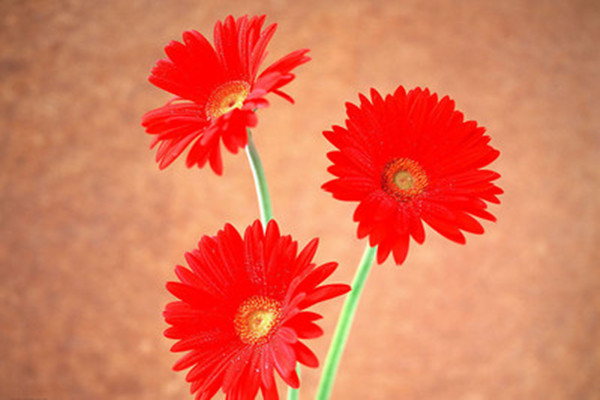
Propagation Methods of Gerbera: Sowing Method
Usually each Gerbera flower can produce twenty or thirty seeds, which can be sown in spring or autumn. Spring sowing is in March and May, and autumn sowing is in September and October.
Sow in pots immediately after the seeds mature, because the seeds have a short lifespan and are not suitable for long storage. It is best to carry out artificial supplementary pollination during the flowering period. The seed germination rate is relatively low, only about 50%. After sowing, cover with paper to prevent direct sunlight, keep the temperature at 20-25°C, and germination will occur within about two weeks.
Sixty to seventy days after sowing, when the seedlings have three or four true leaves, transplant them into flower pots or plant them in the open field. With proper cultivation, flowering can be seen in two to three months.
Propagation Methods of Gerbera: Division Method
Division propagation is mostly carried out in March and April.
First dig out the mother plant and divide it into several daughter plants. The daughter plants must have buds and roots, and should not be divided too small. When potting, do not plant too deep. It is best to dig holes and plant every two plants as a group, which helps increase the number of flowers.
If drought occurs during the growth period, water thoroughly. When watering, the center of the leaf rosette must not get wet and should be kept dry, otherwise the flower buds are prone to rot.
The optimum temperature for growth is 20-25°C. In winter, keep it above 12°C. With careful care, it can bloom all year round.
Regularly remove the excessive old outer leaves of vigorous growth, which is beneficial to the emergence of new leaves and new flower buds, and also aids ventilation, enabling it to bloom continuously.
During the growth period, sufficient sunlight is needed, so that the flower stalks are upright and the flower colors are vivid; if sunlight is insufficient, the leaves become weak and yellow, the flower stalks become soft, thin and drooping, and the flowers are small and pale.
Propagation Methods of Gerbera: Test-tube Seedling Method
Where conditions permit, if test-tube seedling cultivation can be implemented, it will be more beneficial for accelerating the propagation and promotion of superior varieties.
At present, the Netherlands, the United States, Japan, West Germany and other countries have adopted isolated leaf culture and successfully mass-produced test-tube seedlings, then used soilless cultivation to put fresh flowers into enterprise production. Domestically, the Shanghai Landscape Institute also uses tissue culture to propagate large numbers of Gerbera.
How to Propagate Gerbera, Propagation Methods of Gerbera (Division/Cutting/Sowing)
Everyone should have heard of Gerbera. It has large flowers and a wide range of colors, and is a flower deeply loved by flower lovers. As more and more people grow Gerbera, mass propagation is imperative. So how do you propagate Gerbera? In general, there are three propagation methods for Gerbera: division, cutting and sowing. Next, follow the editor to learn about the specific operations in detail.
1. How to Propagate Gerbera, Division/Cutting/Sowing
As a green plant that can be grown indoors, the propagation methods of Gerbera are no different from those of other plants. It is mainly divided into sexual propagation and asexual propagation. Asexual propagation is further divided into cutting and division; sexual propagation is the sowing method. So how do you propagate Gerbera? The editor will explain in detail how to do it specifically.
2. Three Propagation Methods of Gerbera
(1) Division Propagation of Gerbera
The most common propagation method for Gerbera. Generally, every three years, when the plant becomes crowded, we can divide it once. Use a knife to divide the plant into multiple plants. Each plant must have one to several terminal buds and enough roots. Disinfect the wounds and pot them. The specific operations are as follows:
1. Division Time
The division propagation time of Gerbera is mostly in March and April, carried out once every three years.
2. Division Method
Dig out a healthy Gerbera that has grown for three years and divide it into several daughter plants. The daughter plants must have one to several terminal buds and enough roots, and should not be divided too small. Then pot them separately. Note that potted planting should not be too deep. It is best to dig holes and plant every two plants as a group, which helps increase the number of flowers. After that, just care for them according to the cultivation methods for Gerbera.
(2) Cutting Propagation of Gerbera
Cutting is the most common propagation method for plants, but for propagating Gerbera, cutting is not practical because the operation is very inconvenient, so it is not recommended. Simply put, cutting means beheading the plant, then using the large number of side shoots produced for cuttings. The specific operations are as follows:
Choose a robust Gerbera mother plant, dig it out and remove the soil, then cut off the thick part of the rhizome, remove the leaves, cut the growth point, retain the root crown, and finally plant it in a planting box filled with peat for cultivation. Keep the room temperature at 22-24°C and humidity at 70%-80%. After about 2 weeks, leaf axillary buds and adventitious buds will successively grow from the root crown, forming shoot cuttings. Compared with the cutting of other plants, this is frighteningly troublesome!
After the shoots grow 4-5 leaves, cut them off as cuttings, then insert them into a sand bed. After cutting, control the temperature at 25°C and keep the humidity at 80%-90%. They will root in about one month. After rooting, transplant them into nutrient pots and cultivate for one month to form small Gerbera seedlings. One mother plant can be repeatedly cut for cuttings 3-4 times, and 10-20 cuttings can be taken. It is worth mentioning that new plants from cuttings in the same year can bloom in the same year.
(3) Seed Propagation of Gerbera
Gerbera leaves seeds after flowering, so it can be propagated by sowing. It is worth mentioning that Gerbera is self-sterile, and at least two different Gerbera plants must cross-pollinate each other to set seed. Therefore, when we use sowing to propagate Gerbera, we usually go to a flower shop to buy seeds; of course, imported ones are better. The specific operations are as follows:
1. Sowing Time
For seed propagation of Gerbera, first choose the right time. You can sow in spring or autumn. Spring sowing is in March and May, and autumn sowing is in September and October.
2. Sowing Method
After buying the seeds, scatter them into the prepared potting soil. However, the germination rate of Gerbera seeds is relatively low, only about 50%, so post-sowing care is very important. After sowing, cover with paper to prevent direct sunlight, keep the temperature at 20—25°C, and germination will occur within about two weeks. After about sixty to seventy days, when the seedlings have 3-4 true leaves, transplant them into flower pots or plant them in the open field. With proper cultivation, flowering can be seen in 2-3 months.
In general, Gerbera can be propagated by cutting, division and sowing, but the most suitable for the majority of flower lovers are division and sowing. So flower lovers who want to turn one pot of Gerbera at home into many pots should quickly try it themselves. Even beginners have a high probability of success~ That is all the editor has to introduce about Gerbera propagation methods, hoping to help everyone.