How to Divide Guzmania (Guzmania spp.): A Detailed Guide to the Division Propagation Method
How to Divide Guzmania: The Division Propagation Method for Guzmania / Any Season of the Year Will Do
For a flower like Guzmania, gardening enthusiasts are surely no strangers to it; what leaves the deepest impression is that the plant blooms only once in its lifetime! But that is exactly why the Guzmania flower is so beautiful. And to keep enjoying that beauty, there is a good solution: propagation. It is known that Guzmania is generally propagated by division, so how do you divide Guzmania? Below, the editor gives you a detailed introduction.
1. Guzmania Propagation Methods: Division / Sowing
From Guzmania care methods, we know that as long as it is maintained properly, with watering, light and other conditions up to standard, Guzmania is fairly easy to keep alive, and it also survives propagation easily. Guzmania's main propagation methods are two: division and sowing. Next we focus on how to divide Guzmania.
2. How to Divide Guzmania: 5 Steps
1. Timing of Division
Whatever plant is being propagated, choosing the right time matters. For Guzmania, division propagation can generally be done in any season, but it is best to choose April, which is exactly the time for repotting flowers. When gardeners repot, they can divide the plant at the same time, which is very convenient.
2. Turning Out the Pot and Separating
To divide Guzmania, the first thing is to separate the mother plant from the potting soil, using the method of turning out the pot: tip the whole Guzmania, soil and all, out of the pot, then tap the soil ball lightly on the ground, which makes it easy to separate the mother plant; be careful not to bump the tender buds on the tuber.
3. Washing the Roots
After the mother plant is separated from the pot, the tender buds on the tuber are usually hard to see, so gardeners need to carefully wash the plant's roots: rinse with water, and during washing do not touch the roots with your hands, so as to avoid bumping and damaging the tender buds. After rinsing clean, the root system at the base of the plant can be seen clearly.
4. Separating the Tender Buds
Now comes the most critical step in how to divide Guzmania: separating the tender buds from the mother plant. At this point gardeners can use a small knife and cut from top to bottom, keeping the cut as small and smooth as possible. If the tender bud has already rooted, the survival rate is high; if it has not rooted, the wound on the tender bud needs to be disinfected with plant ash, then placed in a cool spot so the wound loses some moisture.
5. Transplanting the Tender Buds
After completing the steps above, the only thing left in how to divide Guzmania is planting. Plant the tender buds in prepared pots; afterwards do not water heavily, as this easily causes the tender buds to rot; simply mist the potting soil appropriately.
The above are the relevant methods for how to divide Guzmania; it is not hard, is it? Beginners can give it a try too. Gardeners should note that after completing the steps above, the pot should be placed in a cool, airy spot, and must not be in direct sunlight; only after the tender buds have rooted and established can they be moved into the sun.
3. Sowing Propagation of Guzmania
Besides division propagation, sowing is also one of Guzmania's propagation methods. It is simple to carry out, but the seeds are not easy to obtain, and the care period is relatively long, so gardeners who want to try this method must think it through clearly. Of course, getting seeds yourself is certainly not easy, but buying them with money is very easy. The specific sowing method is as follows:
Keep the temperature above 16°C, choose acidic potting soil, and broadcast the seeds in the morning after the temperature rises. After sowing, cover with plastic film to retain moisture, keep the temperature at 25-30°C, and seedlings will emerge in about 25 days. When the seedlings grow to about 4 cm, they can be pricked out into shallow trays, then transplanted as the seedlings grow, and finally planted out into pots.
It is worth mentioning that sowing propagation generally takes 3-4 years before the plant blooms, so the editor reminds all gardeners to think clearly before doing it. In fact, Guzmania has very strong vitality, so as long as we carry out the operation properly, the survival rate after propagation is very high. That is all for how to divide Guzmania; I hope it is helpful to everyone.
How to Divide Guzmania
For gardening enthusiasts, Guzmania's main propagation method is division, so how do you divide Guzmania? In the process of dividing, many details and points for attention are unknown to gardeners. This article explains Guzmania division from the most basic angle.First, the timing of Guzmania division: division is suitable in April each year, and it is only suitable when the bud has 6 or more leaves; at temperatures above 30°C they root easily. The specific method is to take the mother plant out of the pot and twist off the new shoots with your hands; if the new shoots are pressed tight against the rhizome and cannot be twisted off by hand, you can also cut the new shoots off with a sharp knife. If the new shoot has no visible roots, the cut is best trimmed into a smooth flat surface, which helps rooting. The wound should promptly be smeared with plant ash to disinfect it, and the shoot placed in a cool, airy spot; plant it after the wound has dried and shrunk.
When planting the new shoots, watering is the key: do not give one thorough watering after planting; you can only spray a layer of water on the leaves and the surface of the potting soil. Put the pot in a semi-shaded, airy environment, and after 20 days it will root.
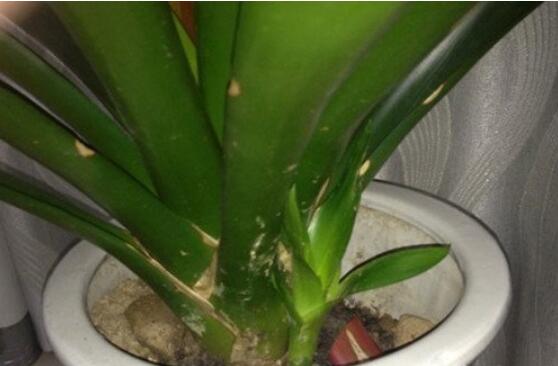
In addition, here is a piece of knowledge to share with gardeners: the Guzmania mother plant blooms only once, so after flowering it gradually withers. If you are not in a particular hurry to divide the plantlets, you can wait until the flowers have faded, then directly cut off the mother plant, trim the roots, and replant the plantlets; this gives a somewhat higher survival rate for the plantlets than dividing early. The small shoots in the picture below can be divided at this time, but the risk is relatively higher; if they grow a bit larger, the risk is relatively lower!
ps: In fact, the division method does not have to be exactly the same; gardeners can operate flexibly.