How to Grow Alocasia macrorrhizos (Giant Taro)? Detailed Guide to Cultivation Methods and Precautions
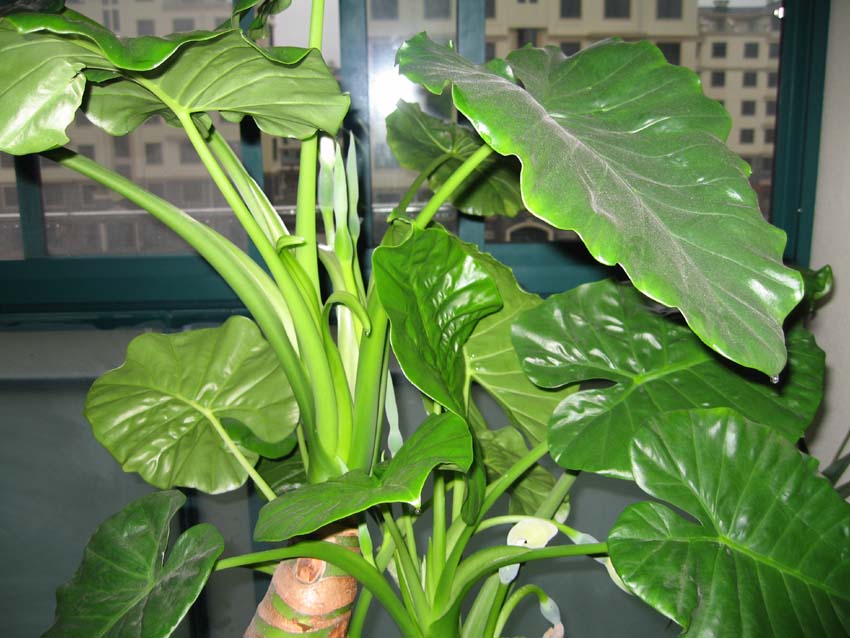
Alocasia macrorrhizos is a plant that likes warm, humid and slightly shaded environments, but during its flowering period it needs to be ensured sufficient sunlight, otherwise its spathe will take on a green color, thereby affecting its quality. For Alocasia macrorrhizos, it must be ensured 3-5 hours of light per day, otherwise its leaf stalks will elongate and its ornamental value will be affected. Alocasia macrorrhizos has weak cold tolerance, and every year in mid-October it should be moved into a greenhouse. In summer, under shaded conditions, it needs frequent spraying with water to cool down and maintain humidity. Alocasia macrorrhizos is naturally fond of moist, fertile soil, which is what farmers often call "heavy fertilizer and heavy water," so during its growth period it should be watered in small amounts but many times.
Alocasia macrorrhizos is currently a very common home-grown green potted plant. Because it is a tropical plant, it generally does not bloom in the north. However, if the temperature and humidity conditions at home are suitable, it may also bloom. Although Alocasia macrorrhizos does not have high requirements for soil, planting it in well-drained, organic-matter-containing sandy loam or humus loam is the most ideal growing method.
The suitable growth temperature for Alocasia macrorrhizos is 20-25°C. It likes warm, humid and semi-shaded environments, so during the growing season place it in a shaded spot on a balcony or courtyard (avoid direct sunlight in summer), keep the potting soil moist at all times, and apply 1-2 times a month a dilute liquid fertilizer mainly of nitrogen fertilizer mixed with phosphorus and potassium fertilizer (stop fertilizing in winter and control watering).
Hydroponic Cultivation of Alocasia macrorrhizos
Remove the yellow leaves and rotten roots of Alocasia macrorrhizos. If the tuber has no roots, place it in a shaded spot to dry for 2-3 days before hydroponic cultivation. After planting, pour in clean water to submerge 2/3 of the root system, change the clean water once every 2-3 days, and new roots can grow after 3 days. After 3 weeks, switch to nutrient solution for maintenance, and replace the nutrient solution about once every 4 weeks. Each time you change the water or nutrient solution, rinse the tuber and the mucus on the tuber with clean water, and remove rotten roots.
Cultivation Methods of Alocasia macrorrhizos
Growing plants in family life is very common. I wonder if everyone has heard of Alocasia macrorrhizos. What are the reasons for Alocasia macrorrhizos leaves turning yellow? What are the cultivation methods of Alocasia macrorrhizos? Below, the editor will take everyone to learn some knowledge about this aspect. Let's take a look together, hoping it will be helpful to everyone.
Reasons for Alocasia macrorrhizos Leaves Turning Yellow
Reasons for Alocasia macrorrhizos leaves turning yellow:1. Red spider mites. Flower lovers can check whether the leaf surface of Alocasia macrorrhizos has white spots and a waxy texture, feels rough, and lacks gloss. If so, then red spider mites are causing trouble. The solution is to wash with soapy water twice, with an interval of two days each time, and it will be fine.
2. If the soil is too poor and lacks nutrients, it will also cause the leaves to turn yellow. Therefore, it is very necessary to add nutrients to the soil in time and apply some nitrogen and phosphorus fertilizers and organic fertilizers.
3. Alocasia macrorrhizos is relatively adapted to warm and humid climates. Because winter temperatures are low and it is kept outdoors for a long time, the leaves are easily frostbitten and turn yellow. At this time, place it indoors at a constant temperature and in a place with sufficient light.
4. A large amount of dust accumulated on the leaves will hinder the leaves' light absorption and cause the leaves to turn yellow. Therefore, the leaves should be maintained regularly and can be wiped with clean water.
5. Not watering for a long time will also cause the leaves to turn yellow due to drought. Therefore, keep the soil moist at all times, and when watering, make sure to water thoroughly, not just wet the soil surface.
Cultivation Methods of Alocasia macrorrhizos
Cultivation methods of Alocasia macrorrhizos:Alocasia macrorrhizos is an ornamental flowering plant that likes warmth, humidity and sufficient sunlight. February to April is the peak flowering period, and the dormant flowering period is from November to May or June of the following year.
The growth temperature of Alocasia macrorrhizos is 20-30°C, and it can tolerate a low temperature of 8°C at minimum. Alocasia macrorrhizos likes semi-shaded environments and should be placed in an environment that is both shaded and ventilated.
Alocasia macrorrhizos is especially fond of moisture. During the growing season, not only is the potting soil required to be moist, but the air humidity is also required to be no less than 60%. During high summer temperatures, spraying with water should be strengthened. In winter, watering should be controlled, and spraying once a week with warm water can keep its leaf color dark green; otherwise, it easily leads to root rot in Alocasia macrorrhizos.
Alocasia macrorrhizos can be cultivated with nutrient soil mixed from leaf mold, peat soil, river sand and a small amount of thoroughly decomposed cake fertilizer. Alternatively, it can also be grown hydroponically. Alocasia macrorrhizos likes fertilizer. From March to October, apply liquid fertilizer once every half month as a top dressing, in which the proportion of nitrogen can be appropriately increased. Fertilizing should be stopped when the temperature is below 15°C.
Cultivation Methods of Alocasia macrorrhizos. Cultivation Methods of Alocasia macrorrhizos, What to Do When Alocasia macrorrhizos Leaves Turn Yellow and Roots Rot
The corms and leaves of Alocasia macrorrhizos can be used as medicine, but they are highly toxic. Its leaf sap is poisonous if ingested, so if there are pets or children at home, it is not suitable to grow Alocasia macrorrhizos, to avoid tragedy. This is a point requiring extra attention when growing Alocasia macrorrhizos. Now let's learn about the cultivation methods of Alocasia macrorrhizos.